中文简体
中文简体





Previous Post
In modern interior design, the value of a material is increasingly shifting from simply “looking beautiful” to creating a combination of visual authenticity, tactile richness, and long-term performance.
Wood, metal, fabric, and leather have long been important design languages in furniture and interiors. Today, however, stone-inspired surfaces are becoming increasingly popular, offering a distinctive way to bring a sense of nature, strength, and material depth into contemporary spaces.
Natural stone is valued for its unique mineral patterns, color variations, and organic textures. Yet its weight, processing requirements, installation complexity, and difficulty in achieving consistent large-scale production can limit its application in furniture and interior products.
YAKCO Rock Design Melamine Board responds to this demand by translating the visual language of natural stone into a decorative surface solution designed for modern furniture manufacturing and interior applications.
To know more about yakco Rock Design Melamine Board
From “Imitating Stone” to Reinterpreting Stone Texture
A truly sophisticated stone-inspired surface is not simply a photographic stone pattern printed onto a board.
The character of natural stone comes from its irregular mineral variations, layered colors, natural transitions, and distinctive surface texture. Therefore, a high-quality Rock Design Melamine Board needs to go beyond visual reproduction. Through decorative printing and surface embossing technologies, the pattern and texture can work together to create greater depth and tactile realism.
YAKCO’s Rock Design concept is developed around this principle. By combining decorative paper, high-resolution printing, and embossed surface textures, the design transforms a two-dimensional stone pattern into a decorative surface with enhanced visual depth and tactile expression.
The result is not simply a “stone color,” but a complete stone-inspired surface language.
Why Stone-Inspired Textures Are Becoming Popular in Modern Furniture
Modern furniture design is gradually moving beyond the traditional pursuit of perfectly smooth and glossy surfaces.
Compared with high-gloss finishes, matte and textured surfaces can reduce visual monotony and create richer interaction between light and material. In large-scale applications such as cabinetry, wall panels, reception counters, commercial furniture, and hospitality interiors, stone-inspired textures can establish a stronger visual identity.
As highlighted in YAKCO’s approach to textured decorative surfaces, contemporary surface design is evolving from purely visual decoration toward a combination of visual and tactile experiences.
Rock-inspired textures are particularly effective because they translate the natural qualities of stone—strength, solidity, rawness, and depth—into a surface language that works naturally within modern furniture design.
Beyond Surface Design: The Importance of the Board Itself
For furniture manufacturers, the value of a decorative board has never been limited to its appearance.
Texture creates the first impression, but bending performance, internal bond strength, dimensional stability, screw-holding capability, and surface durability determine whether a board can perform reliably in production and long-term use.
According to the YAKCO testing report provided, an 18 mm surface-decorated particleboard sample was tested in accordance with GB/T 15102-2017. The sample achieved a bending strength of 29.8 MPa, a modulus of elasticity in bending of 4,240 MPa, an internal bond strength of 0.36 MPa, a 2-hour thickness swelling value of 1.0%, a moisture content of 5.3%, and a density of 0.72 g/cm³. Screw-holding capability reached 1,110 N on the face and 860 N on the edge.
These results demonstrate that the value of a melamine decorative board is ultimately determined by the combination of surface design and substrate performance, rather than by appearance alone.
It is important to note that the above test results apply specifically to the tested 18 mm surface-decorated particleboard sample. They should therefore be regarded as performance reference data for YAKCO’s tested melamine-faced board products and should not automatically be interpreted as universal specifications for every Rock Design Melamine Board thickness or configuration.
The More Complex the Texture, the More Important Surface Durability Becomes
Stone-inspired designs often feature strong contrasts, mineral variations, granular details, and irregular textures.
If a decorative surface does not have sufficient resistance to scratching and wear, prolonged use and repeated cleaning may gradually affect its appearance and reduce the visual impact of the original texture.
According to the testing report, the tested 18 mm surface-decorated particleboard showed no fissures, blistering, discoloration, or wrinkling after the high-low temperature cycle test. Its surface scratching resistance met the specified 1.50 N requirement. In the surface wear test, the surface showed no show-through after 350 rotations, with a wear value of 57 mg/100r.
The sample also achieved Grade 5 for dry heat resistance, cracking resistance, and vapor resistance, while achieving Grade 4 for surface staining resistance and cigarette-burn resistance.
From an engineering perspective, these performance indicators are important because a decorative board must maintain not only its appearance during showroom presentation, but also its surface integrity throughout furniture manufacturing, transportation, installation, and everyday use.
To know more about YAKCO Technology
More Suitable for Scaled Furniture Manufacturing
Natural stone offers an irreplaceable sense of authenticity, but that natural character is also accompanied by greater processing and application complexity.
Stone generally requires cutting, edging, polishing, specialized transportation, and installation. Furniture manufacturing, by contrast, places greater emphasis on processing efficiency, dimensional consistency, and stable appearance across production batches.
The purpose of Rock Design Melamine Board is not to replace every application of natural stone. Instead, it provides designers with a more furniture-friendly way to express the aesthetics of stone.
It can be applied to wardrobes, kitchen cabinets, TV units, office furniture, commercial displays, hospitality furniture, and decorative wall applications. This allows designers to introduce the visual character of stone while working within a more standardized panel-based manufacturing system.
From Surface Material to Spatial Design Language
The real design value of a stone-inspired surface is not simply making furniture “look like stone.” It is about giving furniture and interiors a stronger material identity.
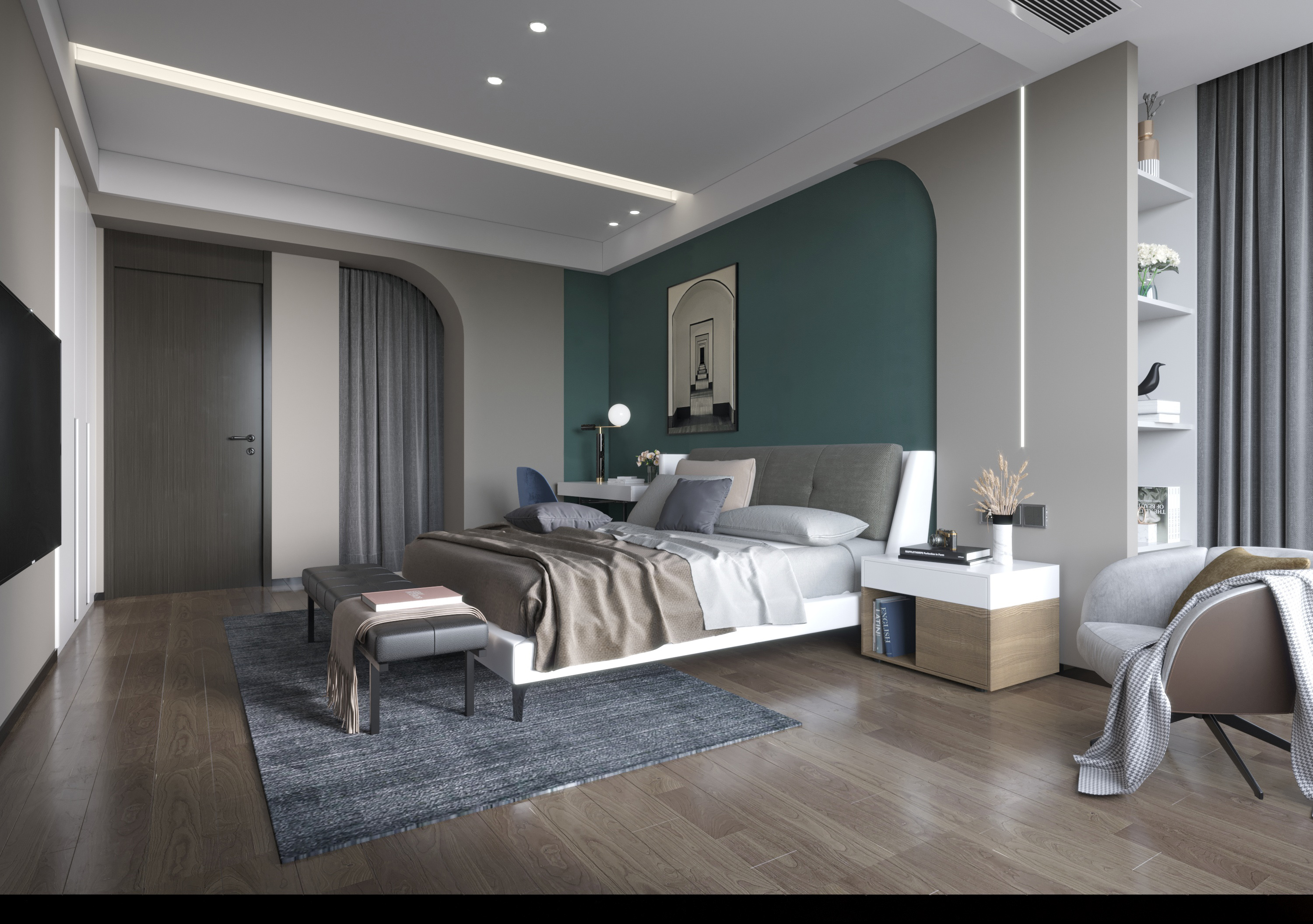
Dark grey stone textures can create a restrained and sophisticated commercial atmosphere.
Light mineral textures are well suited to minimalist and natural residential interiors.
Concrete and stone-inspired textures can reinforce industrial and contemporary architectural styles.
More dramatic mineral patterns and irregular textures can become visual focal points in commercial and hospitality spaces.
In this sense, Rock Design Melamine Board is more than a decorative pattern—it is a spatial design language.
For furniture brands, it offers an opportunity to move beyond conventional woodgrain collections. For designers, it provides a richer material vocabulary than a conventional flat decorative surface. For manufacturers, it offers a way to translate the aesthetics of natural materials into a more standardized furniture production system.
YAKCO Rock Design Melamine Board: Balancing Natural Aesthetics and Manufacturing Efficiency
As modern furniture increasingly emphasizes individuality, tactile experience, and long-term performance, competition in decorative boards is moving beyond simple color selection toward a comprehensive combination of texture, tactility, visual depth, and performance.
YAKCO Rock Design Melamine Board represents this direction by combining the visual characteristics of natural stone, three-dimensional surface texture, and the manufacturing advantages of melamine-faced panel technology.
Rather than simply copying natural stone, it reinterprets the aesthetics of stone through modern surface technology, making natural-inspired textures more suitable for furniture manufacturing, interior design, and scalable applications.
The future of decorative surfaces is not about simply copying nature—it is about engineering nature-inspired aesthetics into better design.
YAKCO Rock Design Melamine Board represents this approach:
Bringing the strength of stone into modern furniture.
Turning the texture of nature into a manufacturable design language.