中文简体
中文简体





Previous Post
In contemporary interior design and custom furniture manufacturing, surface materials are evolving from purely decorative elements into integrated carriers of tactile experience, functional performance, and spatial expression. Among these evolving trends, leather texture has emerged as one of the fastest-growing surface design directions, increasingly becoming a key visual and tactile identity in high-end residential and commercial environments.
As an industrial realization of this trend, YAKCO New Materials (Jiangsu) Co., Ltd. has introduced the YAKCO Leather Design Melamine Board, which redefines scalable leather-like surfaces through structured embossing technology and high-performance substrate systems.
To know more about YAKCO Leather Design Melamine Board
1. From Visual Simulation to True Tactility: The Evolution of Leather Texture
Traditional leather-texture surfaces have long remained at the stage of visual simulation, relying on printing or shallow embossing to approximate the appearance of genuine leather. However, limitations remain in tactile authenticity, gloss control, and durability.
The new generation of leather design panels achieves breakthroughs in three key aspects:
- Deep synchronized embossing (structural embossing system)
A deeper embossing structure ensures high consistency between visual appearance and tactile feedback, significantly reducing the gap between appearance and touch. - Ultra-matte surface system
Advanced resin formulation and surface treatment reduce reflectivity, creating a diffuse, natural leather-like matte finish. - Multi-scale texture design (macro + micro layering)
Macro-level leather grain simulation is combined with micro-level particle textures to enhance realism and tactile richness.
This technical evolution marks a shift from “pattern replication” to “material logic reconstruction.”
2. Structural Performance: Not Just Decorative, but an Engineering Material System
The YAKCO Leather Design Melamine Board is fundamentally an engineered composite surface material system, typically consisting of:
- Surface layer: high-wear melamine-impregnated decorative paper with leather embossing
- Functional layer: anti-scratch and anti-stain resin reinforcement system
- Core layer: MDF / particle board / OSB-type structural substrate
- Balance layer: deformation resistance and structural stability layer
This multilayer structure provides several key engineering advantages:
1. Enhanced abrasion and scratch resistance
The leather texture diffuses light and minimizes visible scratches, while the resin layer improves durability for high-traffic environments such as commercial spaces and custom furniture applications.
2. Improved dimensional stability
Built on high-quality wood-based substrates, the board maintains structural stability and low deformation in large-format applications.
3. Easy cleaning and stain resistance
A closed-surface structure reduces liquid penetration paths, making common stains such as coffee and oil easier to clean.
To know more about YAKCO Technology
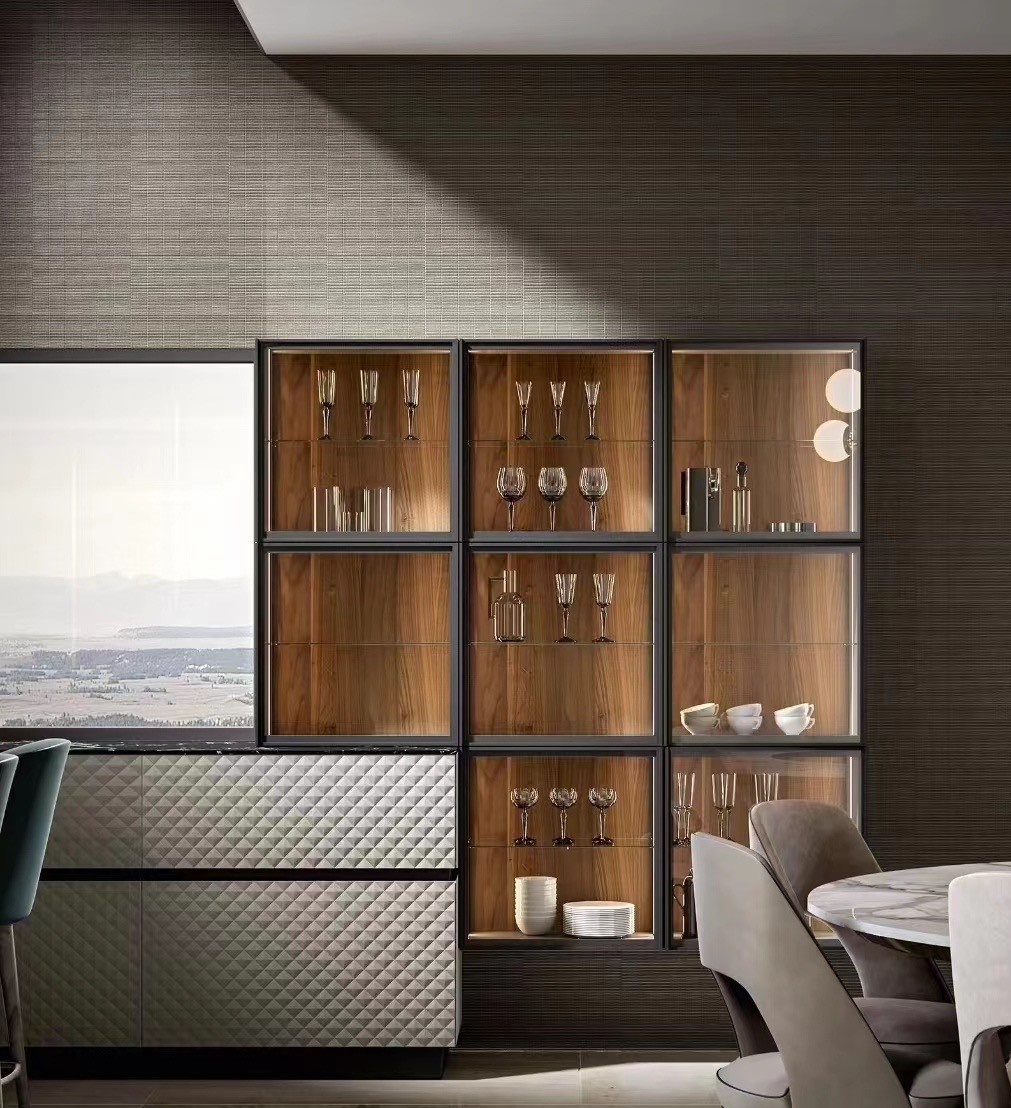
3. Design Language: Leather Texture as Spatial Expression
In design semantics, leather texture typically conveys three spatial narratives:
1. Refined restraint in commercial spaces
In hotels, offices, and exhibition environments, leather textures are used to create a low-saturation, high-end professional atmosphere.
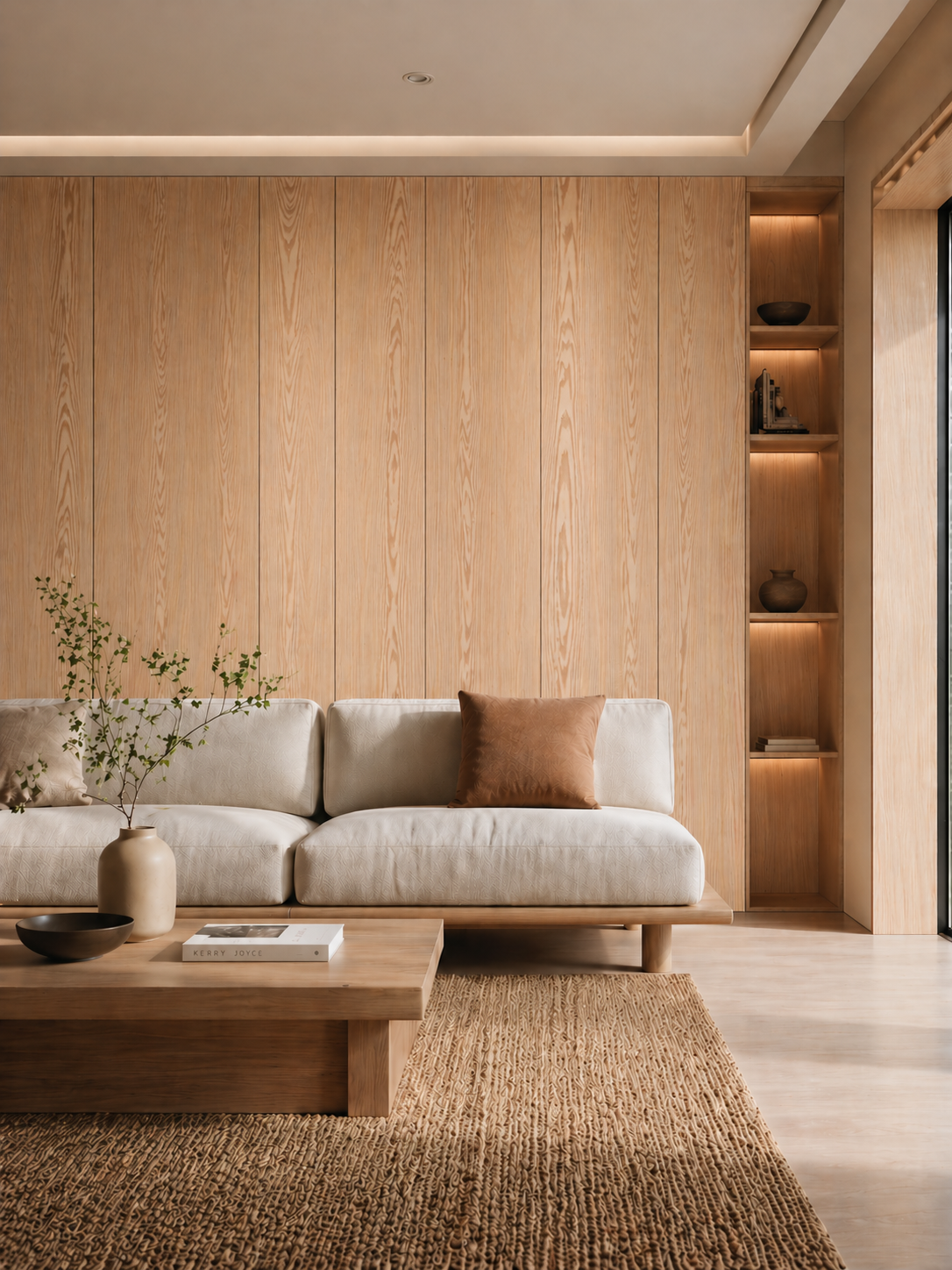
2. Warmth in residential spaces
Compared with cold stone or high-gloss finishes, leather textures provide a more tactile-friendly surface, enhancing comfort and livability.
3. Brand identity in spatial systems
In custom furniture and feature wall systems, leather textures increasingly serve as part of a brand’s visual identity system.
This indicates that surface materials are no longer background elements, but active participants in spatial experience.
4. Comparison with Traditional Materials
|
Dimension |
Genuine Leather |
Traditional Printed Panels |
YAKCO Leather Design Melamine Board |
|
Cost |
High |
Low |
Medium and controllable |
|
Durability |
Prone to aging |
Moderate |
High |
|
Environmental performance |
Limited |
Process-dependent |
E1/E0 compliant system achievable |
|
Consistency |
Variable |
High |
Industrial-grade consistency |
|
Application scope |
Limited |
Broad but weak texture quality |
High-end industrial applications |
This comparison shows that the material is essentially an industrial alternative to the visual language of genuine leather.
5. Performance Validation and Reliability System
Based on standard wood-based panel testing frameworks (such as GB/T and EN standards), such products typically undergo validation in the following areas:
- Static bending strength and modulus of elasticity testing
- Surface abrasion and scratch resistance testing
- Formaldehyde emission compliance testing (E1/E0 standards)
- Heat and humidity cycling stability tests
- Surface adhesion and blister resistance evaluation
According to YAKCO’s testing framework (referencing its 2026 inspection report system), the product emphasizes enhanced stability under both dry heat and humid conditions.
6. Application Scenarios: From Furniture Components to Spatial Systems
The YAKCO Leather Design Melamine Board is widely used in:
- Custom wardrobes and integrated cabinetry systems
- High-end office furniture and meeting spaces
- Hotel rooms and public area interiors
- Commercial exhibition and showroom walls
- Retail brand spatial identity systems
In these applications, it functions not merely as a decorative surface, but as an integral part of spatial system design.
7. Conclusion: The Future of Leather Texture Is Engineering-Driven
The evolution of leather texture is no longer about “becoming more like real leather,” but about optimizing within industrial systems:
- Higher visual and tactile consistency
- More realistic sensory feedback
- Greater environmental adaptability
- Lower lifecycle cost
The YAKCO Leather Design Melamine Board represents this trajectory: transforming the emotional language of natural materials into a scalable engineering system.
In this sense, leather is no longer just a material—it becomes a designed, measurable, and industrially reproducible spatial interface language.