中文简体
中文简体





Previous Post
Black‑gold, blue‑silver, black‑white–Art Deco's high‑contrast colour schemes are its most recognisable visual language.
Bright metallic lines are embedded in dark baseboards, and the boundaries between light and dark colour blocks are sharply defined–this sense of "boundary" is precisely the source of Art Deco's delicacy.
More: yakco technology
But designers and homeowners often overlook one issue: the delicacy of high‑contrast colour schemes is, at its core, a "fragile aesthetic."
The clearer the boundary between dark and light, the more any tiny stain, blurring, or fading is magnified.
A slight bleed at the edge of a gold line, a local darkening in a dark colour block–these can cause the contrast of the entire pattern to collapse.
1.The Two "Enemies" of High‑Contrast Colour Blocks
High‑contrast colour blocks in Art Deco face two main threats in real spaces:
- The first is penetration.
Coffee, red wine, soy sauce–when these liquids come into contact with the decorative layer, if the surface density is insufficient, liquid molecules seep through tiny pores, forming dark spots on dark areas and yellow stains on light areas.
For black‑gold colour blocks, once stains penetrate the edges of the gold lines, the gold darkens and turns grey, and the contrast with the black baseboard diminishes.
- The second is wear.
Walls and cabinet doors in commercial spaces are wiped with cleaning cloths every day. With each wipe, the thickness of the decorative layer decreases at the micron level.
For ordinary patterned panels, this wear may take three to five years to become visible to the naked eye.
But for the fine lines of Art Deco, wear first appears as blurred boundaries–the junction between gold and black begins to "bleed," and the originally sharp edges of the lines become rough.
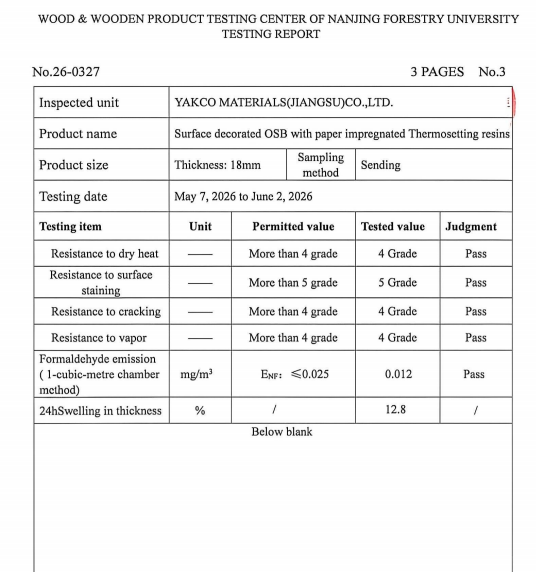
YAKCO's resistance to surface staining Grade 5 and decorative pattern retention 70% precisely address these two threats respectively.
2.Grade 5 Stain Resistance: Boundaries do not bleed or blur
The national standard requires ≥ Grade 4 for resistance to surface staining.
Grade 5 is the highest level, meaning that in the standard test, common contaminants such as coffee, red wine, soy sauce, and oil stains leave no trace after wiping.
For Art Deco's high‑contrast colour blocks, the practical significance of Grade 5 stain resistance is: the boundary between gold and dark colour will not be "breached" by liquids.
When red wine spills on a black‑gold colour block, the liquid does not penetrate along the edges of the gold lines–the gold does not darken, and the black does not develop dark spots.
After cleaning staff wipe with a damp cloth, the pattern is restored, and the boundaries remain clear.
The process logic behind this is the density of the decorative layer. The three‑dimensional network structure formed after the melamine resin cures has extremely small molecular gaps that liquid molecules cannot pass through.
YAKCO's pressing process achieves optimal resin curing through precise control of hot‑pressing temperature, pressure, and time, forming a dense "protective layer."
3.70% Decorative Pattern Retention: Lines do not blur or fade
Decorative pattern retention is a unique evaluation indicator for patterned decorative panels.
Plain colour panels are judged by "whether show‑through occurs after 350 rotations"–i.e., whether the decorative layer is worn through to reveal the substrate.
Patterned panels, on the other hand, are judged by how much of the decorative pattern remains after 100 rotations–the standard requires more than 50% retention to pass.
YAKCO achieved 70% in decorative pattern retention, 20 percentage points above the passing line.
For the fine lines of Art Deco, this 20‑percentage‑point gap means: the edges of the gold lines remain sharp after years of cleaning and wiping, rather than blurring into a mess.
70% pattern retention means that the ink and resin of the decorative layer are minimally lost under friction, and the visual lifespan of the pattern is far longer than that of passing‑grade products.
4.Why Is Art Deco "Particularly Sensitive" to These Two Data Points?
Patterns on ordinary decorative panels usually consist of large colour blocks or repeating textures, where local stains or wear can be easily "absorbed" by the overall visual.
But Art Deco's pattern logic is completely different:
- Lines are the visual skeleton.
The geometric beauty of Art Deco relies on the continuity and precision of its lines. Any interruption or blurring in any line disrupts the entire geometric order.
- Contrast is the visual core.
The visual impact of Art Deco comes from the extreme contrast between dark and light. Once the contrast diminishes–gold darkens, black turns grey–the tension of the entire design language disappears.
- Metallic textures amplify flaws.
The high‑reflectivity of gold, silver, and copper inks makes any stain, bleed, or wear more noticeable than on a matte surface.
YAKCO's Grade 5 stain resistance and 70% pattern retention together form a "boundary defence system" for Art Deco's high‑contrast colour blocks–the former prevents boundaries from being "breached" by liquids, and the latter prevents boundaries from being "worn flat" by friction.
The "Invisible Support" of the Substrate
The performance of stain resistance and pattern retention ultimately depends on the underlying stability of the substrate.
YAKCO's substrate has a stable density of 0.72 g/cm³and internal bond of 0.37 MPa, ensuring that the decorative layer does not develop micro‑cracks due to substrate deformation over long‑term use–micro‑cracks are "shortcuts" for liquid penetration and "accelerators" of pattern wear.
A stable substrate keeps the decorative layer intact and dense.
6.Conclusion: The "Delicacy" of High Contrast Withstands Everyday "Roughness"
Designers choose Art Deco for the visual impact of high‑contrast colour blocks. But this impact is fragile–it depends on clear boundaries, full contrast, and complete lines.
YAKCO Art Deco Melamine Board answers the most practical questions for high‑contrast colour blocks in real spaces with resistance to surface staining Grade 5 (the highest level) and decorative pattern retention 70% (far exceeding the standard):
How long can the delicacy of the boundaries be maintained?
The answer is:
As long as the surface is not penetrated by liquids and not worn down by daily friction, black remains black, gold remains gold, and boundaries remain boundaries. The delicacy of high contrast withstands everyday roughness.
More: Art Deco Melamine Board