中文简体
中文简体





Previous Post
From Decorative Imitation to Tactile Material Design
Furniture surfaces are changing.
For years, decorative boards were primarily evaluated by color, pattern, and visual similarity to natural materials. Today, designers and manufacturers are paying much more attention to another dimension: how a surface looks, feels, and performs in daily use.
This shift has created growing interest in leather-inspired furniture surfaces. Leather has always been associated with sophistication, warmth, and premium craftsmanship. However, using genuine leather as a large-area furniture finish can introduce challenges in material cost, processing consistency, maintenance, and mass production.
YAKCO Leather Design Melamine Board approaches the problem from a different perspective.
Instead of simply reproducing a leather image through decorative printing, YAKCO combines decorative paper, resin impregnation, precision embossing, and high-pressure lamination to transform leather-inspired patterns into an engineered furniture surface.
The result is a material that combines the visual character and tactile richness of leather with the consistency and manufacturing efficiency expected from modern melamine boards.
Wholesale Leather Design Melamine Board Manufacturers, Factory
Why Leather Texture Is Becoming a High-Value Surface Language
Interior design is increasingly moving from purely visual decoration toward sensory design.
A cabinet door, wardrobe surface, reception desk, or retail display is experienced at close range. Subtle differences in grain depth, matte level, surface reflection, and tactile feedback can influence how users perceive the quality of an entire product.
Leather texture is particularly effective because it brings several design characteristics together:
- A refined and understated visual appearance
- Rich micro-texture and tactile variation
- A softer visual impression compared with high-gloss surfaces
- Strong compatibility with contemporary and luxury furniture styles
- The ability to create visual depth without relying on complex geometric patterns
For furniture brands, this makes leather-inspired surfaces more than a decorative trend. They can become an effective tool for building a differentiated product identity.
What Makes YAKCO Leather Design Melamine Board Different?
The value of a leather-effect decorative board is not simply determined by whether the printed pattern resembles leather.
The more important question is whether the visual pattern and physical texture work together.
YAKCO Leather Design Melamine Board is developed around this principle.
The decorative layer provides the visual foundation, while precision embossing creates the corresponding surface structure. Under different lighting conditions, the textured surface generates subtle changes in reflection and shadow, making the leather pattern appear more dimensional.
This creates a closer relationship between:
Pattern → Texture → Light → Touch
Rather than presenting leather as a flat image, the surface becomes a three-dimensional design element.
This approach is especially valuable for minimalist furniture, where relatively simple colors and forms rely heavily on material details to create a premium impression.
Engineered Texture for Consistent Furniture Production
Natural leather is inherently variable. Differences in grain, color, thickness, and surface condition can occur from one section to another.
For furniture manufacturers, however, consistency is critical.
Large-volume furniture production requires decorative materials to deliver stable visual results from panel to panel and from batch to batch.
YAKCO's engineered surface technology is designed to support this requirement by controlling decorative pattern reproduction and embossing during industrial production.
This makes Leather Design Melamine Board suitable for manufacturers who want the visual character of leather while maintaining the repeatability required for modern furniture production.
The material can be integrated into applications where machining, cutting, edge processing, and panel assembly need to remain consistent across multiple pieces.
Performance Matters as Much as Appearance
Premium furniture surfaces are expected to do more than look attractive.
They need to withstand repeated contact, cleaning, handling, friction, and the general demands of daily use.
YAKCO's testing program provides measurable data for the performance of its surface-decorated particleboard substrate.
According to Test Report No. 25-0494, an 18 mm double-finish board sample was evaluated under GB/T 15102-2017. The test covered bending strength, modulus of elasticity in bending, internal bond strength, thickness swelling, moisture content, density, screw holding capability, resistance to high-low temperature cycling, scratching, surface wear, cigarette burns, dry heat, staining, cracking, and vapor. The tested samples passed the listed requirements.
Several results are particularly useful when considering furniture applications.
The tested bending strength reached 29.8 MPa, while the modulus of elasticity in bending reached 4240 MPa. Internal bond strength was 0.36 MPa, and two-hour thickness swelling was 1.0%. The measured density was 0.72 g/cm³.
The board also demonstrated a face screw-holding capability of 1110 N and edge screw-holding capability of 860 N in the reported test.
For surface durability, the sample passed the high-low temperature cycle test without fissures, blistering, discoloration, or wrinkling. It also met the reported scratching requirement at 1.50 N, while the surface showed no show-through after 350 rotations in the reported abrasion test; the measured wear value was 57 mg/100r, against a permitted value of ≤80 mg/100r.
Additional testing recorded Grade 4 for resistance to cigarette burns and surface staining, while dry-heat resistance, cracking resistance, and vapor resistance each reached Grade 5.
These results demonstrate an important principle: a premium decorative surface should be supported by measurable substrate and surface performance rather than aesthetics alone.
From Luxury Appearance to Practical Furniture Material
One of the major advantages of an engineered leather surface is the ability to separate luxury appearance from the limitations of genuine leather.
Leather Design Melamine Board can provide a leather-inspired visual and tactile effect while remaining a panel-based material designed for furniture manufacturing.
This creates opportunities for a much wider range of applications, including:
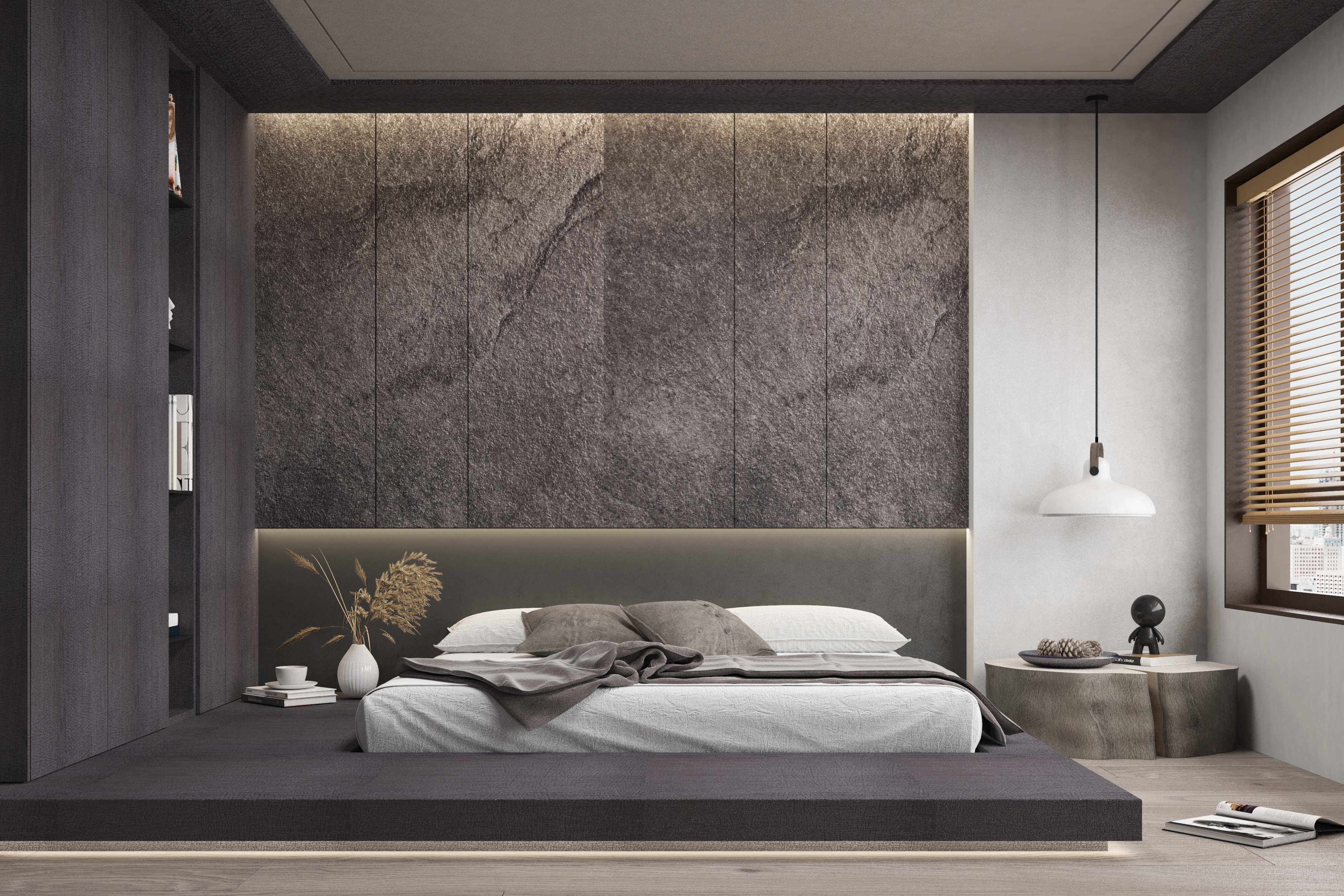
Residential Furniture
Leather textures can introduce sophistication to wardrobes, bedroom furniture, TV cabinets, sideboards, storage systems, and customized furniture.
Combined with warm neutrals, deep browns, charcoal tones, or muted contemporary colors, the texture can create a restrained luxury aesthetic.
Hospitality Interiors
Hotels, serviced apartments, and premium hospitality spaces require materials that balance appearance, durability, and maintenance efficiency.
Leather-inspired boards can be used for wall furniture, wardrobes, reception furniture, guest-room cabinetry, and feature elements where designers want a richer material expression.
Retail and Commercial Spaces
Retail environments depend heavily on visual identity.
Leather textures can reinforce a premium brand image in display furniture, shelving, counters, wall systems, and product presentation areas.
Executive and High-End Office Furniture
For conference tables, executive storage, reception counters, and private office furniture, leather-inspired finishes can create a sophisticated atmosphere without requiring genuine leather upholstery or surface wrapping.
A New Role for Texture in Furniture Design
The growing popularity of textured decorative boards reflects a larger change in the furniture industry.
Design differentiation is becoming increasingly difficult to achieve through color alone. As production technologies become more standardized, surface texture becomes an important source of perceived value.
A successful decorative surface therefore needs to perform on several levels simultaneously:
Visual identity — Does the surface create a recognizable design language?
Tactile quality — Does the surface feel convincing when touched?
Manufacturing consistency — Can the same appearance be reproduced across multiple products?
Physical performance — Can the board withstand the demands of everyday furniture use?
Application flexibility — Can the material work across residential, hospitality, retail, and commercial environments?
YAKCO Leather Design Melamine Board is developed around this multidimensional approach.
Why Leather-Inspired Surfaces Matter for the Next Generation of Furniture
The future of decorative boards is not simply about making imitation materials look more realistic.
It is about creating engineered surfaces with their own material identity.
Leather Design Melamine Board represents this transition.
Instead of treating leather texture as a printed decoration, YAKCO integrates visual reproduction and physical embossing to create a more immersive surface experience. Combined with tested substrate and surface performance, the material provides furniture manufacturers with a practical alternative for achieving premium leather-inspired aesthetics at industrial scale.
For designers, this means greater freedom to explore texture.
For manufacturers, it means greater consistency and production efficiency.
For brands, it creates another opportunity to translate material character into product value.
Conclusion
As furniture design moves from visual imitation toward sensory and performance-driven materials, surface texture is becoming an increasingly important part of product differentiation.
YAKCO Leather Design Melamine Board responds to this evolution by combining leather-inspired aesthetics, three-dimensional surface texture, engineered consistency, and measurable physical performance.
It is not simply a board designed to look like leather.
It is an engineered decorative surface designed to bring the visual depth, tactile character, and premium perception of leather into modern furniture manufacturing.
For furniture brands, interior designers, architects, and OEM/ODM manufacturers looking for differentiated surface solutions, YAKCO Leather Design Melamine Board offers a practical way to turn texture into a stronger design statement—and design into measurable product value.