中文简体
中文简体





Previous Post
The appeal of rock grain boards lies in using industrial methods to replicate the visual language of natural stone – the grain of granite, the layering of slate, the mottling of terrazzo.
Designers use it on lobby feature walls, corridor wall cladding, and elevator lobby walls, pursuing a spatial effect that is "as present as stone."
But natural stone has a well‑known weakness: it fears moisture and temperature differences.
Rainwater seeps into micro‑pores to form yellow stains, and day‑night temperature differences cause micro‑cracks on the surface – these "stone diseases" keep the maintenance costs of natural stone high.
As an industrial product, rock grain boards should theoretically overcome these weaknesses. But the prerequisite is: its own "temperature and humidity tolerance" must be strong enough.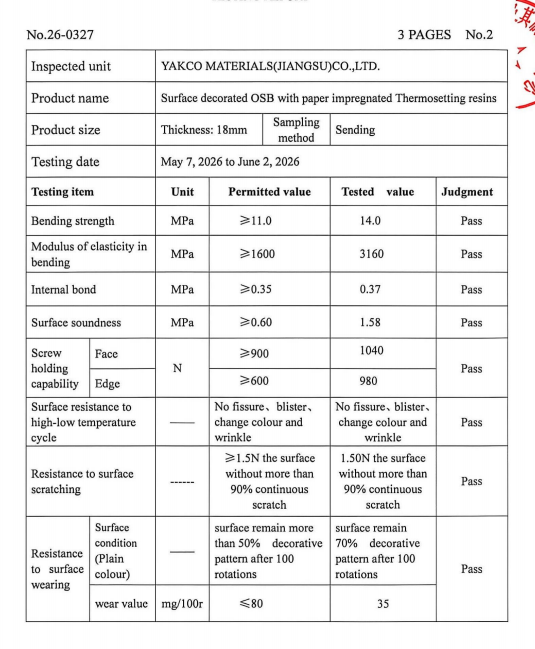
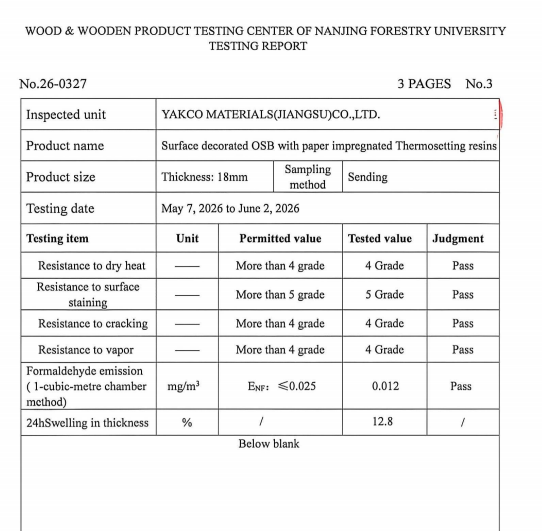
YAKCO Rock Design Melamine Board, in the 2026 national test, achieved a 24h swelling in thickness far below the national standard requirement.
At the same time, the surface resistance to high‑low temperature cycle result was: no fissure, no blister, no change of colour, no wrinkle.
These two data points precisely answer the most practical questions for rock grain boards under temperature and humidity changes: Will it swell and deform in damp environments? Will it crack and fade under temperature alternations?
More:yakco technology
1.24h Swelling in Thickness: The "Moisture Defence Baseline" of Rock Texture Melamine Board
24h swelling in thickness measures the percentage change in thickness after a panel is soaked in water for 24 hours. The lower the value, the better the dimensional stability of the panel in damp environments.
Ordinary particleboard typically has a 24h swelling in thickness of 6%‑12%. YAKCO's tested value is far below this range, meeting the national standard requirement. Low swelling means the substrate maintains dimensional stability under humidity changes – it does not "pull" the decorative layer due to moisture absorption and swelling, nor does it develop surface micro‑cracks due to moisture loss and shrinkage.
What does this data actually mean for rock grain boards?
Kitchens and bathrooms can be used with confidence.
When rock grain boards are placed near sinks, dishwashers, or shower areas, moisture and condensation are the norm. Low swelling means the panels do not "bulge" in damp environments, cabinet doors do not fail to close due to moisture absorption, and edge banding does not pop off due to expansion.
Balcony cabinets and laundry rooms withstand the test.
Humidity spikes during the rainy season and steam in laundry rooms – these scenarios are long‑term tests of the panel's moisture resistance.
Low swelling allows rock grain boards to maintain dimensional stability in these "high‑humidity areas" – no deformation, no warping.
Cross‑regional shipping is worry‑free.
When a batch of panels is shipped from East China to South China (high humidity) or North China (dry), if the swelling rate fluctuates significantly, dimensional deviations may occur upon arrival.
Low swelling means the panels remain stable across different climate zones, and logistics departments do not need to distinguish between "southern version" and "northern version."
2.Surface Resistance to High‑Low Temperature Cycle: The "Temperature Difference Immunity" of Rock Texture Melamine Board
The surface resistance to high‑low temperature cycle test simulates a panel's performance under extreme temperature differences – after alternating cycles of specified high and low temperatures, the surface is examined for cracks, blistering, discoloration, or wrinkles.
YAKCO's tested result: no fissure, no blister, no change of colour, no wrinkle.
What does this data mean for rock grain boards?
Rock grain walls near lobby floor‑to‑ceiling windows are not afraid of sun exposure.Summer days bring heat from direct sunlight while nights cool down – repeated temperature fluctuations.
Passing the resistance to high‑low temperature cycle means that the grain and layering of the rock grain do not develop micro‑cracks due to expansion and contraction, and the stone‑imitation texture does not "fracture" due to temperature differences.
Rock grain wall cladding above underfloor heating does not delaminate.
Radiant heat from the floor transfers to the lower wall areas, and the thermal strain difference between the substrate and the decorative layer may cause cracking or delamination.
Passing the resistance to high‑low temperature cycle ensures that the rock grain decorative layer remains "tightly attached and blister‑free" in sustained warm environments.
Office walls with frequent air conditioning switching do not "disfigure."The alternating hot and cold cycles continuously apply thermal stress to the interface between the decorative layer and the substrate.
Passing the resistance to high‑low temperature cycle means that the dark mineral veins and light matrix of the rock grain do not develop colour differences or blurred boundaries due to temperature differences.
3.The "Chassis" of Temperature and Humidity Tolerance: Substrate Stability
24h swelling in thickness and surface resistance to high‑low temperature cycle – these two seemingly independent indicators share the same solution: substrate stability.
YAKCO's substrate has a stable density of 0.72 g/cm³ and internal bond of 0.37 MPa. Uniform density means that the substrate expands consistently in all directions when absorbing moisture, without local stress concentration.
High internal bond means the internal layers of the substrate are "held together tightly," and thermal stress does not cause internal micro‑cracks under temperature changes.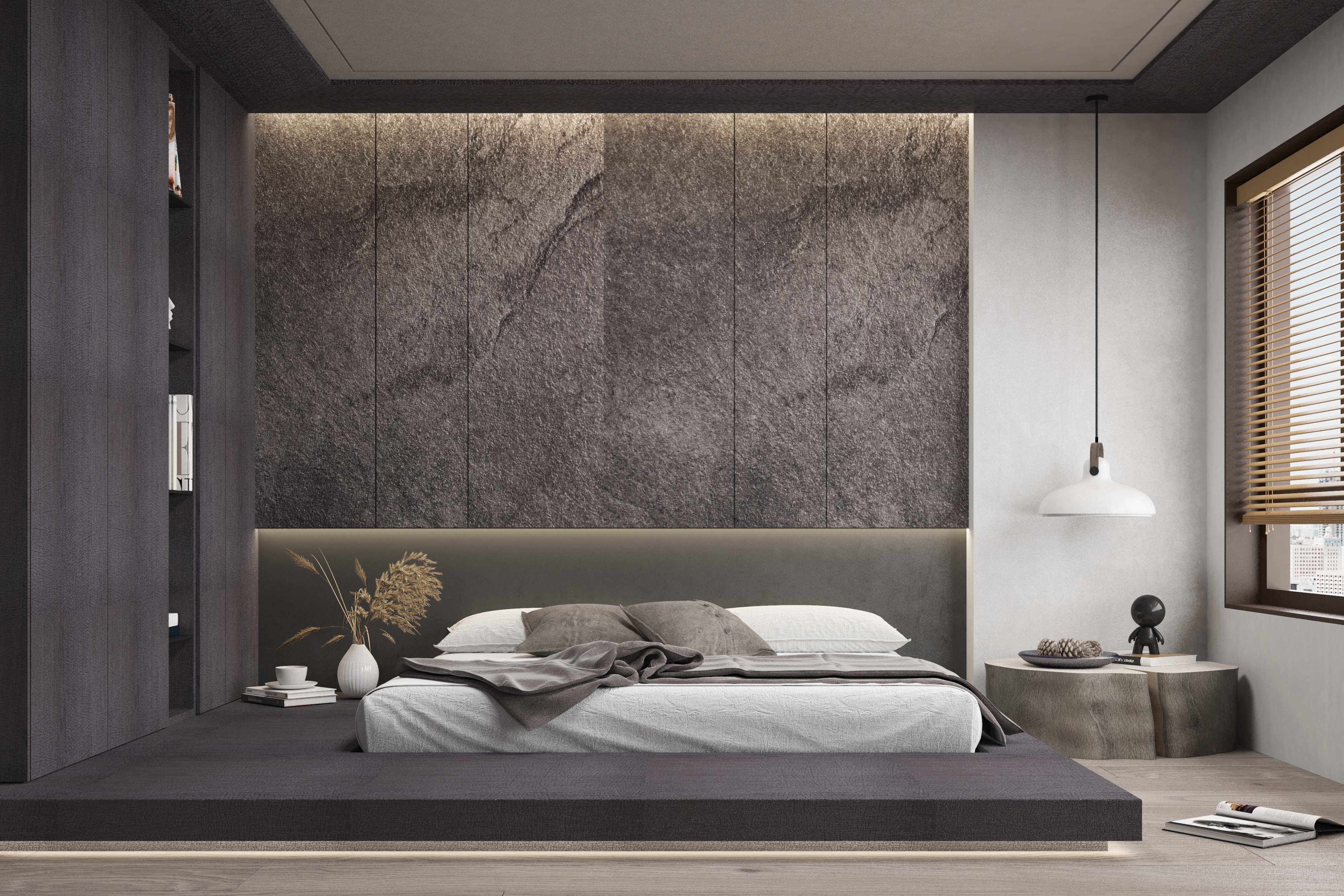
A stable substrate allows the "temperature and humidity tolerance" of rock grain to last. Low swelling is not "stacked" by additives – it is the systematic result of particle size distribution, moisture content control, and hot‑pressing curve optimisation.
Passing the resistance to high‑low temperature cycle is not "held up" by a surface coating – it is due to the sufficient interfacial bonding strength between the substrate and the decorative layer.
YAKCO's surface soundness of 1.58 MPa (2.6 times the national standard of 0.60 MPa) ensures that the decorative layer remains firmly anchored under thermal cycling.
4.The Engineering Value of Rock Grain "Temperature and Humidity Tolerance"
For engineering projects, the temperature and humidity tolerance of rock grain boards directly translates into three practical values:
Reduced after‑sales maintenance due to moisture.
A large proportion of after‑sales complaints for kitchens, bathrooms, and balcony cabinets come from panel moisture absorption and swelling – cabinet doors not closing, edge banding popping off, wall cladding warping. Low swelling cuts off the probability of these issues at the source.
Lower quality risks due to temperature differences.
If large‑area rock grain walls develop micro‑cracks or blistering under temperature changes, repair costs are extremely high – often requiring the entire wall to be removed and reinstalled. Passing the resistance to high‑low temperature cycle means that these risks are "eliminated" before installation.
Expanded application scope of rock grain boards.
From the dry north to the humid south, from air‑conditioned rooms to underfloor heated rooms, from hotel lobbies to kitchens and bathrooms – the "temperature and humidity tolerance" of rock grain boards allows them to be used in more scenarios, so designers do not have to abandon rock grain aesthetics due to fear of "moisture" or "temperature differences."
5.Conclusion: The "Stone Presence" of Rock Grain Has Not Only Visuals but Also "Tolerance"
Designers choose rock grain boards for a spatial effect that is "as present as stone."
But true "stone presence" should not remain only at the visual level – it also needs to "withstand" moisture and temperature differences like stone, and even be more "worry‑free" than stone.
YAKCO Rock Design Melamine Board uses the two data points of low 24h swelling in thickness and passing the resistance to high‑low temperature cycle to prove that the stone‑imitation texture of rock grain has not only visual "realism" but also physical "tolerance" – no swelling in damp conditions, no cracking under temperature differences, no fading over time.
When a designer says, "I want to use the same rock grain board in both the kitchen and the hotel lobby," YAKCO answers the unspoken question with data: "It handles both damp and sun‑exposed places."
More about Rock: Rock Texture Melamine Board