中文简体
中文简体





Previous Post
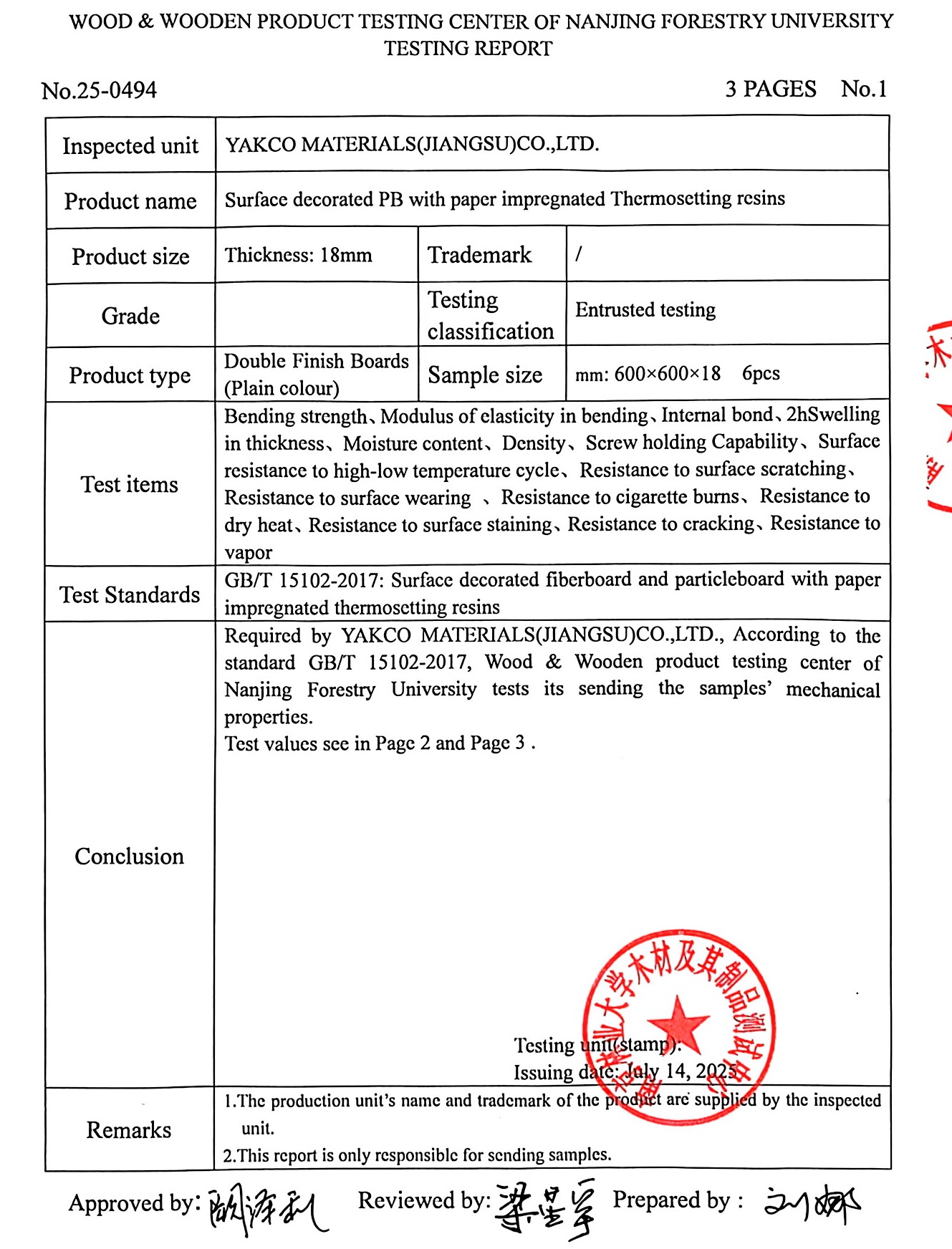
In today’s world of luxury interiors and bespoke furniture, visually and tactically striking finishes such as leather-touch textures have become a defining element of high-end design. Yet behind every flawless premium decorative surface lies an invisible but decisive foundation: the Surface Decorated Particleboard with Paper Impregnated Thermosetting Resins.
According to rigorous testing conducted by the National Forestry and Grassland Administration’s Wood-Based Panel and Products Quality Inspection Center (Nanjing), based on the national standard GB/T 15102-2017, a truly high-performance substrate capable of supporting premium decorative applications must achieve a precise balance between wood-fiber density distribution and polymer resin formulation. Only then can it deliver exceptional dimensional stability under mechanical stress and fluctuating temperature-humidity conditions.
To learn more about YAKCO technology
1. Density Optimization & Internal Matrix Cohesion
The foundation of a premium decorative melamine board substrate lies in its engineered density profile and the uniformity of its core fiber structure. Conventional commercial boards often suffer from internal stress voids caused by uneven density distribution. In contrast, advanced substrates utilize precision airflow forming technology to create a multilayer gradient fiber matrix with enhanced structural consistency.
Scientifically Controlled Density
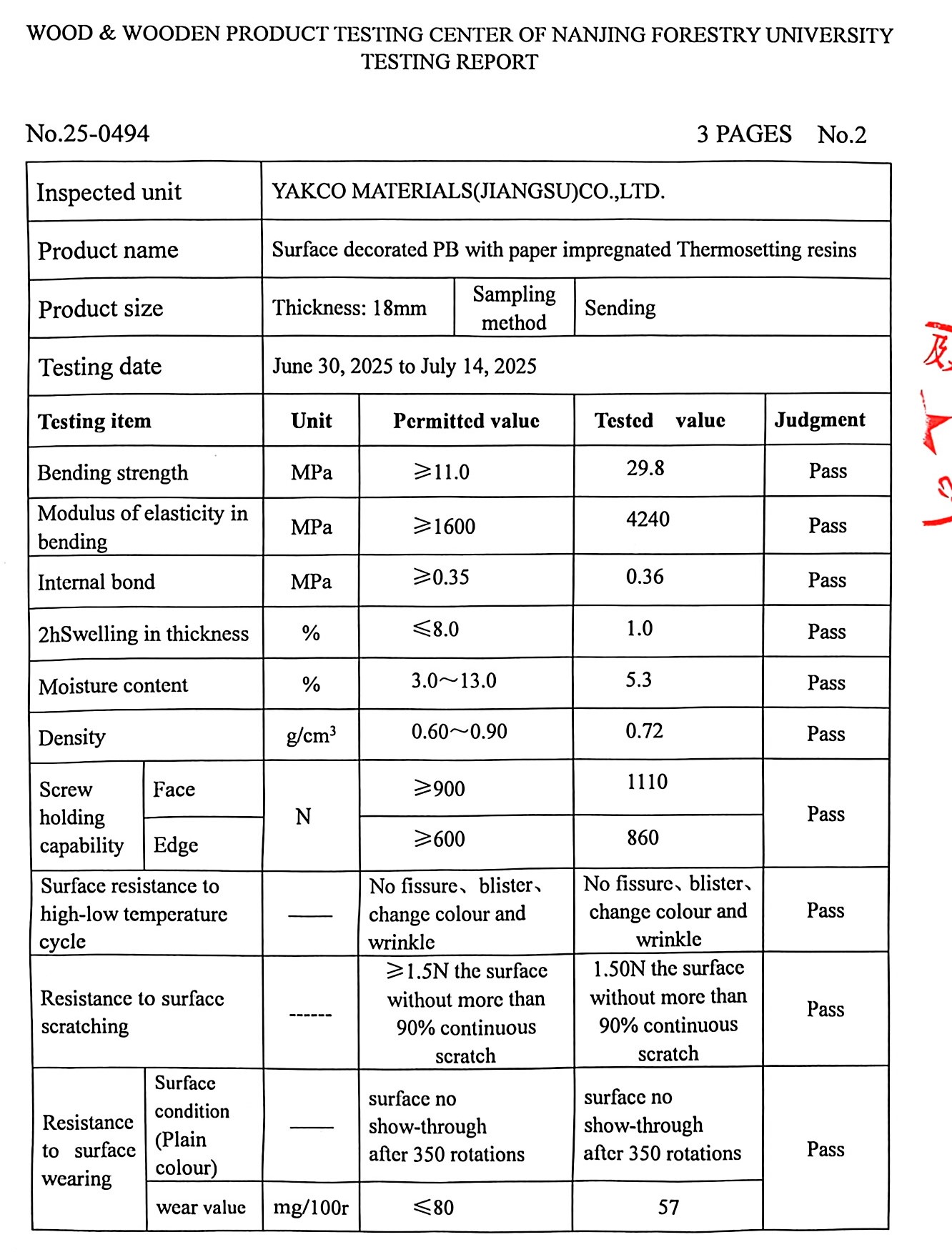
Test results show that the substrate density is precisely controlled at:
0.72 g/cm³
This falls within the “golden density window” for high-end melamine board substrates. It provides the panel with a solid tactile feel, excellent acoustic damping performance, and superior vibration absorption, while avoiding excessive self-weight that could impose unnecessary shear stress on cabinet hardware systems.
Exceptional Internal Bond Strength
As a critical indicator of adhesive cohesion between wood fibers, the substrate achieves an impressive internal bond strength of:
0.36 MPa
This ensures structural integrity during complex machining processes such as grooving, large-span suspended applications, and high-load fastening, preventing fiber separation or delamination even under intensive structural stress.
2. Mechanical Load Resistance: Bending Strength & Structural Rigidity
When melamine board substrates are applied in large-span shelving, full-height luxury wardrobe doors, or premium commercial wall systems, they must withstand long-term vertical loads and creep deformation. The substrate therefore requires outstanding flexural performance to prevent visible sagging over years of use.
Static Bending Strength
Laboratory testing demonstrates a remarkable bending strength of:
29.8 MPa
This indicates an exceptionally high load-bearing threshold within the internal fiber matrix, significantly exceeding standard industry performance levels.
Modulus of Elasticity in Bending
The modulus of elasticity reaches:
4240 MPa
Such high structural rigidity allows long shelves and luxury cabinet doors to maintain flatness under heavy loads, generating only minimal elastic deformation and rapidly recovering their original geometry once stress is removed. This effectively minimizes the risk of warping and long-term distortion.
3. Dimensional Stability & Screw Holding Performance in Variable Climates
Wood fibers naturally absorb and release moisture, resulting in expansion and contraction cycles that can eventually cause decorative surfaces to crack, bubble, or deform. This challenge becomes especially critical in kitchens, luxury bathrooms, humid coastal climates, or dry heated winter environments.
Low Thickness Swelling & Moisture Stability
Conventional boards often swell significantly under humid conditions, causing texture telegraphing and surface irregularities. This high-performance substrate incorporates advanced nano-grade paraffin emulsion technology to enhance water resistance.
The measured 2-hour thickness swelling rate is only:
1.0%
This demonstrates extremely strong hydrophobic stability.
The moisture content remains stably controlled at:
5.3%
This maintains the internal fiber network in an ideal equilibrium state regardless of regional climate differences.
Superior Screw Holding Capability
A high-end melamine board substrate must remain structurally reliable even after repeated cabinet assembly, hinge movement, and hardware adjustments.
Face Screw Holding
The face screw holding strength reaches:
1110 N
Edge Screw Holding
Edge screw holding performance is equally outstanding at:
860 N
Even under repeated heavy-duty hardware adjustments, screw holes remain stable without stripping or loosening.
4. Surface Physical-Chemical Resistance & Comprehensive Protection
The final performance of decorative melamine boards is determined by the hot-press integration between melamine-impregnated paper and the engineered substrate. When premium brands such as YAKCO apply complex leather or stone textures using specialized steel press plates, the substrate must deliver perfectly uniform heat transfer and structural support.
Final test results demonstrate comprehensive high-level resistance across all major performance categories:
|
Testing Item |
Standard Requirement |
Tested Result |
Judgment |
|
Resistance to Surface Scratching |
≥ 1.5 N, no continuous scratches |
1.50 N, no continuous scratches |
Pass |
|
Resistance to Surface Wearing |
No substrate exposure after 350 cycles; wear ≤ 80 mg/100r |
No exposure after 350 cycles; only 57 mg/100r wear |
Pass |
|
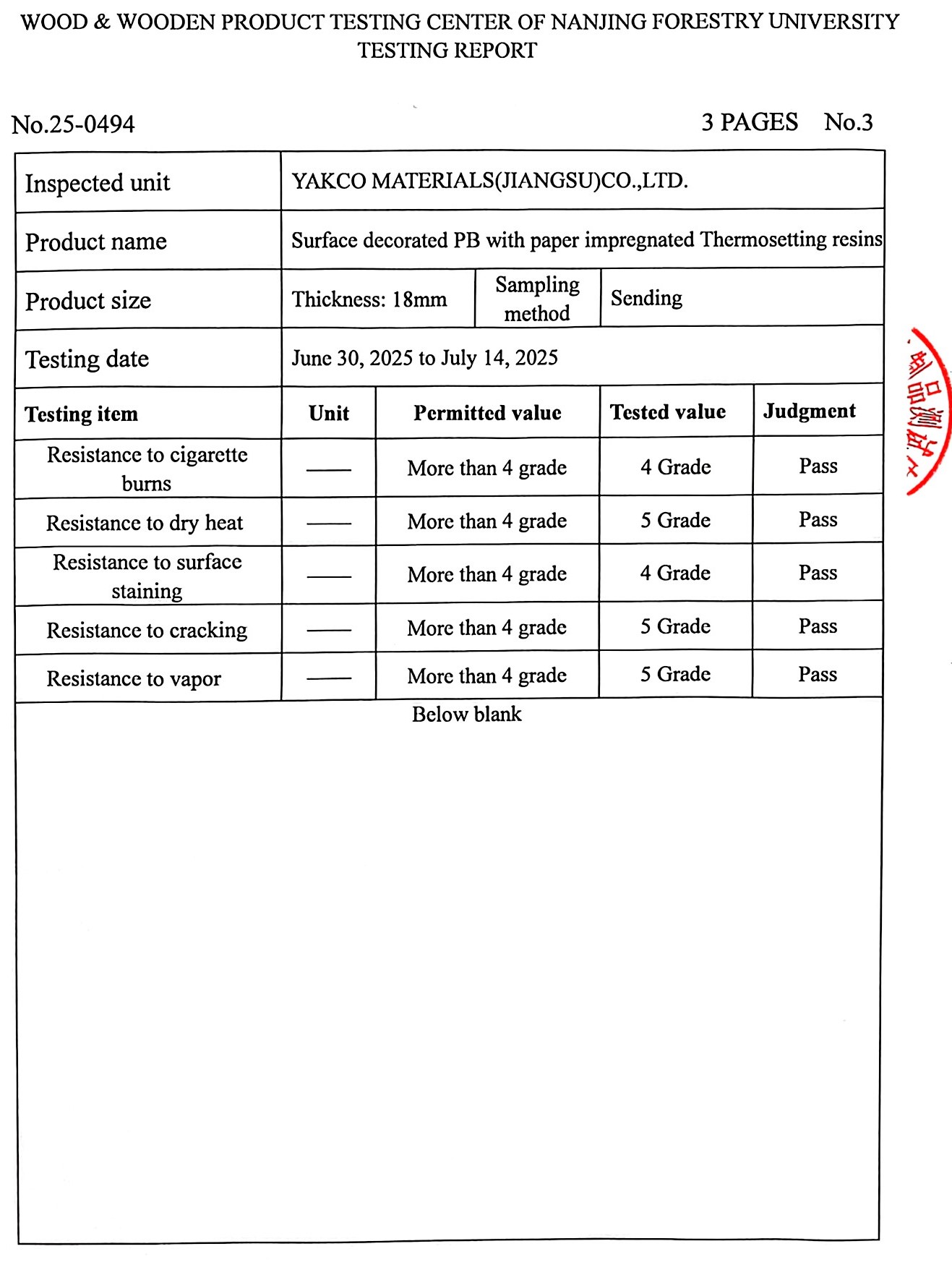
Resistance to Dry Heat |
≥ Grade 4 |
Grade 5 (no visible change) |
Pass |
|
Resistance to Vapor |
≥ Grade 4 |
Grade 5 (no bubbling or delamination) |
Pass |
|
Resistance to Cracking |
≥ Grade 4 |
Grade 5 (excellent thermal expansion resistance) |
Pass |
|
Resistance to Cigarette Burns |
≥ Grade 4 |
Grade 4 |
Pass |
|
Resistance to Surface Staining |
≥ Grade 4 |
Grade 4 |
Pass |
Particularly noteworthy is the substrate’s high-low temperature cycle resistance. After repeated exposure to extreme cold and heat cycles, the surface remained completely free from cracking, bubbling, discoloration, or shrinkage. This is precisely the hidden engineering foundation that allows sophisticated leather textures and deep embossed decorative surfaces to maintain their dimensional richness and premium appearance over time.
Conclusion: The Hidden Engineering Behind Luxury Aesthetics
The luxury appeal of high-end custom furniture may begin with visual beauty, but it ultimately depends on engineering quality beneath the surface.
Products such as YAKCO decorative leather-texture melamine panels are able to preserve their refined tactile aesthetics for years because they are built upon a high-performance melamine board substrate featuring:
- a golden density of 0.72 g/cm³
- outstanding bending strength of 29.8 MPa
- and comprehensive physical-chemical durability.
It is this hidden matrix of advanced material engineering that transforms decorative wood-based panels from ordinary furniture materials into enduring architectural elements defined by elegance, strength, and long-term performance.