中文简体
中文简体





Previous Post
The mechanical properties of wood-based panels directly affect the service life and safety of furniture and decorative products. Among various test indices, bending strength and modulus of elasticity in bending are the two core parameters for evaluating the load-bearing capacity and deformation resistance of wood-based panels.
The 18mm Melamine faced Board submitted by YAKCO was tested by the Wood-Based Panel Quality and Testing Center of National Forestry and Grassland Administration (Nanjing) and the Wood & Wooden Product Testing Center of Nanjing Forestry University. The results show that both indices far exceed the requirements of the national standard GB/T 15102-2017.
More Details: yakco technology
Bending Strength – Direct Reflection of the Board’s “Fracture Resistance”
1.What is Bending strength?
Bending strength refers to the maximum stress that a board can withstand before its surface fibers reach the failure limit under gradually increasing bending force.
It is expressed in MPa (megapascals). Simply put, it determines whether a furniture board is prone to fracture when subjected to external forces (e.g., heavy loads, leaning, tightening during installation).
The higher the bending strength, the “stronger” the board, making it more suitable for load-bearing structures such as shelves, tabletops, and cabinet side panels.

2.YAKCO’s performance:
GB/T 15102-2017 requires bending strength of ≥11.0 MPa for melamine faced board. The tested sample of YAKCO achieved 29.8 MPa, which is 2.7 times the national standard limit.
This means that under the same thickness and loading conditions, YAKCO boards can withstand significantly higher external loads, greatly reducing the risk of fracture during furniture use.
Modulus of Elasticity in Bending – Rigidity Indicator Against Bending Deformation
1.What is modulus of elasticity in bending?
Modulus of elasticity in bending (also referred to as bending modulus) reflects the board’s ability to resist bending deformation within its elastic range. It is also expressed in MPa.
The higher the value, the “stiffer” the board, meaning it does not easily bend or sag under external force. For long-span shelves, cabinet doors, and large-format furniture, a high modulus of elasticity effectively prevents the board from sagging due to its own weight over time, maintaining a flat appearance.
2.YAKCO’s performance:
The national standard requires modulus of elasticity in bending of ≥1600 MPa. YAKCO’s tested sample reached 4240 MPa, which is 2.65 times the standard limit.
This data shows that YAKCO decorative boards maintain excellent bending rigidity even under long-term loading or changing humidity conditions, greatly enhancing the dimensional stability and durability of furniture.
Excellent Substrate as the Foundation, Combining Function and Aesthetics
YAKCO states that the outstanding performance in both bending properties results from continuous optimization of the Melamine Board Substrate process, including reasonable slenderness ratio of wood chips, precise glue application, and hot-pressing control.
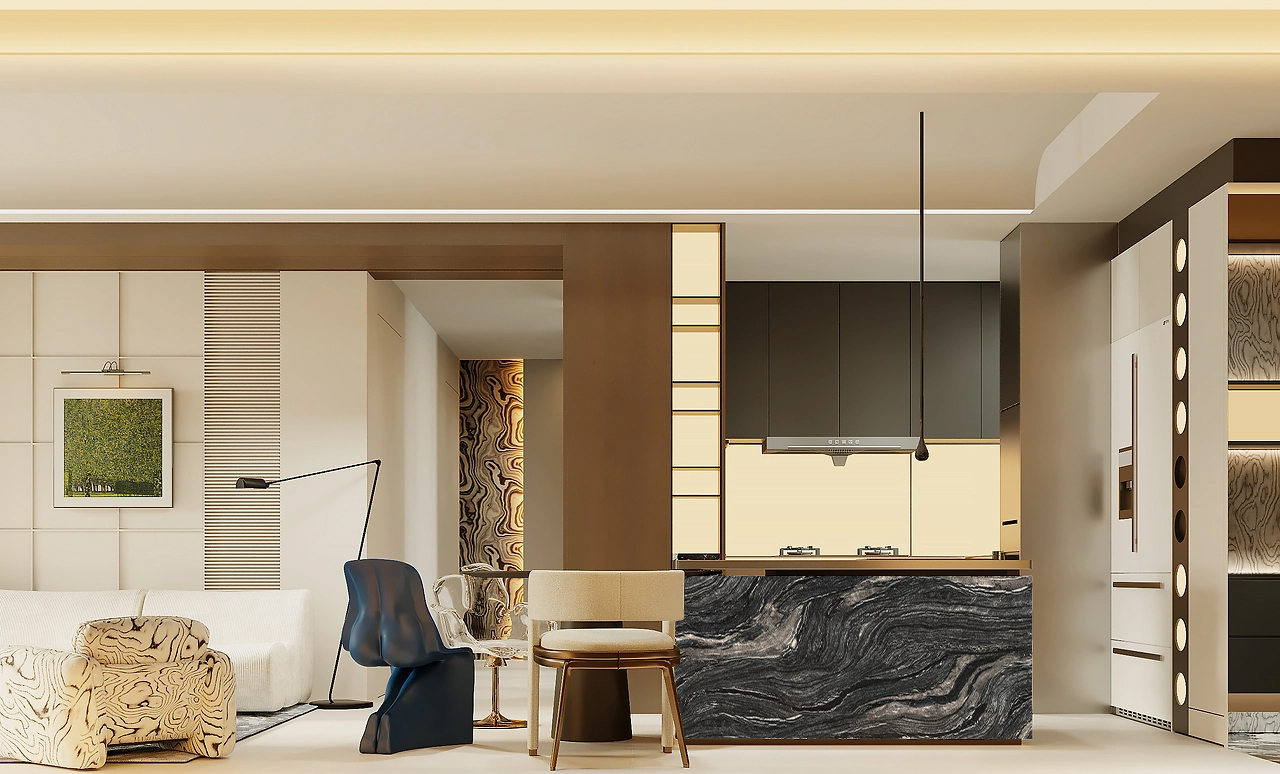
Based on this foundation, YAKCO will further introduce decorative panels such as Rock Design Melamine Board, 3D Embossed Wood Panel, and Leather Design Melamine Board, ensuring stable mechanical performance while meeting diverse interior space style requirements.
YAKCO specializes in the R&D and manufacturing of high-quality Melamine Faced Board. With stable mechanical properties and strong surface durability as its core advantages, YAKCO serves the furniture manufacturing, decoration, and commercial space sectors.
View More:Premium Melamine Board Product