中文简体
中文简体





Previous Post
What is the difference between MDF and melamine?
MDF board is a core substrate, a dense panel made from compressed wood fibers and resin, while Melamine Board is a surface finish, a layer of resin saturated Decorative paper bonded onto a substrate such as MDF board or Particle board. The two are not competing materials in the same category. MDF board is what a panel is made of. Melamine Board describes what the surface of that panel looks like and how it is protected. When a manufacturer refers to Melamine MDF, they mean an MDF board core with a melamine surface on one or both faces. Understanding this relationship answers most practical questions about What is the difference between melamine and MDF before any other detail needs to be examined.
| Attribute | MDF board (bare) | Melamine Board |
|---|---|---|
| What it is | Compressed wood fiber core panel | Panel with melamine resin surface paper fused on |
| Surface finish | Raw, must be painted or laminated | Ready to use, scratch and stain resistant |
| Moisture resistance | Poor unless moisture resistant grade | Better on face, still vulnerable on edges |
| Paintability | Excellent with primer | Difficult without sanding and adhesion primer |
| Typical use | Painted cabinets, moldings, routed profiles | Kitchen cabinets, wardrobe interiors, shelving |
| Relative cost | Lower for raw board | Slightly higher due to surface lamination |
What is MDF board, what is mdf baseboard, and what is an idf and mdf
MDF board stands for medium density fiberboard. It is a category of Engineered wood panel manufactured from wood fiber residues, including sawdust, wood shavings, and pulped wood chips, bonded together with synthetic resin under heat and pressure. The result is a flat, dense, smooth panel that has no grain direction, cuts cleanly in any direction, and takes paint and router profiles better than almost any other panel product. MDF board sits in the medium density range, denser than low density fiberboard but less dense than hardboard, with a typical density of 650 to 800 kilograms per cubic meter.
What is mdf baseboard? In interior construction, MDF board is used extensively as baseboard and door casing material because it paints to a smooth, flawless finish with no visible grain lines, which is impossible to achieve with solid pine or finger jointed wood at the same price point. MDF baseboard accepts primer and topcoat paint well and is stable enough to hold its profile shape without the cupping or bowing that natural wood sometimes develops after installation in a climate controlled interior.
What is an idf and mdf? In telecom and data networking, IDF stands for intermediate distribution frame and MDF stands for main distribution frame. These are patch panel enclosures used to organize telephone, data, and other cabling in buildings. This is a completely separate meaning from the woodworking panel material covered in this guide. When the subject is furniture or construction, MDF board always refers to the wood fiber panel product.
how is medium density fiberboard made: The Manufacturing Process
how is medium density fiberboard made is a question worth answering in practical detail because the manufacturing process explains most of the material's properties, including its uniform density, its smooth face, and its vulnerability to moisture.
- Wood residues including sawmill chips, planer shavings, and sometimes purpose grown timber are chipped into small pieces and then fed into a refiner that separates the chips into individual wood fibers using heat and mechanical action
- The wet fibers are dried in a rotating drum dryer to reduce moisture content to around 8 to 12 percent, which is the optimal range for resin bonding without premature adhesive curing
- Urea formaldehyde resin, or in lower emission grades melamine urea formaldehyde resin, is blended into the dry fibers along with wax for water resistance and any required additives such as fire retardant or moisture resistant compounds
- The blended fiber mat is formed and then pressed in a continuous or multi opening hot press at temperatures of 160 to 200 degrees Celsius and pressures of 2.5 to 4 megapascals, which cures the resin and densifies the mat into a solid panel
- Panels are cooled, trimmed to dimension, and sanded on both faces to the tight thickness tolerance required for lamination or direct painting
The pressing process is what gives MDF board its defining characteristic: a completely uniform density and surface smoothness from face to face and edge to edge. Unlike Particle board, which is made from larger wood particles and has a coarser surface, MDF board is made from refined fibers that produce a face smooth enough to accept Decorative paper, lacquer, or veneer without a visible substrate texture telegraphing through.
Melamine Board and Decorative paper: How the Surface Is Applied
Melamine Board is produced by fusing a sheet of Decorative paper that has been impregnated with melamine resin directly onto the face of a substrate panel, most commonly MDF board or Particle board, using heat and pressure. The melamine resin in the paper cures under the press and forms a hard, thermoset plastic surface that is bonded chemically and mechanically to the substrate. The resulting surface is smooth, resistant to scratches and household stains, easy to clean, and available in an enormous range of colors, wood grain prints, and solid textures.
The Decorative paper itself is a specialty printing paper that is first printed with the desired pattern or color, then impregnated with liquid melamine resin and dried to form a prepreg sheet. When the prepreg is pressed onto the substrate at 150 to 200 degrees Celsius and 20 to 30 kilograms per square centimeter of pressure, the melamine resin melts and flows into the substrate surface before curing permanently. The final melamine surface layer is typically 0.1 to 0.3 millimeters thick and is far harder than the underlying MDF board or Particle board core, which is why Melamine Board scratches from the surface only rather than being gouged into the core under normal use.
Particle board deserves a specific note here because it is the most common substrate for budget Melamine Board products sold in flatpack and ready to assemble furniture. Particle board is made from larger wood chips and shavings bonded with resin, giving it a lower density and rougher internal structure than MDF board. When used as the core for Melamine Board, Particle board produces a panel that is lighter and cheaper than Melamine MDF but holds screws and fixings less securely and is more vulnerable to swelling if edges are exposed to moisture.
melamine faced MDF: Why Combining Both Materials Is Common Practice
melamine faced MDF is the product category that resolves the most common conflict in furniture and cabinet manufacturing: the need for a smooth, durable, decorative surface combined with the structural and machining performance of a quality substrate. MDF board as a core provides uniform density for screw holding, a smooth face that needs no filling before lamination, and the ability to route clean profiles on edges. The melamine surface provides scratch resistance, color, pattern, and easy cleaning without any painting or further finishing by the fabricator.
melamine faced MDF panels are available in standard sheet sizes of 1220 by 2440 millimeters and 1830 by 2440 millimeters, with thicknesses most commonly ranging from 9 millimeters up to 30 millimeters for Furniture board applications in shelving, cabinet carcasses, wardrobe interiors, and office desk tops. The MDF board core allows the edge of the panel to be routed, shaped, or profiled before an Edge banding strip is applied to cover the raw fiber edge, which the melamine surface cannot wrap around without specialized press forming.
Edge banding is the finishing strip applied to the exposed edges of melamine faced MDF and Particle board panels to protect the substrate from moisture and to complete the decorative appearance of the finished piece. Edge banding is available in PVC, ABS, and solid wood veneer, typically 0.4 to 3 millimeters thick, and is bonded to the panel edge using hot melt adhesive. Matching Edge banding in the same color or wood grain as the melamine face is standard practice in cabinet making so that the finished panel looks like a single seamless material.
Melamine vs MDF for kitchen cabinets: Which Material Wins in Practice
Melamine vs MDF for kitchen cabinets is one of the most frequently asked material selection questions in the cabinet making and renovation industry, and the answer depends on whether the cabinet is a face frame carcass body or a door and drawer front.
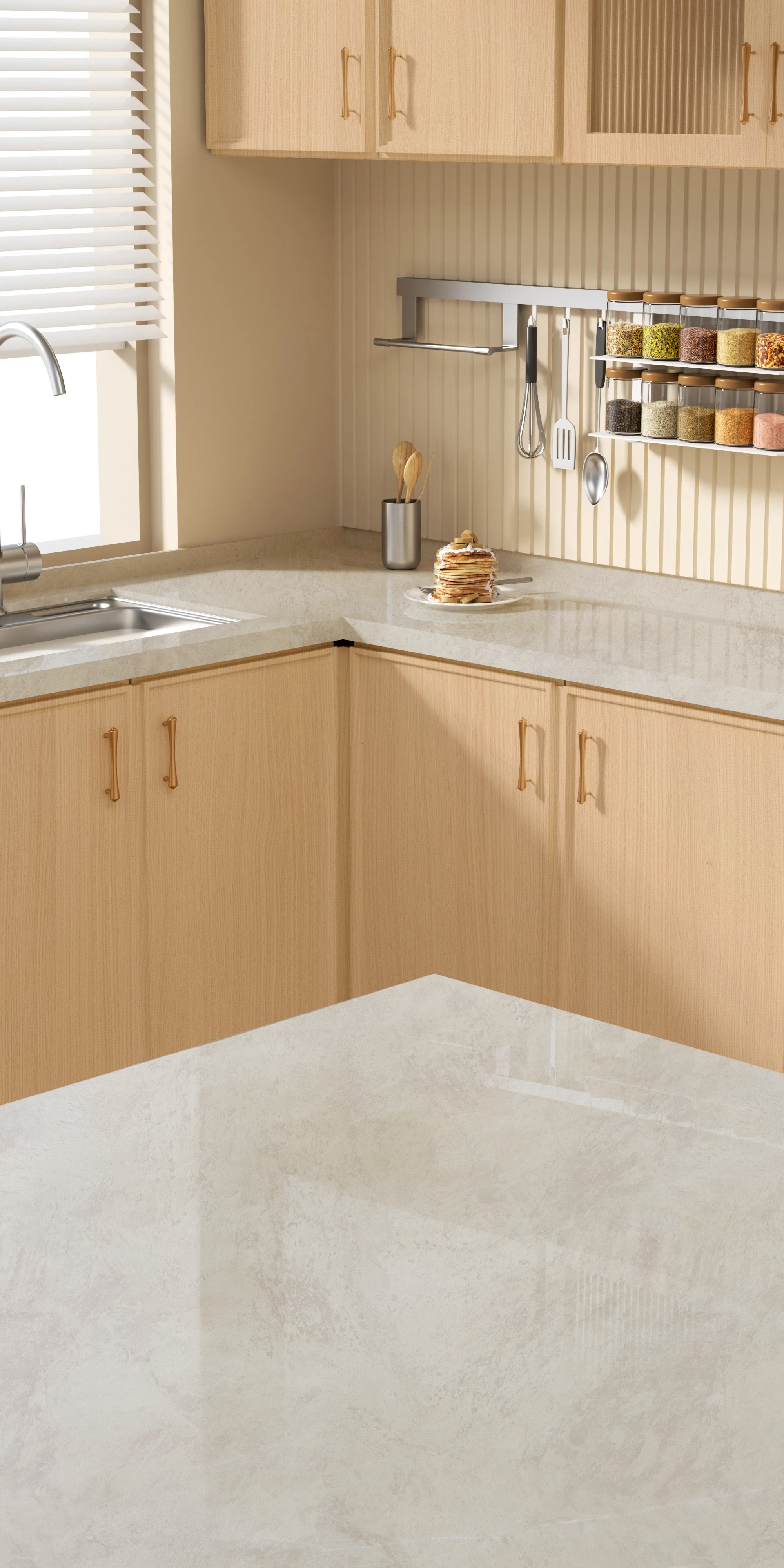
For cabinet carcass boxes, the structural interior that holds shelves and hardware, melamine faced MDF or melamine on Particle board is the dominant material in both trade and retail cabinet manufacturing. The melamine surface on the interior of the cabinet requires no painting after assembly, resists kitchen humidity better than bare MDF board, and cleans easily. Most flat pack kitchen cabinets from major manufacturers use Particle board carcasses with a white Melamine Board interior because the cost saving is significant at volume and the interior of a base cabinet is not subject to the same physical stress as the door or the countertop above it.
For kitchen cabinet doors, the comparison between Melamine vs MDF for kitchen cabinets becomes more nuanced. Lacquered MDF doors are the premium choice for painted kitchens because the MDF board core routes to a clean routed profile edge, sands perfectly smooth, and accepts multiple coats of lacquer without grain raising or surface inconsistency. Lacquered MDF kitchen doors typically cost 30 to 60 percent more than flat melamine doors of the same size but deliver a visual quality level that melamine lamination, with its fixed surface thickness, cannot match for complex profiles or high gloss finishes.
Melamine Board doors are flat or have only simple grooves and are available in hundreds of printed wood grain and solid color options that are completely stable, meaning they do not fade, peel, or need repainting over the life of the kitchen. They suit modern, handleless, or contemporary kitchen styles better than classic profiled door styles that require a router cut edge detail.
Is melamine stronger than MDF and Pros and cons of each material
Is melamine stronger than MDF? This question conflates surface hardness with structural strength, and the two are different properties. The melamine surface layer on a Melamine Board is significantly harder than bare MDF board and resists surface abrasion, scratching, and staining far better than any paint applied to MDF board. However, the structural strength of the panel, meaning its stiffness under load, its screw holding capacity, and its resistance to impact bending, comes entirely from the core material, not the surface. An MDF board core with a melamine face has the same structural strength as bare MDF board of the same thickness and density.
Pros and cons of MDF board
- Smooth face that paints to a flawless finish with primer and topcoat lacquer, ideal for Lacquered MDF cabinet doors and baseboards
- Routes cleanly in any direction without tearout, allowing decorative edge profiles that solid wood and Particle board cannot match
- Uniform density throughout the panel thickness means consistent machining and drilling results without hard knots or soft grain areas
- Heavier than Particle board at comparable thicknesses, which adds to shipping and handling costs and can make large furniture panels awkward to lift
- Absorbs water readily if uncoated edges or faces are exposed to moisture, swelling and losing structural integrity when wet
- Contains urea formaldehyde resin which contributes to indoor emissions if the board does not meet current Formaldehyde emission standards
Pros and cons of Melamine Board
- Surface is ready to use with no additional painting or finishing, saving fabrication time and material cost
- Scratch resistant and stain resistant surface performs well in kitchens, wardrobes, and office environments under everyday use
- Available in hundreds of colors and printed wood grain patterns through Custom color melamine paper for MDF lamination and standard catalog colors
- Cannot be routed to a decorative profile on the face without exposing the raw core beneath the thin surface layer
- Edges must be banded or sealed because the core below the melamine face remains vulnerable to moisture and physical damage
- Once chipped or damaged, the melamine surface cannot be touched up or repaired the way a painted MDF board surface can be sanded and repainted
Is melamine board waterproof and Does MDF board swell with water
Is melamine board waterproof? No, but the melamine surface is highly water resistant on the face. The fused melamine resin layer repels water and resists staining from household liquids, which is why Melamine Board is widely used in kitchen and bathroom cabinet interiors where cleaning with damp cloths is routine. However, the word waterproof overstates what the melamine surface does. Prolonged standing water on a Melamine Board surface, particularly near edges or at seams, will eventually find its way to the substrate core and cause swelling.
Does MDF board swell with water? Yes, and this is one of the most critical properties to understand when specifying MDF board for any application near moisture. Standard MDF board contains no inherent water resistance because the urea formaldehyde binder that holds the wood fibers together begins to break down when wet, and the fibers themselves absorb water readily. Standard MDF board can swell by 10 to 30 percent in thickness when fully saturated, and once this swelling occurs the board does not return to its original thickness when dried, making the damage permanent.
Moisture resistant MDF board, sometimes called MR MDF or green core MDF due to the green dye used to identify it on site, uses a higher proportion of resin and wax additives during manufacture to slow moisture absorption. It is not waterproof, but it tolerates the humidity levels found in kitchens and bathrooms well enough for cabinet carcass use provided edges are properly sealed with Edge banding and faces are either painted or melamine surfaced. For genuinely wet areas such as directly behind sinks or in steam rooms, neither standard MDF board nor standard Melamine Board on Particle board is the right specification regardless of moisture resistant grade claims.
Formaldehyde emission standards for MDF: What Buyers and Specifiers Need to Know
Formaldehyde emission standards for MDF are a practical purchasing consideration for anyone sourcing panels for residential interiors, children's furniture, or any enclosed space where occupants spend significant time. Urea formaldehyde resin is the binder used in most MDF board and Particle board production, and it off gases formaldehyde for months or years after the board is manufactured. The amount emitted depends on the resin formulation, the press conditions, and whether the panel surface has been sealed with a low permeability coating such as melamine lamination or lacquer.
| Standard | Region | Maximum Emission Limit | Notes |
|---|---|---|---|
| E0 | Europe and international | 0.03 ppm or below | Strictest standard, used in children's furniture |
| E1 | Europe and widely exported | 0.1 ppm or below | Standard residential interior requirement in EU |
| CARB P2 | United States (TSCA Title VI) | 0.11 ppm for composite wood | Required for all composite wood sold in USA |
| JIS F4 Star | Japan | 0.02 to 0.3 ppm by class | Four star rating is strictest |
When sourcing MDF board or melamine faced MDF for residential furniture, always request the Formaldehyde emission standards certification that applies in your market and confirm the specific test method used, since E1 by the European desiccator test and E1 by the chamber test are not the same result and some suppliers use the method that produces the more favorable number. Low formaldehyde or zero formaldehyde MDF board uses alternative binders such as melamine urea formaldehyde at modified ratios or polyurethane based adhesives to achieve E0 level emissions, and these grades command a price premium of approximately 15 to 30 percent over standard E1 board.
Best board for wardrobe closets melamine or MDF: A Practical Recommendation
Best board for wardrobe closets melamine or MDF is a question with a clear practical answer for most situations: Melamine MDF or melamine on Particle board wins for the interior carcass of wardrobe closets, while bare MDF board is the better choice only if the wardrobe doors or visible face panels will be spray painted to a high gloss or custom color finish.
For wardrobe interiors, the melamine surface requires no additional painting after assembly, resists the light moisture and humidity of a bedroom environment well, and cleans easily if clothing transfers dust or fabric residue onto shelves. A white or light wood grain Melamine Board interior is also visually brighter than a painted MDF board interior because the melamine surface reflects light more evenly than even a well painted surface in the enclosed space of a wardrobe. For the carcass box and fixed shelves of a wardrobe, 18 millimeter melamine faced MDF or 18 millimeter melamine on Particle board with a density of at least 600 kilograms per cubic meter is the most widely used specification in trade fitted wardrobe manufacturing.
For wardrobe sliding doors or hinged doors with a painted finish, MDF board is superior because it accepts primer and spray lacquer to produce a perfectly smooth, grain free surface that Particle board cannot match. A 9 to 12 millimeter MDF board door panel routed with a simple profile edge, primed with two coats of MDF primer, and sprayed with two coats of polyurethane lacquer produces a door face that is indistinguishable from a solid wood painted door at a fraction of the material cost.
How to cut melamine board without chipping: Practical Workshop Technique
How to cut melamine board without chipping is one of the most searched practical questions among joiners, cabinet makers, and DIY enthusiasts working with Melamine Board for the first time. The melamine surface is harder and more brittle than the MDF board or Particle board core beneath it, which means an aggressive saw blade tears through the surface layer rather than cutting it cleanly, leaving a ragged chipped edge that is immediately visible in the finished piece.
- Use a fine tooth saw blade specifically designed for laminated boards, typically a triple chip grind or alternate top bevel blade with 60 to 80 teeth on a 250 millimeter circular saw blade, as more teeth create smaller individual chip loads and leave a cleaner cut edge
- Score the cut line on the face side of the panel with a sharp utility knife before cutting, making a 1 to 2 millimeter deep scratch along the line that interrupts the surface layer and prevents it from tearing as the blade passes through
- Cut with the good face up on a table saw, since table saw blades rotate upward through the work and the chipping occurs on the top face where the blade exits, meaning the face up side stays clean
- Cut with the good face down on a jigsaw or circular saw, since handheld tools rotate upward through the cut on the bottom and exit through the top, reversing where the chipping occurs
- Run the blade at maximum speed and move the saw through the cut at a steady, moderate feed rate, since both a feed rate that is too fast and one that is too slow increase chipping compared to the optimal cutting speed
- Apply a strip of masking tape along the cut line as an alternative to scoring, which gives the surface layer support during the cut and can be peeled away cleanly afterward
A panel saw or beam saw in a professional workshop is the single most reliable solution to How to cut melamine board without chipping because the machine holds the panel completely flat and stable, uses a scoring blade that pre cuts the bottom face a fraction of a second before the main blade passes through, and controls feed rate precisely. For site work or one off cuts, the scoring knife plus fine tooth blade combination achieves close to the same result without workshop machinery.
Can you paint over melamine board and What Preparation Is Required
Can you paint over melamine board? Yes, but the result depends almost entirely on the preparation process rather than the paint itself. The melamine surface is a thermoset plastic that does not absorb paint by nature, so standard wall paint or untreated wood paint applied directly to Melamine Board will peel or flake within weeks of use because the paint has no mechanical grip on the smooth, non porous surface.
Successful painting over Melamine Board follows this sequence:
- Clean the surface with a degreaser to remove any wax, silicone, or handling contamination from the melamine face, since any residue will prevent adhesion even after sanding
- Scuff sand the entire melamine surface with 150 to 180 grit sandpaper to create a mechanical key, giving the primer something to grip rather than sitting on top of a glassy surface
- Apply a dedicated adhesion primer or bonding primer designed for glossy and non porous surfaces, which contains etching agents or special binders that key into the sanded melamine surface
- Apply two coats of a hard wearing topcoat such as a water based polyurethane or an oil modified enamel, sanding lightly between coats with 240 grit paper for the smoothest possible result
Can you paint over melamine board for a permanent result? Expect a functional but not perfect outcome. A well prepared and painted Melamine Board surface will hold paint for years in low contact areas such as wardrobe interiors or upper cabinet doors. In high contact areas such as kitchen drawer fronts and base cabinet doors, the paint over melamine is more likely to chip or wear at edges and corners within two to three years of daily use. For those applications, stripping back to bare MDF board and applying Lacquered MDF finishing is the more durable approach.
Lacquered MDF and Veneered board: Premium Surface Options for Furniture board Applications
Lacquered MDF and Veneered board represent the premium surface finish tier above standard Melamine Board, both using MDF board as their core substrate but delivering different visual and tactile outcomes.
Lacquered MDF is MDF board that has been sealed, primed, and spray finished with polyurethane or catalyzed lacquer to produce a high gloss, semi gloss, or matte painted surface. The manufacturing process involves multiple sanding and coating cycles, typically five to seven individual applications of sealer, primer, and topcoat, which is why Lacquered MDF panels and doors command a significant price premium over Melamine Board equivalents. The advantage is complete freedom of color choice within any RAL, NCS, or Pantone color system, extremely smooth surface quality with no texture from the substrate, and the ability to repair minor damage by sanding and recoating a localized area rather than replacing the entire panel.
Veneered board is MDF board or high quality Particle board surfaced with a thin slice of real wood veneer, typically 0.5 to 0.6 millimeters thick, bonded to the core under vacuum pressure. The veneer can be from any commercially available hardwood species, including oak, walnut, ash, maple, or cherry, and gives the Furniture board a genuine wood grain appearance and feel that printed Decorative paper on Melamine Board cannot replicate. Veneered board is stained, sealed, and lacquered after cutting and assembly, giving designers full control of the final wood tone within the limits of the veneer species chosen. Veneered board panels typically cost two to four times the price of equivalent Melamine Board panels and are used primarily in high end residential cabinetry, hotel and hospitality interiors, and executive office furniture where a genuine wood appearance justifies the cost difference.
Melamine laminated MDF sheets for office furniture: Specification and Selection
Melamine laminated MDF sheets for office furniture represent one of the highest volume applications of this panel category in commercial interiors. Office desks, storage units, partition screens, reception counters, meeting room tables, and built in shelving systems in commercial offices are built predominantly from Melamine laminated MDF sheets for office furniture because the combination of an MDF board core and melamine surface delivers the right balance of flatness, screw holding strength, surface durability, and consistent appearance across large installations where multiple panels must match in color and finish.
Key specifications to establish when ordering Melamine laminated MDF sheets for office furniture include board thickness (most commonly 18 or 25 millimeters for structural desk and shelving panels), surface finish type (matte and fine texture finishes are preferred in offices over high gloss because they resist fingerprints and reduce glare under office lighting), core density (higher density MDF board at 720 to 800 kilograms per cubic meter provides better screw holding for adjustable shelf pins and drawer slide fixings than standard 650 kilogram board), and formaldehyde emission grade (E0 or E1 certification is standard for any occupied office space, and CARB P2 compliance is required for US commercial interiors).
Edge banding specification is critical in Melamine laminated MDF sheets for office furniture because office furniture is subjected to daily contact and the edges of desks and shelves accumulate more wear than the horizontal faces. A 2 millimeter thick ABS Edge banding in a matching color, applied with polyurethane hot melt adhesive and trimmed flush, provides edge protection that lasts the full service life of the furniture without lifting or discoloring at the same rate as thinner PVC banding.
Custom color melamine paper for MDF lamination: How It Works and When to Use It
Custom color melamine paper for MDF lamination is a service offered by specialty laminate manufacturers and Decorative paper suppliers that allows furniture brands, office fit out contractors, and retail fixture designers to specify a panel color or texture that is not available in any standard catalog. Instead of choosing from the 50 to 200 standard options a panel supplier stocks, a Custom color melamine paper for MDF lamination order defines the exact color by RAL or Pantone reference, specifies the surface texture (smooth, fine grain, coarse grain, brushed, linen, and many others), and has the Decorative paper printed and impregnated with melamine resin to that specification before lamination onto the MDF board core.
Minimum order quantities for Custom color melamine paper for MDF lamination typically start at 500 to 1000 square meters of finished panel, which corresponds to a medium sized commercial project or a meaningful production run of branded furniture. Below this threshold, Lacquered MDF in the specified color is usually more practical because spray finishing can be dialed in to any color without a minimum run quantity. Above this threshold, Custom color melamine paper for MDF lamination delivers consistent color matching across the entire project, faster production cycle times compared to multi coat lacquering, and a surface that requires no curing time after assembly unlike freshly sprayed Lacquered MDF that needs several days before being safe from fingerprint marking.
Lead times for Custom color melamine paper for MDF lamination from order to delivered panel typically run 4 to 8 weeks, covering paper printing and impregnation, lamination onto the specified MDF board core, panel sanding and QC, and shipping. This lead time must be built into any project schedule that relies on a custom color specification, since standard catalog color panels ship from stock at most major suppliers within a few days.
Frequently Asked Questions
What is the difference between MDF and melamine?
What is the difference between MDF and melamine? MDF board is a substrate panel made from compressed wood fibers and resin. Melamine is a surface finish, a resin impregnated Decorative paper fused onto a substrate such as MDF board or Particle board under heat and pressure. Melamine MDF combines both: an MDF board core with a melamine surface on one or both faces. The two are not competing alternatives but complementary materials used together in most finished Furniture board products.
Is melamine stronger than MDF?
Is melamine stronger than MDF? The melamine surface is harder than bare MDF board and resists scratching and abrasion far better. Structural strength, meaning stiffness under load and screw holding capacity, comes from the core material. A Melamine Board with an MDF board core has the same structural performance as bare MDF board of the same thickness because the thin melamine surface layer adds negligible structural contribution.
Is melamine board waterproof?
Is melamine board waterproof? No. The melamine face is water resistant and repels normal cleaning and splashes well. However, Melamine Board is not waterproof and the core substrate, whether MDF board or Particle board, will swell and degrade if edges or unsealed faces are exposed to persistent moisture. Edge banding and proper sealing of all cut edges is essential in any kitchen or bathroom application.
Does MDF board swell with water?
Does MDF board swell with water? Yes, significantly. Standard MDF board can swell by 10 to 30 percent in thickness when fully saturated with water, and this swelling does not reverse when the board dries out. Moisture resistant MDF board reduces but does not eliminate this risk. Sealing all faces and edges with paint, melamine lamination, or edge banding is essential wherever MDF board will be used near moisture sources.
How is medium density fiberboard made?
how is medium density fiberboard made involves refining wood residues into individual fibers, drying them to an optimal moisture content, blending them with urea formaldehyde resin and wax, forming the blended fiber into a mat, and pressing that mat under heat at 160 to 200 degrees Celsius and high pressure until the resin cures and the mat densifies into a smooth, uniform panel. The pressed panels are then cooled, trimmed, and sanded to tight thickness tolerances.
Can you paint over melamine board?
Can you paint over melamine board? Yes, with proper preparation. The surface must be degreased, scuff sanded with 150 to 180 grit sandpaper, and primed with an adhesion primer before topcoats are applied. Without this preparation, paint will not bond to the smooth melamine surface and will peel within weeks. Even with proper preparation, painted Melamine Board in high contact areas will chip at edges faster than Lacquered MDF.
What are the Formaldehyde emission standards for MDF?
Formaldehyde emission standards for MDF include E0 at 0.03 ppm and below for the strictest applications, E1 at 0.1 ppm for standard European residential interiors, and CARB Phase 2 at 0.11 ppm for the US market. Always request the relevant certification from the supplier and confirm which test method was used, since different test methods produce different results for the same board.
How to cut melamine board without chipping?
How to cut melamine board without chipping: use a fine tooth triple chip grind blade with 60 to 80 teeth, score the cut line with a utility knife before cutting, and orient the panel with the good face up on a table saw or face down on a jigsaw. A panel saw with a pre scoring blade is the most reliable professional solution. Masking tape along the cut line is a practical alternative to scoring for site work with handheld tools.
What is the best board for wardrobe closets melamine or MDF?
Best board for wardrobe closets melamine or MDF: for the carcass, shelves, and interior of the wardrobe, 18 millimeter melamine faced MDF or melamine on quality Particle board is the standard professional choice because it requires no painting after assembly and resists everyday bedroom humidity well. For painted doors with a high quality finish, bare MDF board primed and lacquered is superior because it produces a smoother, more durable painted surface than any Particle board substrate can achieve.
What is the difference between melamine and MDF for kitchen cabinets?
Melamine vs MDF for kitchen cabinets: Melamine Board is the practical choice for cabinet carcass boxes where a durable, ready finished interior is needed at controlled cost, while Lacquered MDF is the superior choice for cabinet doors that will be spray painted to a custom or premium color. Many professional kitchen installations use Melamine Board carcasses with Lacquered MDF doors to get the best of both materials at a cost that is competitive with solid wood alternatives.