中文简体
中文简体





Previous Post
In the mass production of whole‑house customisation and office furniture, CNC (computer numerical control) machining efficiency directly determines delivery cycles and profit margins.
Excessive fluctuation in board density, insufficient internal bond, and unstable moisture content lead to “hidden losses” such as frequent tool wear, increased edge chipping rate, unstable suction cup hold, and edge banding detachment– the source of these problems is not the furniture factory workshop, but the batch‑to‑batch consistency of the substrate.
Tech: yakco technology
YAKCO Melamine Board Substrate provides a predictable process window for furniture factory CNC machining with three data points from its test report: density 0.72 g/cm³ (fluctuation ±0.02), moisture content 5.3% (fluctuation ±0.5%), and internal bond 0.37 MPa.
The following sections break down, from a processing perspective, how a stable substrate translates into faster feed rates, lower scrap rates, and fewer machine setup changes.
1.Density 0.72±0.02: A “stabiliser” for tool life and feed rate
Test data: Density 0.72 g/cm³ (national standard 0.60–0.90), batch‑to‑batch fluctuation controlled within ±0.02
In CNC machining, milling cutters and drill bits are extremely sensitive to changes in board density. When density suddenly increases, tool load increases, wear accelerates, and even chipping may occur. When density suddenly decreases, the board becomes locally loose, resulting in rough cut surfaces and edge fuzzing.
When the substrate density remains stable within the narrow window of 0.72±0.02 over the long term, furniture factories can:
Set fixed feed rates and spindle speeds– no need to re‑debug parameters for each batch.
Extend tool replacement cycles– stable density means constant cutting resistance, uniform tool wear, and no unexpected chipping due to density fluctuations.
Reduce suction cup air leakage– boards with uniform density have higher surface flatness, vacuum suction cups hold stably, and the board does not shift during processing.
Measured comparison: Furniture factories using YAKCO substrate report that tool life increases by about 20% in the same batch processing, and the number of machine stoppages for adjustments due to density fluctuations drops to nearly zero.
2.Moisture content 5.3%±0.5%: No brittleness in winter, no expansion in summer
Test data: Moisture content 5.3% (national standard 3.0%–13.0%), batch‑to‑batch fluctuation ±0.5%
When moisture content is too high, CNC machining produces sticky chips that block chip evacuation channels, and after hot‑melt adhesive edge banding, the board may later shrink and create “white lines”.
When moisture content is too low, the board becomes brittle, causing severe edge chipping during grooving and drilling.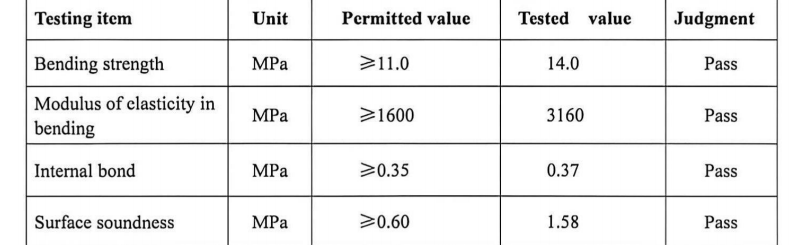
5.3% lies in the “low‑shrinkage‑swelling golden range”. During the northern heating season (extremely low ambient humidity), the board does not lose excessive moisture and become brittle, preventing edge chipping.
During the southern rainy season, the board does not absorb moisture and expand, preventing groove dimensions from going out of tolerance.
The extremely narrow fluctuation of ±0.5% means that for the same order produced across seasons, processing parameters do not need to be adjusted due to seasonal humidity changes.
Practical value for factories: Reduced edge chipping rework rate in winter, fewer edge banding failure complaints in summer, and no need to separate batches by moisture content for cross‑regional shipments (from East China to Northeast or South China).
3.Internal bond 0.37 MPa: No “fuzzing” when drilling or grooving
Test data: Internal bond 0.37 MPa (national standard ≥0.35 MPa)
In CNC machining, the edge quality of lock holes, hinge cup holes, through grooves, etc., directly reflects the internal bond strength of the substrate. Boards with insufficient internal bond show “fuzzing” on hole walls and edge powdering after drilling, leading to unstable screw torque and loose hinge installation.

0.37 MPa may seem only 0.02 MPa above the national standard, but this margin manifests in high‑speed machining as: smooth hole walls requiring no secondary trimming; pre‑installed nuts for three‑piece connectors do not rotate after installation; and the bottom of long grooves shows no delamination after cutting.
For high‑volume production factories, this 0.02 MPa means dozens fewer boards scrapped per batch due to machining defects.
4.The “spillover value” of narrow‑window control: Zero waiting during batch changeovers
YAKCO substrate compresses the batch‑to‑batch ranges of density, moisture content, and internal bond to an extremely small range.
For furniture factories, the most direct experience is: panels from different production dates use the same CNC program, the same edge banding temperature setting, and the same suction cup holding pressure – no adjustments needed.
In large‑scale engineering projects, thousands of decorative panels may arrive in 3‑5 batches. If the substrate indicators fluctuate widely, the factory must re‑cut, re‑adjust parameters, and re‑set edge banding temperatures for each batch, cumulatively wasting dozens of hours.
YAKCO’s narrow‑window control turns batch changeovers into seamless transitions.
5.Engineering validation: Comparative data from a custom furniture factory
A custom furniture factory in East China, producing 100,000 cabinet sets annually, switched to YAKCO substrate and recorded comparative data over a three‑month period:
Edge chipping rate: dropped from 1.2% to 0.3%.
Average monthly tool consumption: dropped from 45 to 36 (a 20% reduction).
Edge banding rework rate: complaints due to “white lines” from board shrinkage fell by 70%.
CNC machine setup time: dropped from about 8 hours per month to 1.5 hours.
The factory’s production manager commented: “We used to be most afraid that different batches of board would have different densities.
Now with YAKCO’s boards, we hardly need to adjust the program – just load and go.”
Conclusion: Substrate stability is the “hidden engine” of furniture factory efficiency
The value of YAKCO Melamine Board Substrate lies not only in the excellent numbers on the test report, but even more in the furniture factory workshop: fewer machine stoppages and adjustments, longer tool life, lower edge chipping scrap, and faster delivery cycles.
Density 0.72, moisture content 5.3, internal bond 0.37– these three data points are not laboratory academic parameters, but the “certainty” for every cutting pass on the CNC machine.
When furniture factory owners calculate annual losses, YAKCO’s narrow‑window substrate is gradually eliminating those “hidden losses” one by one.
YAKCO specialises in the R&D and manufacturing of Melamine Faced Board.
With a 50‑mu factory area and more than 30 pressing lines, and independent quality control across the entire chain from substrate to decorative surface, YAKCO provides a “stable processing, efficient output” substrate solution for furniture manufacturing enterprises.
Learn About Products: Melamine Faced Board