中文简体
中文简体





Previous Post
The logic of selecting decorative panels is undergoing a shift from "looking at the surface" to "looking at the foundation."
Colour, texture, and tactile feel – these surface characteristics are certainly important, but what truly determines whether a decorative panel lasts five years or fifteen years is the "skeleton" hidden beneath the decorative layer.
More:yakco technology
YAKCO Melamine Board Substrate, in the 2026 national test, delivered a set of data worth examining in depth: density 0.72 g/cm³, internal bond 0.36 MPa, bending strength 29.8 MPa, and modulus of elasticity in bending 4240 MPa.
The following sections break down the design logic behind these data points from a material engineering perspective.
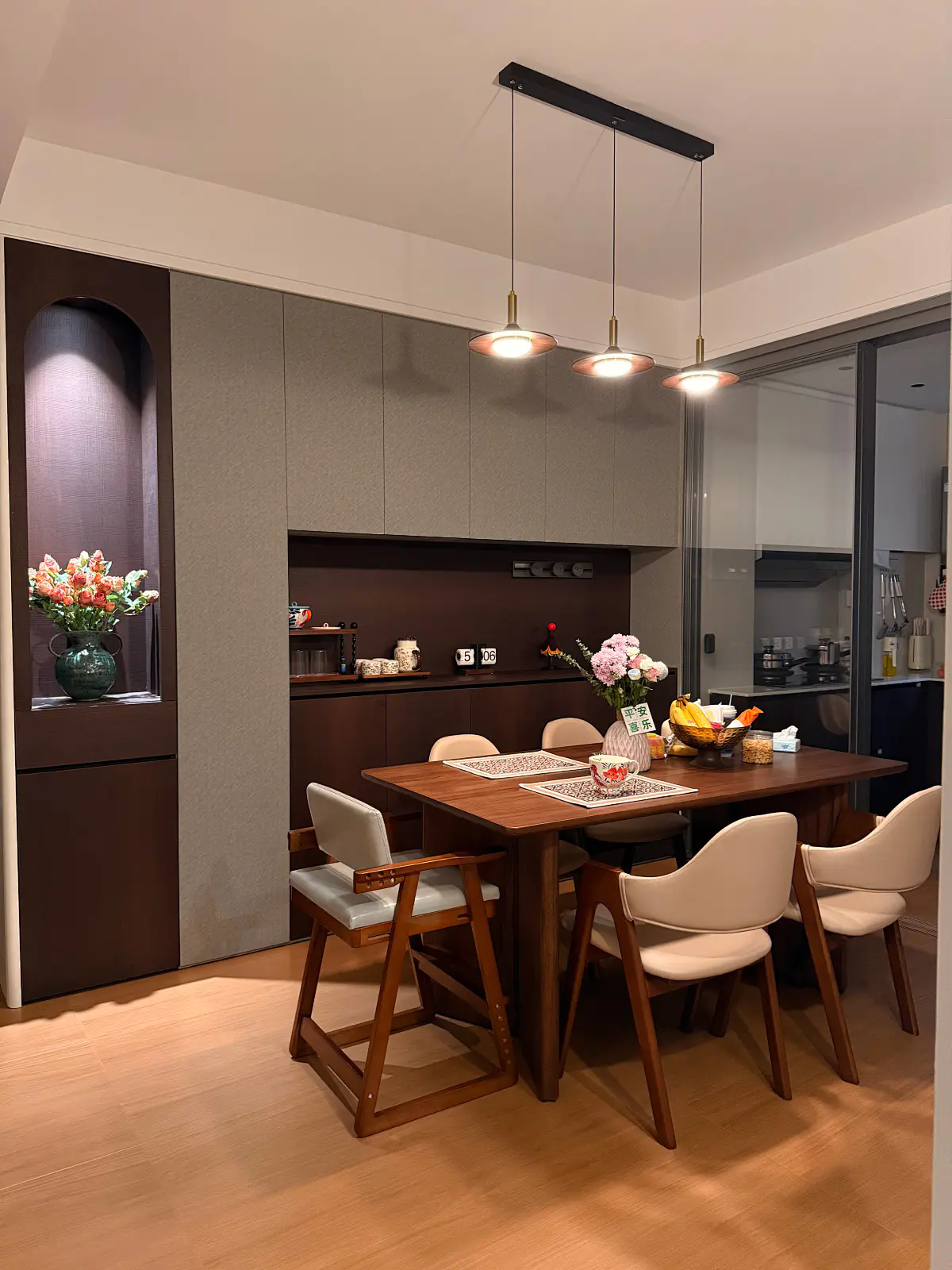
1.Density 0.72 g/cm³: Not a Trade‑Off Between "Light" and "Heavy", but a Pursuit of "Uniformity" and "Consistency"
The national standard requires particleboard density to be between 0.60 and 0.90 g/cm³ – a fairly wide range.
Within this range, panel density can vary from 0.60 to 0.90, a weight difference of up to 50%. But weight itself is not the core issue – the real problem lies in density uniformity.
If the substrate density is uneven, "soft spots" and "hard spots" appear within the mat. Soft spots have insufficient screw holding capability, while hard spots are prone to edge chipping during processing.
A more subtle effect is that substrates with uneven density have inconsistent stress distribution during hot pressing, making the decorative layer more susceptible to micro‑cracks or blistering due to local deformation over long‑term use.
YAKCO precisely controls density at 0.72 g/cm³ and locks it within a narrow window of 0.72±0.02. This value avoids both the looseness of low‑density panels and the processing brittleness and excessive weight of high‑density panels – for applications such as large‑area cabinet doors and long‑span shelves, this "golden density" of 0.72 means a balance between structural strength and processing efficiency.
2.Internal Bond 0.36 MPa: The Baseline for the Substrate "Not Falling Apart"
Internal bond measures the adhesion strength between the wood particles and the adhesive inside the substrate. The higher the value, the less likely the substrate is to "fall apart" from within.
The national standard requires ≥0.35 MPa, and YAKCO achieved 0.36 MPa.
While this appears to be only 0.01 MPa above the standard, this margin means in real‑world use: the substrate does not develop internal fibre separation or delamination during complex processing (grooving, drilling, long‑span load‑bearing).
More importantly, internal bond is the "foundation" for surface durability. In tests such as resistance to vapor and resistance to high‑low temperature cycle, if the substrate's internal bond is insufficient, the decorative layer can easily delaminate or blister under moisture or thermal shock.
0.36 MPa ensures that even under 100°C steam jet conditions, the decorative layer remains firmly "attached" to the substrate.
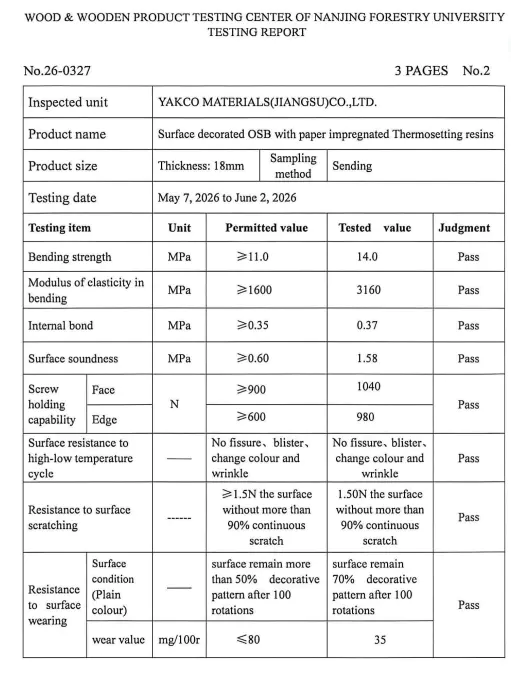
3.Bending Strength 29.8 MPa and Modulus of Elasticity in Bending 4240 MPa: The "Load‑Bearing Logic" for Long Spans
Bending strength reflects "how much weight the panel can take before breaking" – the national standard requires ≥11.0 MPa, and YAKCO achieved 29.8 MPa, 2.7 times the standard.
Modulus of elasticity in bending reflects "how much the panel deflects under load" – the national standard requires ≥1600 MPa, and YAKCO achieved 4240 MPa, 2.65 times the standard.
These two data points together answer the long‑standing question of furniture designers: "How long can I make it? How much can I cantilever?"
A bending strength of 29.8 MPa means: cantilevered desktops up to 2.4 metres, open shelves with no intermediate support, reception desks with hollow bases – these long‑span designs can be confidently realised without worrying about the panel breaking under heavy loads.
A modulus of elasticity of 4240 MPa means that even after years of continuous loading, the panel will not develop visible "sagging" or deflection – high rigidity keeps long shelves and tall cabinet doors straight under load, quickly returning to their original shape after stress is relieved.
4.The "Narrow‑Window" Control of the Substrate: The Watershed Between "Passing" and "Reproducible"
A single data point meeting the standard is just the passing line – what truly distinguishes industrial products from "samples" is batch‑to‑batch consistency.
YAKCO locks density at 0.72±0.02 and moisture content at 5.3±0.5, forming an "internal control narrow window" far tighter than the national standard.
The significance of the narrow window is: the mechanical properties, processing performance, and surface suitability of every batch of panels are highly reproducible.
For furniture factories undertaking large‑scale projects, this means CNC machining parameters can be set once without the need for re‑adjustment for each batch; the screw torque for hinges and handles can be standardised, avoiding on‑site rework caused by "this batch tightens well, the next batch strips."
5.Conclusion: The "Skeleton" of a Decorative Panel Determines How Far It Can Go
The lifespan of a decorative panel may appear to be "supported" by its colour and tactile feel on the surface, but it is actually the substrate that provides the "skeleton."
Density 0.72 ensures structural uniformity, internal bond 0.36 ensures internal compactness, and bending strength 29.8 MPa and modulus of elasticity in bending 4240 MPa ensure that long spans do not break or sag – these data points together form one thing: the "skeleton" of a decorative panel determines how far it can go.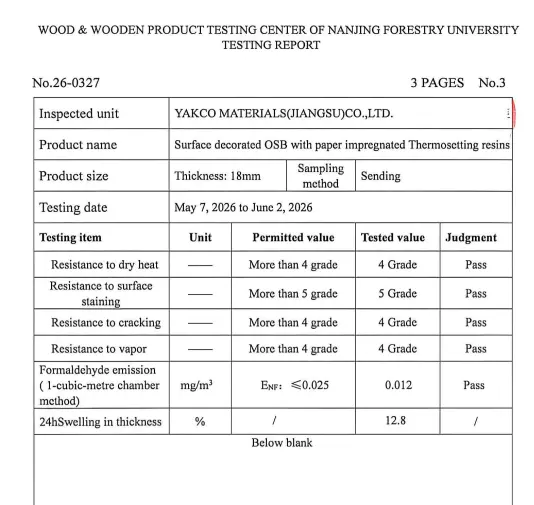
The value proposition of YAKCO Melamine Board Substrate is clear: not pursuing the peak limit in the laboratory, but ensuring that every panel on the production line falls stably within the narrow window.
When a designer says, "I want to do long‑span designs," YAKCO answers the unspoken question with data: "The skeleton is strong enough – go ahead."
More about Product:Premium Melamine Board