中文简体
中文简体





Previous Post
The Art Deco style is renowned for geometric symmetry, metallic accents, bold colours, and luxurious texture. In furniture and interior design, Art Deco Melamine Board recreates this classic aesthetic through crisp line divisions, colour-blocking contrasts, and refined surface finishes.
However, behind a seemingly lightweight geometric colour-block panel lie multiple physical and surface performance data points that ensure those sharp straight lines, clean colour fields, and delicate tactile qualities remain pristine through daily wear and tear.
More:yakco technology
Resistance to Cracking: The "Boundary Defence Line" of Geometric Lines
Art Deco emphasises the precision of straight lines and geometric blocks – any micro-crack at the borders would directly disrupt the sense of order in the design.
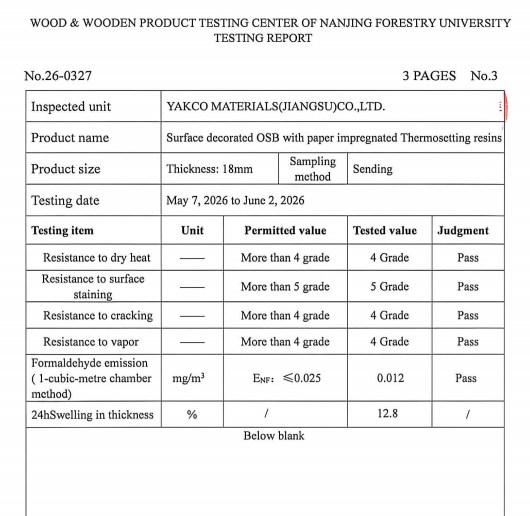
The standard requires resistance to cracking ≥ Grade 4, and the test result was Grade 4 (Pass).
This means that under alternating dry-wet conditions or temperature changes, no visible cracks will appear at colour-block junctions or embossed line edges, ensuring every line maintains its initial clarity and sharpness.
Surface Resistance to High-Low Temperature Cycles: The "Seasonal Stabiliser" for Colour and Geometry
Another hallmark of Art Deco is striking colour contrasts – such as black-gold, dark green with brass tones. Colour stability is paramount.
The high-low temperature cycle test requires no fissures, blistering, colour change, or wrinkling, and the results fully complied.
Whether panels are transported from dry, cold northern warehouses to humid southern workshops, or installed in homes with four distinct seasons, colour blocks will not shift at their boundaries or wrinkle due to differential expansion, and colour saturation remains constant.
Resistance to Surface Staining: The "Self-Cleaning Power" of Colour-Blocked Surfaces
Art Deco panels are often used on entryway cabinets, sideboards, feature walls, and other areas prone to fingerprints, beverages, and food residue.
The stain resistance test achieved Grade 5 (Full score), demonstrating excellent resistance to everyday stains such as coffee, red wine, soy sauce, and tea.
Cleaning does not require strong chemicals – a damp cloth restores the surface, preventing localised fading or uneven gloss caused by improper cleaning – particularly important for colour-blocked panels.
Resistance to Scratching and Wearing: The "Daily Guardian" of Refined Surfaces
The refinement of Art Deco panels comes from a delicate surface finish and uniform sheen. Scratches and wear are the biggest enemies.
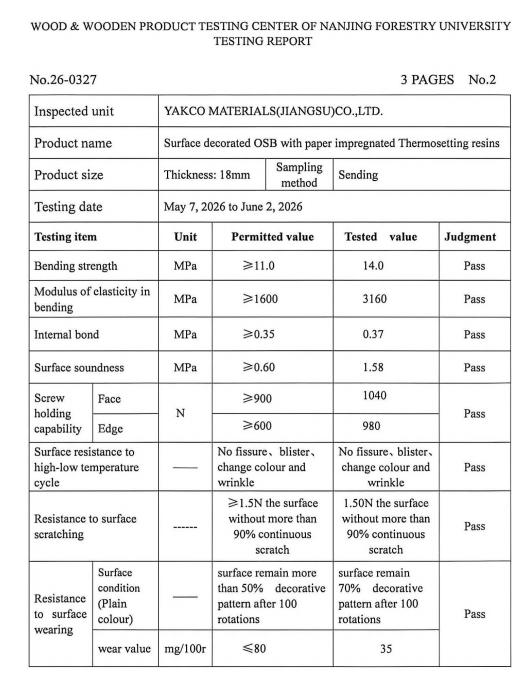
The scratch resistance test showed no continuous scratch exceeding 90% at 1.5 N – result Pass. The wear test retained 70% of the pattern after 100 rotations (standard ≥50%), with a wear value of 35 mg/100r (standard ≤80 mg/100r).
Both indicators significantly exceed the standard, ensuring that even on frequently touched cabinet doors and countertops, the geometric patterns and gloss texture remain intact.
Surface Soundness: The "Never Separate" Bond Between the Colour-Blocked Decorative Layer and Substrate
The colour-blocking process for Art Deco panels often involves splicing or overprinting multiple decorative papers.
If bonding strength is insufficient, the junctions between colour blocks are highly prone to blistering or edge curling.
Surface soundness tested at 1.58 MPa – 2.6 times the standard value (≥0.60 MPa). This exceptional adhesion ensures the integrity of colour-blocked areas; regardless of environmental changes, different colour blocks remain tightly bonded to the substrate with no sign of delamination.
Internal Bond and Substrate Density: The "Invisible Support" of the Substrate
The uniformity of the substrate determines the processing performance of Art Deco panels during cutting, grooving, and edge-banding.
The internal bond strength of 0.37 MPa (standard ≥0.35 MPa) ensures that internal layers do not separate. The density of 0.72 g/cm³ falls in the upper-middle range of the national standard, offering both sufficient compactness and moderate weight.
Uniform density ensures that every batch of Art Deco panels machines consistently and delivers exceptional flatness after installation, perfectly presenting the precision of geometric design.
Conclusion
While the aesthetic value of Art Deco Melamine Board undeniably lies in its signature geometric lines and colour contrasts, it is the less visible performance data that truly makes this design "enduringly fresh."
Resistance to cracking, high-low temperature cycles, staining, scratching, wear – combined with high surface soundness and a premium substrate – every data point is a protection of the designer's creativity and a commitment to the user's long-term experience.
When choosing Art Deco panels, remember: true artistic sophistication stands the test of daily life.