中文简体
中文简体






Previous Post
Wood has always been one of the most influential materials in furniture and interior design. Its grain, depth, tonal variation, and tactile warmth can create a sense of natural character that few other materials can match. However, modern furniture manufacturing requires more than visual appeal. Designers, manufacturers, and international buyers increasingly need decorative surfaces that combine realistic wood aesthetics with consistency, durability, processing efficiency, and reliable quality.
This is where YAKCO Wood Design Melamine Board offers a practical surface solution.
By combining wood-inspired decorative designs with three-dimensional embossing technology, YAKCO develops boards that go beyond flat printed wood patterns. The surface is designed to bring visual grain together with physical texture, creating a more authentic wood-like experience for contemporary furniture, cabinetry, wall applications, and interior spaces.
From Printed Wood Grain to Tactile Wood Design
Traditional wood-look decorative boards mainly rely on printed patterns to reproduce the appearance of natural timber. While modern printing technology can achieve highly detailed grain images, a completely flat surface can still feel visually different from real wood.
Natural wood is not only seen; it is experienced through touch.
The grain has ridges, pores, growth patterns, and variations in surface depth. YAKCO Wood Design Melamine Board approaches this challenge by integrating decorative wood patterns with embossed surface structures. The combination allows the grain design and surface relief to work together, giving the board a stronger visual and tactile identity.
This is particularly important for furniture and interior projects where surfaces are viewed and touched at close range. Cabinet doors, wardrobe fronts, furniture panels, wall decoration, and other visible surfaces can benefit from a more dimensional material expression.
Rather than simply imitating the image of wood, the design direction is to reproduce more of the visual rhythm and tactile character associated with natural wood.
Deep Embossing Creates Greater Surface Definition
One of the key characteristics of YAKCO Wood Design Melamine Board is its emphasis on three-dimensional surface texture.
Deep embossing gives the decorative layer a stronger relief than conventional flat-finish melamine boards. Depending on the design, the embossed structure can emphasize long wood grains, saw-cut effects, corrugated lines, rustic textures, or more refined linear patterns.
The result is a surface with greater light-and-shadow variation.
Under natural or artificial lighting, the raised and recessed areas interact with light differently, making the wood pattern appear more dimensional. This can be especially effective in large furniture surfaces, where a flat decorative print may otherwise appear repetitive.
The tactile dimension also adds another layer to the design. Instead of seeing a wood texture and feeling a smooth board, users can directly perceive the surface structure through touch.
For furniture designers, this creates more possibilities for developing surfaces that communicate a clear material identity without relying exclusively on natural solid wood.
Wood Aesthetics with the Consistency of Engineered Boards
Natural wood is valued for its individuality, but that individuality can also create manufacturing challenges. Timber can vary in color, grain direction, knots, moisture content, and structural characteristics from piece to piece.
For large-scale furniture production and cross-border supply, consistency is often equally important as appearance.
Melamine-faced engineered boards provide a more controlled substrate and decorative surface system. This makes them suitable for manufacturers who need repeatable dimensions, coordinated decorative effects, and predictable processing performance.
YAKCO Wood Design Melamine Board can be produced on engineered board substrates such as MDF, particle board, and OSB-based constructions, depending on project requirements.
This creates a balance between two priorities:
the natural visual language of wood and the manufacturing consistency of engineered board materials.
For furniture factories and interior manufacturers, this can simplify material selection while still allowing them to build products around wood-inspired aesthetics.
Surface Performance Matters in Real Furniture Applications
For decorative boards, appearance is only one part of the material equation. A surface must also withstand the practical conditions encountered during manufacturing, transportation, installation, and daily use.
The YAKCO test report No. 25-0494 provides an independent reference for the mechanical and surface performance of an 18 mm surface-decorated particleboard sample. The report was issued by the Wood & Wooden Product Testing Center of Nanjing Forestry University and the Wood-Based Panel Quality Inspection and Testing Center of the National Forestry and Grassland Administration (Nanjing). The testing was conducted according to GB/T 15102-2017.
The tested sample recorded a bending strength of 29.8 MPa, a modulus of elasticity in bending of 4,240 MPa, and an internal bond strength of 0.36 MPa. Its 2-hour thickness swelling was 1.0%, while the measured density was 0.72 g/cm³.
The same report also examined several surface-related properties. The sample achieved a scratch-resistance result of 1.50 N, while its abrasion test recorded a wear value of 57 mg/100r. The reported results were judged as Pass under the stated testing conditions.
Further surface tests recorded Grade 4 resistance to cigarette burns, Grade 5 dry-heat resistance, Grade 4 resistance to surface staining, Grade 5 cracking resistance, and Grade 5 vapor resistance.
These results provide useful technical reference points for evaluating the performance of YAKCO's surface-decorated particleboard construction.
Designed for Furniture and Interior Manufacturing
The appeal of wood design melamine board lies not only in its appearance but also in its flexibility across different applications.
In furniture manufacturing, wood-inspired embossed surfaces can be used for:
- Wardrobe and cabinet doors
- Kitchen and storage furniture
- Bedroom furniture
- Office furniture
- TV units and decorative furniture
- Wall-mounted furniture and feature surfaces
In interior projects, the same design language can be extended to wall decoration, retail spaces, hospitality interiors, commercial areas, and residential applications where a natural material atmosphere is desired.
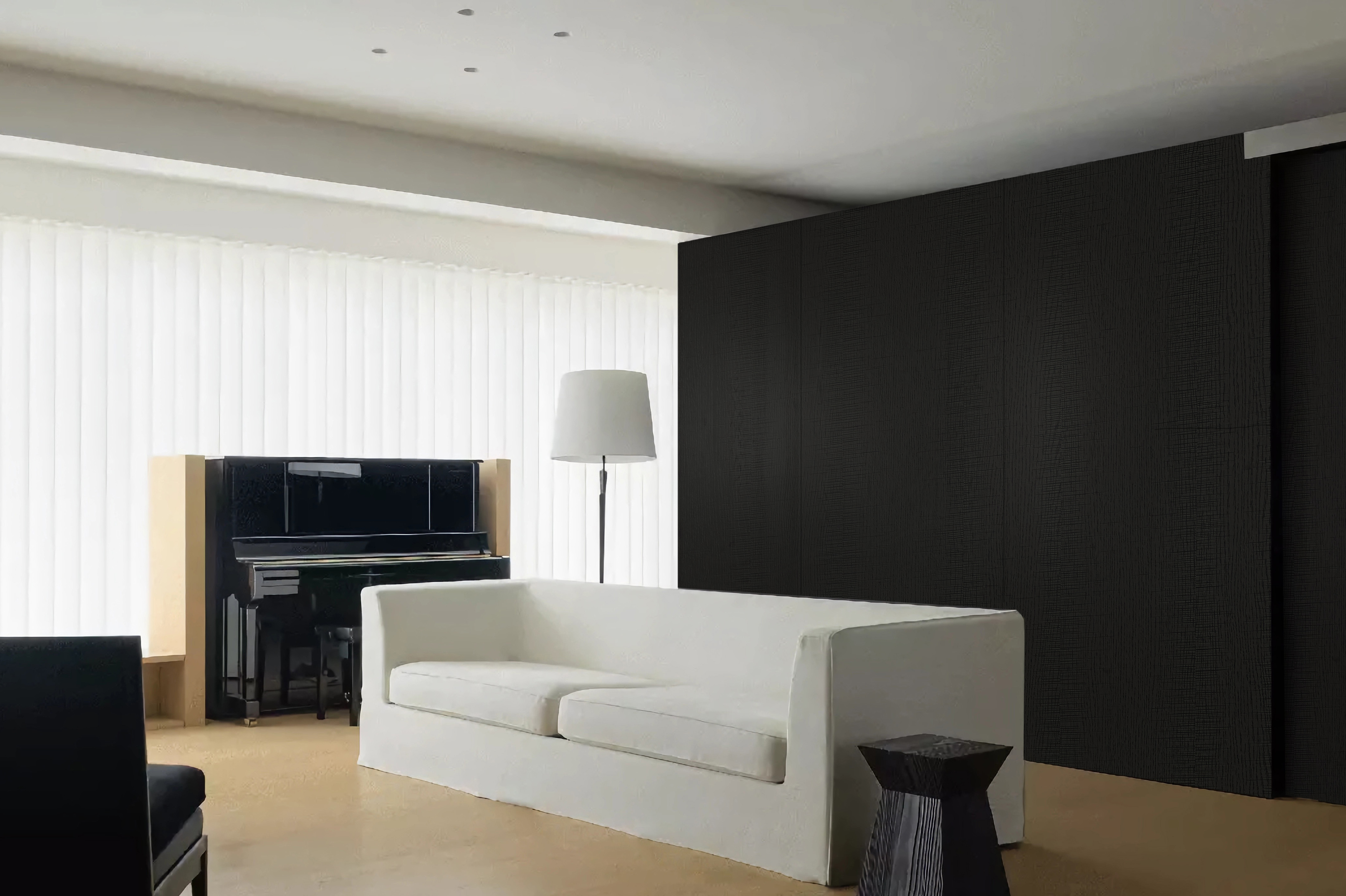
The embossed surface can also help designers create visual hierarchy. A deeply textured wood finish can become a feature surface, while smoother or more understated finishes can be used for surrounding elements. This allows furniture and interior concepts to combine different surface characters without moving completely away from a consistent material palette.
Wood Texture Is Becoming More Architectural
Contemporary wood design is no longer limited to reproducing conventional oak, walnut, or ash patterns.
Designers are increasingly experimenting with more architectural wood effects: linear grooves, saw-cut textures, irregular grain structures, aged surfaces, corrugated patterns, and other tactile interpretations of timber.
This evolution changes the role of decorative board.
The board is not simply a substitute for natural wood. It becomes a design medium in its own right, allowing manufacturers to create surfaces with stronger rhythm, depth, and visual structure.
This is particularly relevant to modern interiors, where material surfaces often need to contribute to the overall architectural expression of a space.
A deeply embossed wood design can visually connect furniture with flooring, wall elements, doors, or other architectural details, creating a more integrated interior language.
Balancing Natural Appearance and Industrial Efficiency
One of the continuing challenges in furniture design is balancing the emotional appeal of natural materials with the practical requirements of industrial production.
Real timber offers individuality, but sourcing, grading, machining, color consistency, and yield can introduce additional variables. Decorative engineered boards offer a more standardized manufacturing platform while providing designers with a wide range of visual possibilities.
YAKCO Wood Design Melamine Board sits within this intersection.
Its purpose is not simply to copy natural wood visually, but to combine wood-inspired aesthetics, tactile embossing, engineered-board consistency, and practical surface performance into a material suitable for contemporary manufacturing.
For B2B buyers, this means the material can be evaluated from both design and production perspectives: how the surface looks, how it feels, how it behaves in use, and how consistently it can be integrated into furniture and interior projects.
A Tactile Approach to Modern Wood Design
As furniture surfaces become increasingly expressive, texture is becoming as important as color and pattern.
A wood design that can be seen from a distance but also felt at close range creates a stronger material experience. Deep embossing adds physical depth to the decorative pattern, while the engineered-board structure supports repeatable production requirements.
That combination makes YAKCO Wood Design Melamine Board a relevant option for manufacturers and designers looking for a more dimensional interpretation of wood aesthetics.
The future of wood-look surfaces may not be about making engineered boards look exactly like timber.
It may be about taking the most recognizable qualities of natural wood—grain, depth, tactility, warmth, and visual rhythm—and translating them into a modern surface material designed for today's furniture and interior manufacturing.
YAKCO Wood Design Melamine Board is developed with this philosophy: bringing the depth and character of wood into a more consistent, versatile, and production-oriented decorative board solution.