中文简体
中文简体





Previous Post
In high‑end furniture and commercial space design, “long span” has always been the touchstone for testing the true quality of panels.
A 2.4‑metre cantilevered desktop, a 3‑metre open shelf with no intermediate support, a reception desk with a floating bottom– these design languages impose demanding requirements on panels: they must not only bear their own weight but also carry external loads such as books, equipment, and people leaning on them, while remaining non‑sagging, non‑bending and non‑vibrating over long‑term use.
More Details: yakco technology
YAKCO Melamine Board Substrate responds to this industrial challenge with two core data points from its test report: bending strength of 14.0 MPa and modulus of elasticity in bending of 3160 MPa.
The following sections interpret, from a material mechanics perspective, how the rigidity of the substrate provides designers with “long‑span freedom”.
1.Bending strength 14.0 MPa: A hard indicator of fracture resistance
Test item: Bending strength
National standard requirement: ≥11.0 MPa
YAKCO tested value: 14.0 MPa 
Bending strength is the maximum stress that a panel can withstand before its surface fibres reach the failure limit under gradually increasing bending force. The higher the value, the less likely the panel is to break.
14.0 MPa means that an 18mm thick YAKCO substrate panel, supported at both ends and loaded in the middle, can bear far higher loads than ordinary panels without breaking.
Specific applications:
1.Library cantilevered shelves: the shelf end has no vertical support and carries a full load of books
Yakco: substrate provides a higher safety margin
2.Commercial exhibition stand cantilevered tabletop: visitors lean on it, heavy objects are placed
Yakco: the panel edges do not break
3.Large‑span office desk: the weight of two computer towers plus a monitor
Yakco: the middle of the desk does not sag
Compared to ordinary particleboard (bending strength typically 11‑15 MPa), YAKCO’s 2.7 times higher value means designers can reduce support points and increase cantilever lengths, achieving a lighter structural language.
2.Modulus of elasticity in bending 3160 MPa: The confidence of bending rigidity
Test item: Modulus of elasticity in bending
National standard requirement: ≥1600 MPa
YAKCO tested value: 3160 MPa 
Modulus of elasticity in bending (bending modulus) reflects the panel’s ability to resist bending deformation, expressed in MPa. The higher the value, the “stiffer” the panel, and the smaller the deflection (sag) under load.
For long‑span design, bending strength answers “will it break?”, while bending modulus answers “will it bend?”. Both are indispensable.
A tested value of 3160 MPa means that on a 2.4‑metre long desktop, a central load of 80 kg (equivalent to an adult’s weight) produces an instantaneous deflection far lower than the national standard allowable value, and no permanent “sag” will appear after long‑term use.
Specific applications:
1.Open kitchen island (unsupported cantilever area): the countertop extends as a bar with no cabinets underneath
Yakco:high modulus of elasticity ensures it remains level after many years of use
2.Supermarket shelf panels: long‑span panels fully loaded with goods
Yakco:the middle does not sag, and merchandise is displayed neatly
3.Museum display stands: large‑area stands carrying precious artefacts, with a hollow bottom design
Yakco:extremely high panel rigidity is required
3.Density and internal bond: The “logistical support” for rigidity
The outstanding bending performance depends on the synergistic support of other substrate indicators:
1.Density 0.72 g/cm³ (national standard 0.60–0.90)– in the favourable middle range, uniformly distributed, ensuring no “soft spots” in the mat become stress concentration zones.
2.Internal bond 0.37 MPa (national standard ≥0.35 MPa – the substrate is compact; under long‑span load, it does not delaminate or loosen internally, and load transmission is continuous.
3.substrate deformation due to environmental humidity changes that could affect long‑term flatness.

4.Four “liberations” of long‑span design
Based on a bending strength of 14.0 MPa and a bending modulus of 3160 MPa, YAKCO substrate brings four dimensions of liberation to furniture and space design:
1.Fewer support points: a 2‑metre long table that originally required three support legs can now use only two, or even be cantilevered from one end.
2.Thinner shelf thickness: for the same span, thinner boards (e.g., 15mm instead of 18mm) can be used, achieving a lighter visual effect.
3.Strength retention after cut‑outs: after cutting socket holes or cable troughs in the desktop, the remaining cross‑sectional strength is still higher than that of a full section of ordinary board.
4.Long‑term maintenance‑free: high modulus means low creep– even after many years of heavy loading, the panel will show no visible sagging.
Typical application scenarios
1.Library cantilevered shelf-Shelf length 1.8m, no intermediate support, fully loaded with books
Yakco: Bending strength 14.0 MPa – ample fracture resistance margin
2.Executive office desk-Desktop length 2.4m, central load of computer + files
Yakco: Bending modulus 3160 MPa – no sagging
3.Commercial exhibition stand cantilevered tabletop-Fixed at one end, cantilever 1.2m, bearing exhibits
Yakco: High rigidity ensures the cantilever end does not droop
4.Open kitchen island-Countertop extends 1m as a bar with no lower support
Yakco: Long‑term use without deformation
5.Supermarket shelf panel-Length 1.5m, fully loaded with beverage cartons
Yakco: High bending modulus – shelf does not bend 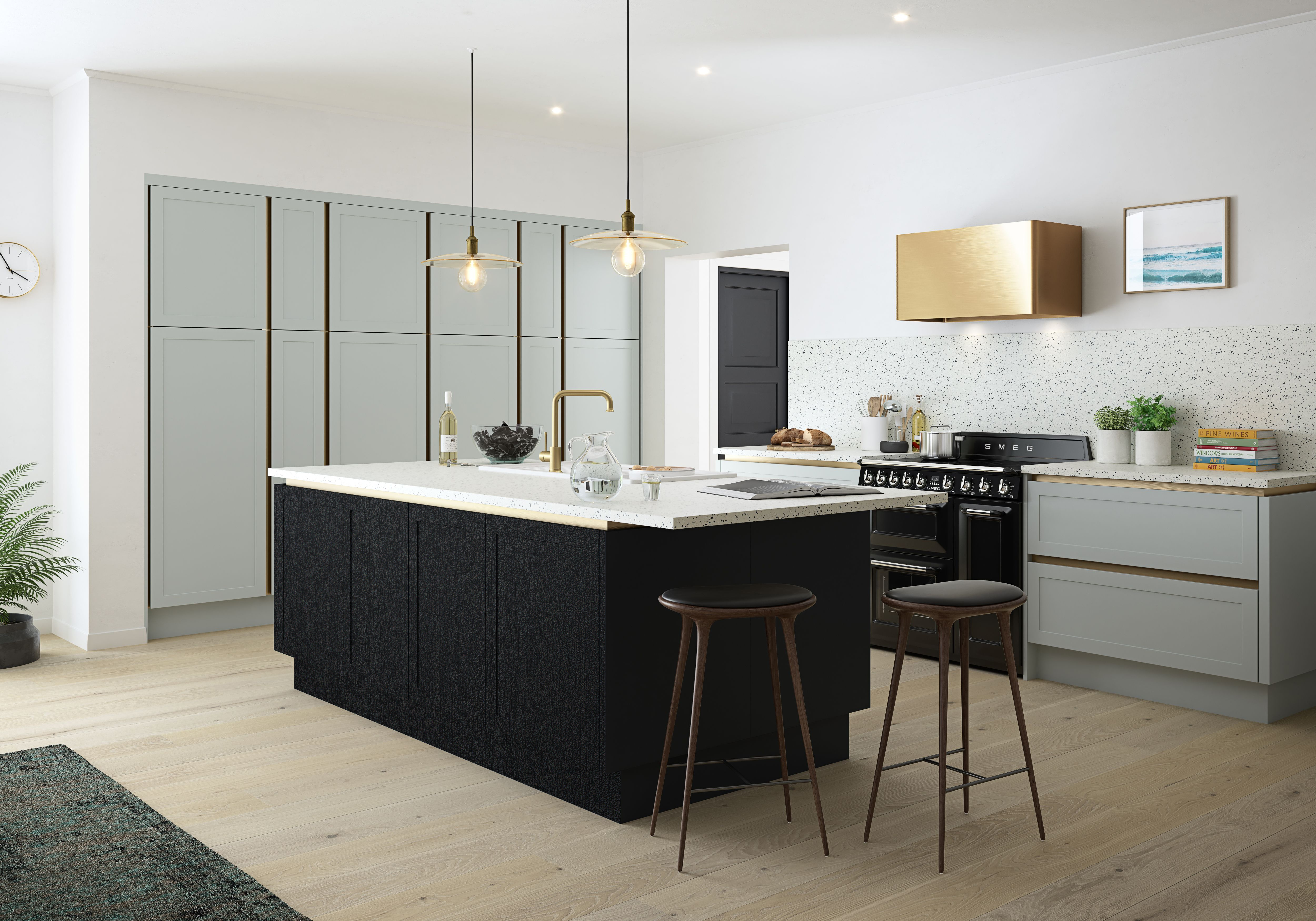
Conclusion: The confidence of long‑span design comes from the rigidity data of the substrate
YAKCO Melamine Board Substrate answers the long‑standing question of furniture designers – “How long can I make it? How much can I cantilever?” – with a bending strength of 14.0 MPa and a bending modulus of 3160 MPa.
These two data points are not laboratory peak boasts; they are the safety boundaries of long‑span structural design.
When designers want to achieve column‑free long countertops in commercial spaces or create unsupported floating desks in high‑end residences, YAKCO substrate provides industrial‑grade mechanical assurance.
The freer the design language, the more “conservatively” the substrate data must underpin it – this is the core value of YAKCO.
About Products: Premium Melamine Board