中文简体
中文简体






Previous Post
Art Deco is more than a historical style.
Since emerging in the early 20th century, Art Deco has established a highly recognizable visual language through geometric compositions, symmetrical proportions, stepped lines, metallic accents, and rich material contrasts. Even in contemporary interior design, it has never truly disappeared. Instead, it is returning to furniture, wall systems, cabinetry, and commercial spaces in a more refined and modern form.
For today's designers, the goal is not simply to reproduce traditional Art Deco. It is to transform its core principles—geometric order, proportion, layering, and material expression—into a surface design language suitable for contemporary manufacturing.
This is where Wholesale Art Deco Melamine Board Manufacturers and Art Deco Melamine Board Factory YAKCO Art Deco Melamine Board finds its value.
From Decorative Style to Surface Design Language
One of the defining characteristics of traditional Art Deco is its strong sense of geometric order.
Repeated lines, symmetrical compositions, and the interaction of rectangular and curved forms create visual rhythm. At the same time, contrasts between different materials add depth and sophistication to furniture and interiors.
In contemporary furniture design, this language is evolving.
Designers are no longer relying solely on elaborate ornamentation. Greater attention is being placed on:
proportion, lines, texture, tactility, and the way surfaces interact with light.
As a result, the value of a decorative board is also moving beyond simply providing color and pattern toward delivering a more complete surface experience.
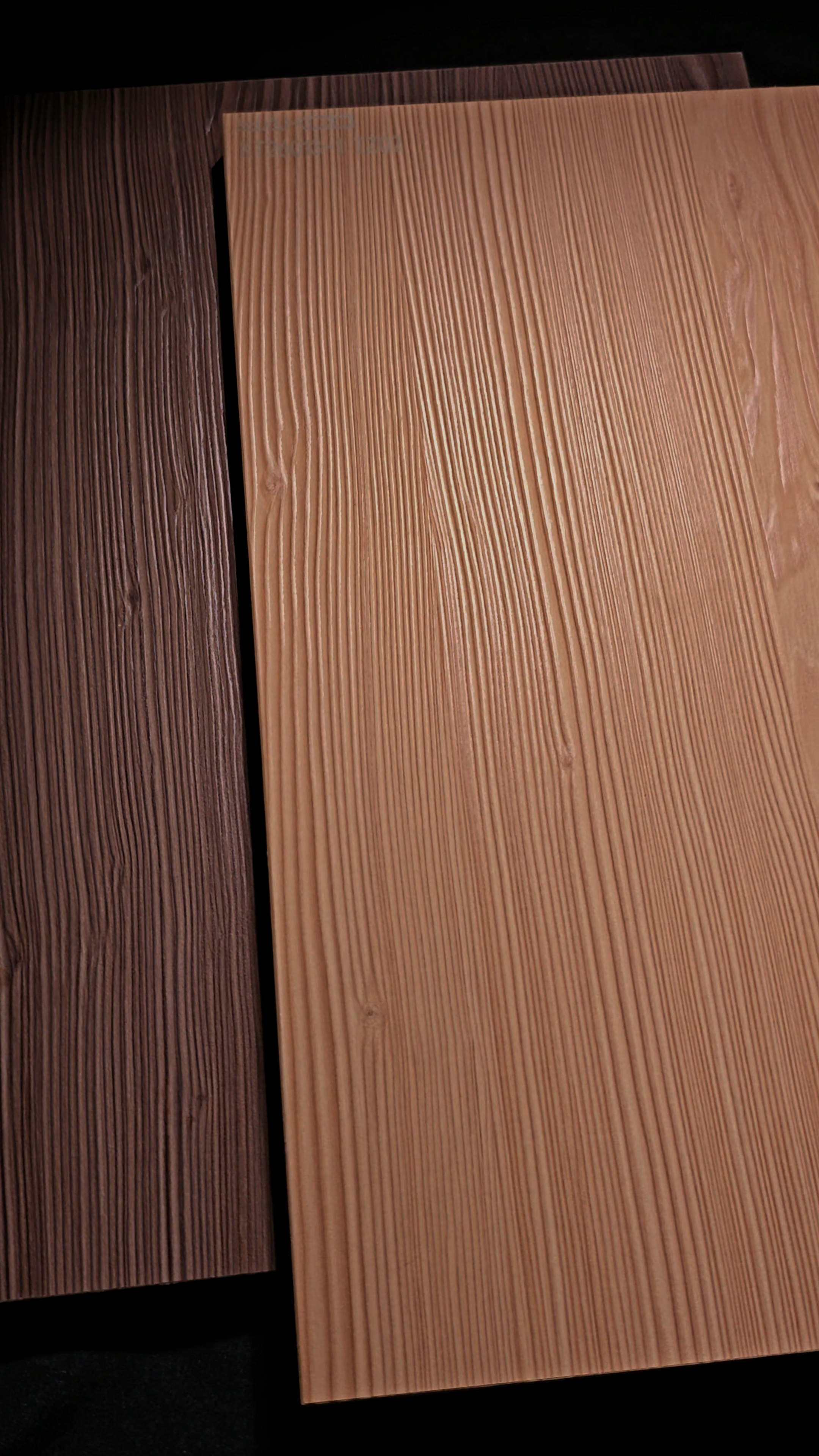
YAKCO Art Deco Melamine Board responds to this design direction by combining the geometric aesthetics of Art Deco with modern decorative surface materials, allowing this distinctive visual language to be integrated into standardized furniture and interior applications.
Geometric Aesthetics Require Consistent Surface Performance
Art Deco may appear visually simple, but it places demanding requirements on surface materials.
The stronger the emphasis on geometric proportions and precise lines, the more important it becomes for the decorative surface to deliver a stable and consistent visual effect.
Subtle changes in color, texture, and surface finish can directly influence the overall design result. In large-scale applications such as cabinet doors, wall panels, and furniture surfaces, consistency becomes essential to achieving a cohesive and refined aesthetic.
For this reason, an Art Deco decorative board should not only look convincing. It should also provide dependable surface performance to withstand furniture manufacturing, processing, and everyday use.
According to the YAKCO test report, an 18 mm surface-decorated particleboard sample was tested in accordance with GB/T 15102-2017, covering bending strength, modulus of elasticity in bending, internal bond strength, 2-hour thickness swelling, moisture content, density, screw holding capability, resistance to high-low temperature cycles, surface scratching, surface wearing, cigarette burns, dry heat, surface staining, cracking, and vapor. The tested items all received a passing judgment.
The tested 18 mm sample recorded a bending strength of 29.8 MPa, internal bond strength of 0.36 MPa, 2-hour thickness swelling of 1.0%, moisture content of 5.3%, and density of 0.72 g/cm³. In the surface wear test, the surface showed no show-through after 350 rotations, with a wear value of 57 mg/100r. The sample also passed the relevant tests for surface scratching and resistance to high-low temperature cycles.
For additional surface-resistance testing, the sample achieved Grade 4 for cigarette-burn resistance, Grade 5 for dry-heat resistance, Grade 4 for surface-staining resistance, Grade 5 for cracking resistance, and Grade 5 for vapor resistance.
These performance results are not intended to separate material performance from design. Rather, they provide a more reliable foundation for translating a distinctive design language into practical applications.
Modern Art Deco Is Not Simply Retro
A sophisticated Art Deco interior does not mean bringing every decorative element from the past into a contemporary space.
Today's design approach tends to simplify the language of Art Deco.
Complex patterns are translated into clearer geometric relationships.
Highly saturated colors are replaced by more restrained neutral palettes.
Traditional notions of luxury are expressed through texture, surface finish, and material contrast.
As a result, modern Art Deco is increasingly becoming a refined surface design language defined by structure and proportion.
Within this design logic, a decorative board is no longer simply the outer layer of a piece of furniture. It becomes an important medium connecting visual perception, tactile experience, and spatial structure.
YAKCO Art Deco Melamine Board can be applied to cabinet doors, wardrobes, kitchen cabinetry, TV walls, furniture panels, commercial display systems, hotels, and premium residential interiors, allowing the same design language to extend across multiple surfaces.
From Individual Furniture Pieces to Complete Interior Systems
One of the most compelling qualities of Art Deco is its ability to extend throughout a space.
A geometric texture can continue from cabinet doors onto wall surfaces.
A color palette can transition from furniture into surrounding architectural elements.
A distinctive surface texture can become a visual anchor for an entire interior.
This means the value of a decorative board is no longer limited to an individual furniture product. It is increasingly becoming a systematic design material capable of carrying a consistent visual identity across multiple applications.
For furniture brands and customized furniture manufacturers, this approach can help create more cohesive design concepts while also supporting standardized production and series-based product development.
Design Value Ultimately Comes Back to the Material Itself
Sophisticated design is never simply about adding more decorative elements.
A truly valuable surface must balance visual expression, tactility, durability, and manufacturing adaptability.
Art Deco provides the aesthetic language, while modern decorative surface technology determines whether that language can be consistently translated into real-world applications.
YAKCO Art Deco Melamine Board explores precisely this relationship:
using the geometric order of Art Deco to shape visual identity, modern surface technology to deliver material expression, and reliable performance to support long-term applications.
This means Art Deco no longer needs to remain a historical style that is simply reproduced.
It can become a contemporary method of surface design—
more restrained geometry,
richer material expression,
clearer structural relationships,
and a surface solution better suited to modern furniture manufacturing.
When timeless aesthetics meet contemporary material technology, Art Deco is no longer confined to the past.
It becomes a living surface language for today's furniture and interior design.