中文简体
中文简体




Previous Post
The value of wood texture boards lies in using industrial methods to replicate the visual language of natural wood–the texture of oak, the waves of walnut, the delicacy of cherry.
But wood texture differs fundamentally from leather texture and stone texture: wood texture has "direction."
More:yakco technology
Leather texture particles have no direction; stone texture mottling has no direction; but every wood texture line has a clear direction–from the head to the tail of the board, texture runs longitudinally, waves flow transversely.
This directionality is both the aesthetic core of wood texture and its "vulnerability."
When designers execute large‑area wood texture walls or long‑size wood texture cabinet doors, the problem they most fear is: the wood texture "goes off course."
On the same wall, the texture direction is inconsistent–some panels lean left, others lean right; on the same panel, the grain direction is not parallel, "turning a corner" from head to tail.
Visually, once the "directionality" of the wood texture is disrupted, the sense of order in the entire space collapses.
The following sections break down, from the perspective of wood texture directionality, how these three data points ensure the wood texture "does not go off course."
1.The "Enemy" of Wood TextureDirectionality: Substrate Deformation
The printing direction of wood texture is fixed at the factory.
But if the substrate deforms during use–expansion, contraction, warping– the wood texture printed on the decorative layer will "deform" accordingly.
The greater the substrate deformation, the more noticeable the deviation of the wood texture direction.
Substrate deformation mainly comes from three causes:
Moisture absorption and expansion: the substrate changes in thickness and length after absorbing moisture.
Bending under load: large‑span shelves or door panels deflect under their own weight and loads.
Internal stress release: unstable bonding between internal layers of the substrate leads to warping over time.
YAKCO's three data points correspond to these three issues.
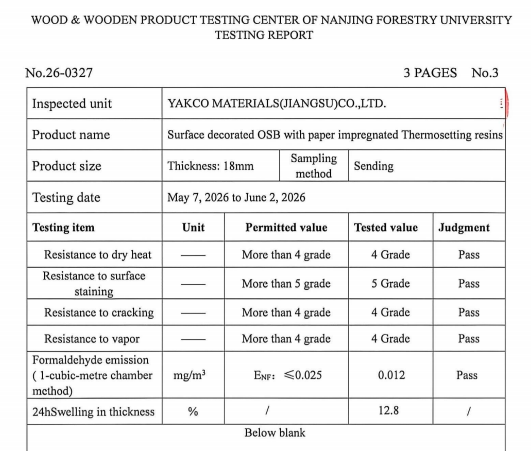
2.24h Swelling in Thickness: Wood Texture"does not distort"
The printing direction of wood texture is longitudinal.
If the substrate expands unevenly in the width direction due to moisture absorption, the longitudinal lines of the wood texture will "distort"–originally straight texture becomes curved, originally parallel lines become non‑parallel.
YAKCO's 24h swelling in thickness is far lower than that of ordinary particleboard. Low swelling means that the substrate maintains dimensional stability under humidity changes, with no uneven expansion or contraction.
The longitudinal lines of the wood texture remain straight, with "direction consistent" from head to tail.
For wood texture cabinets in high‑humidity environments such as kitchens, bathrooms, and balconies, this data is especially important.
Moisture does not cause oak grain to "turn corners," nor walnut waves to "deform."
3.Modulus of Elasticity in Bending 3160 MPa: Wood Texture"does not deviate"
Large‑span cabinet doors or shelves undergo slight bending under their own weight and loads–not necessarily visible to the naked eye, but the longitudinal lines of the wood texture deviate slightly with the bending.
The wood texture in the middle of the door and at the bottom may differ by a few millimetres in direction.
This deviation is not noticeable on a single door, but on multiple side‑by‑side doors, the visual effect appears as "misaligned texture."
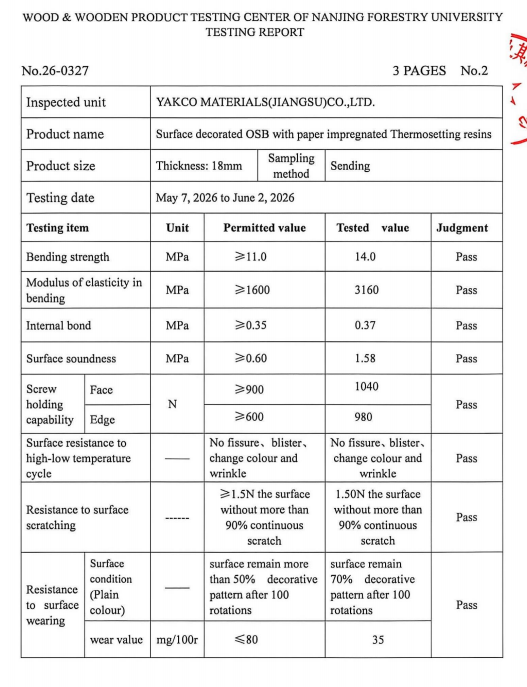
YAKCO achieved a modulus of elasticity in bending of 3160 MPa, while the national standard requires only 1600 MPa–nearly double.
High modulus means that the door bends minimally under its own weight, and the longitudinal lines of the wood texture remain parallel.
On multiple side‑by‑side doors, the texture direction is consistent, visually "neat and uniform."
4.Internal Bond 0.37 MPa: Wood Texture "does not arch"
If the bonding between the internal layers of the substrate is unstable, over time and with changes in temperature and humidity, the surface layer may develop slight "arching"–the plane of the wood grain becomes uneven, and the longitudinal lines develop slight fluctuations.
YAKCO achieved an internal bond of 0.37 MPa, higher than the national standard of 0.35 MPa.
The internal layers of the substrate are "held together tightly," without warping or arching over time.
The plane of the wood texture remains flat, and the longitudinal lines remain straight.
5.The Engineering Challenge of Large‑Area Wood Grain Applications: Consistency of Direction
The texture direction of a single wood texture panel is "correct."
When ten panels are joined together, the direction may "deviate slightly" on each.
The real engineering challenge is: how do you keep the direction consistent across dozens of wood grain panels in large‑area applications?
YAKCO's dimensional stability ensures that each panel maintains the same deformation amplitude under humidity changes, self‑weight loads, and the passage of time.
The wood texture direction on the first panel and the tenth panel always "aligns."
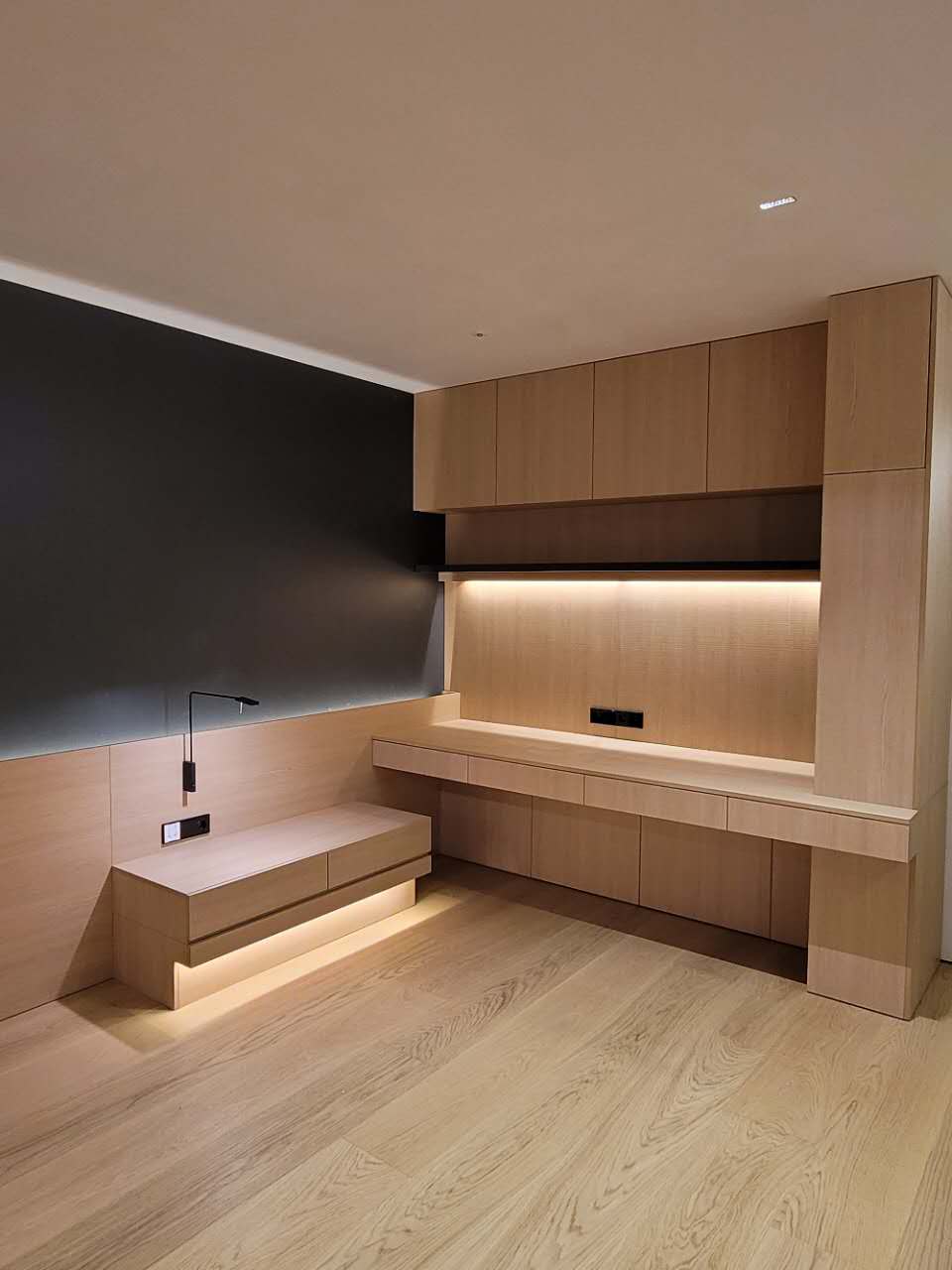
After large‑area wood texture walls are joined, the texture direction from head to tail is consistent–no panels "off course," no lines "turning corners."
For wood texture cabinet doors, high modulus of elasticity and low swelling ensure that the doors remain flat after years of use, with the wood grain direction unchanged.
On multiple side‑by‑side doors, the texture remains parallel, visually "uniform and orderly."
6.Conclusion: The "Directionality" of Wood Texture the External Manifestation of Substrate Stability
Designers choose wood texture boards for the "directionality" of natural wood–texture running longitudinally, waves flowing transversely, the direction of the texture defining the order of the space.
But this directionality cannot be guaranteed by printing precision alone–it requires the stability of the substrate to maintain.
When a designer says, "I want the texture direction of the large‑area wood texture wall to be consistent," YAKCO provides an answer with substrate stability–an answer that does not require choosing between "aesthetic effect" and "long‑term durability."