中文简体
中文简体





Previous Post
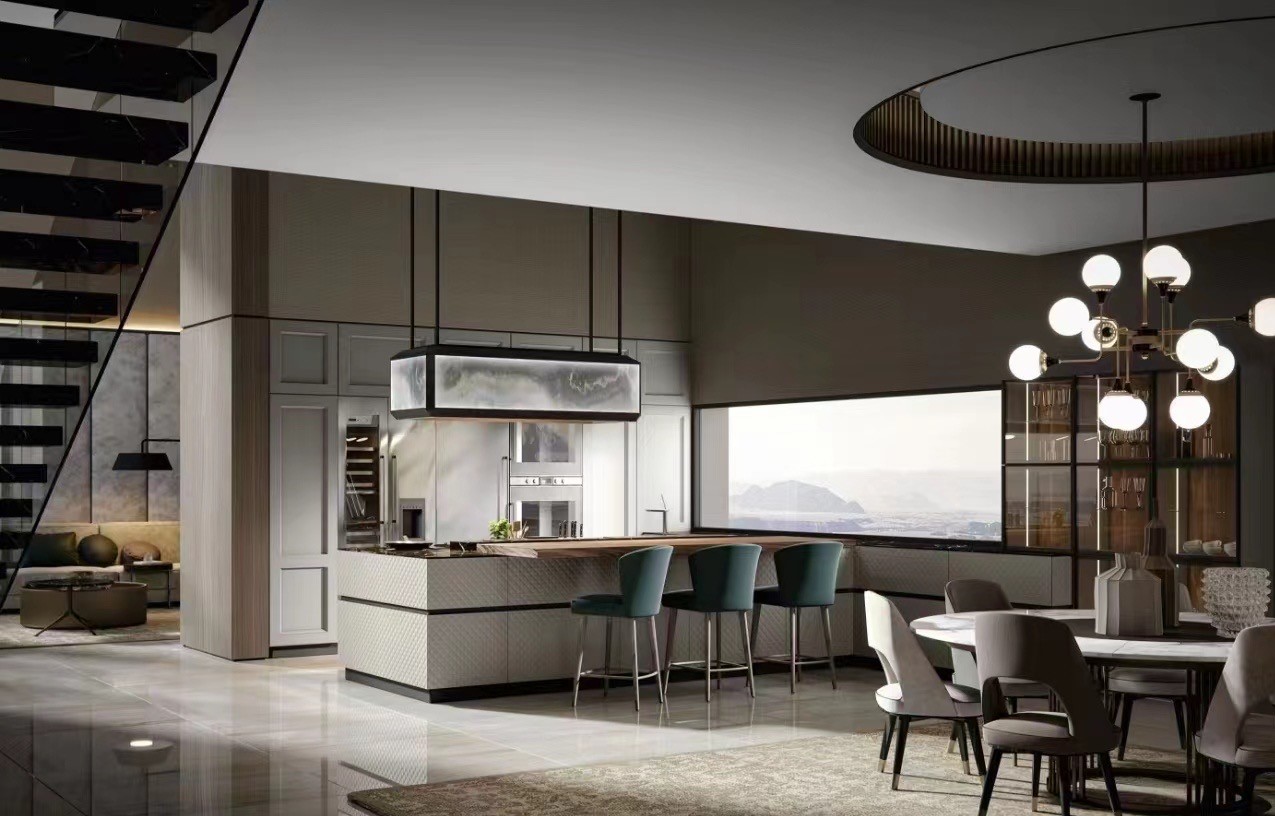
In 2026, Art Deco is returning under the name "Neo Deco" – not as a direct replica of the decorative language from a century ago, but as a more restrained, more modern re‑entry into spatial design.
Architectural Digest lists it as a designer‑approved trend of the year, and Pinterest Predicts paints a clear picture of "herringbone patterns and brass frameworks."
From the reopening of the Waldorf Astoria in New York to newly opened Art Deco hotels in Milan and Shanghai, geometric symmetry, metallic lines, and high‑contrast colour blocks are redefining the visual language of high‑end commercial spaces.
But when executing Neo Deco, designers face an increasingly obvious dilemma: there are too many "imitation geometry" panels on the market – they all look the same.Traditional wood grain, stone grain, and leather grain decorative panels have dominated the industry for years, and the sector is now entering a phase of intense homogenisation.
Spatial expressions are becoming increasingly similar, and pattern repetition is widespread. Furniture manufacturers and interior contractors are being forced into price competition, while the space for design innovation and brand premium continues to shrink.
More:yakco technology
YAKCO BZ02 Granules Texture Art Deco Melamine Board was launched precisely in this context. It is not a conventional decorative panel, but a design system that integrates original pattern copyright, 3D deep embossing technology, and Art Deco geometric language.
1.From "Texture Imitation" to "Geometry Creation" – A Fundamental Shift in Design Logic
The design logic of traditional decorative panels is "imitation" – imitating wood grain, imitating stone, imitating leather.
This imitation approach was effective in the early days of the industry, but today, wood grain, stone grain, and leather grain panels on the market are highly similar in appearance, making it difficult for consumers and designers to distinguish between different brands.
The design logic of the YAKCO BZ02 series is completely different. It does not imitate natural textures, but creates a geometric language.
The series is built on four geometric elements – straight lines, triangles, woven structures, and granular textures – to construct a modern Art Deco expression system.
Triangular grids, woven particles, and retro metallic textures – these geometric languages are not imitations of nature, but constructions of order.
The BZ02 granules texture is a representative example.
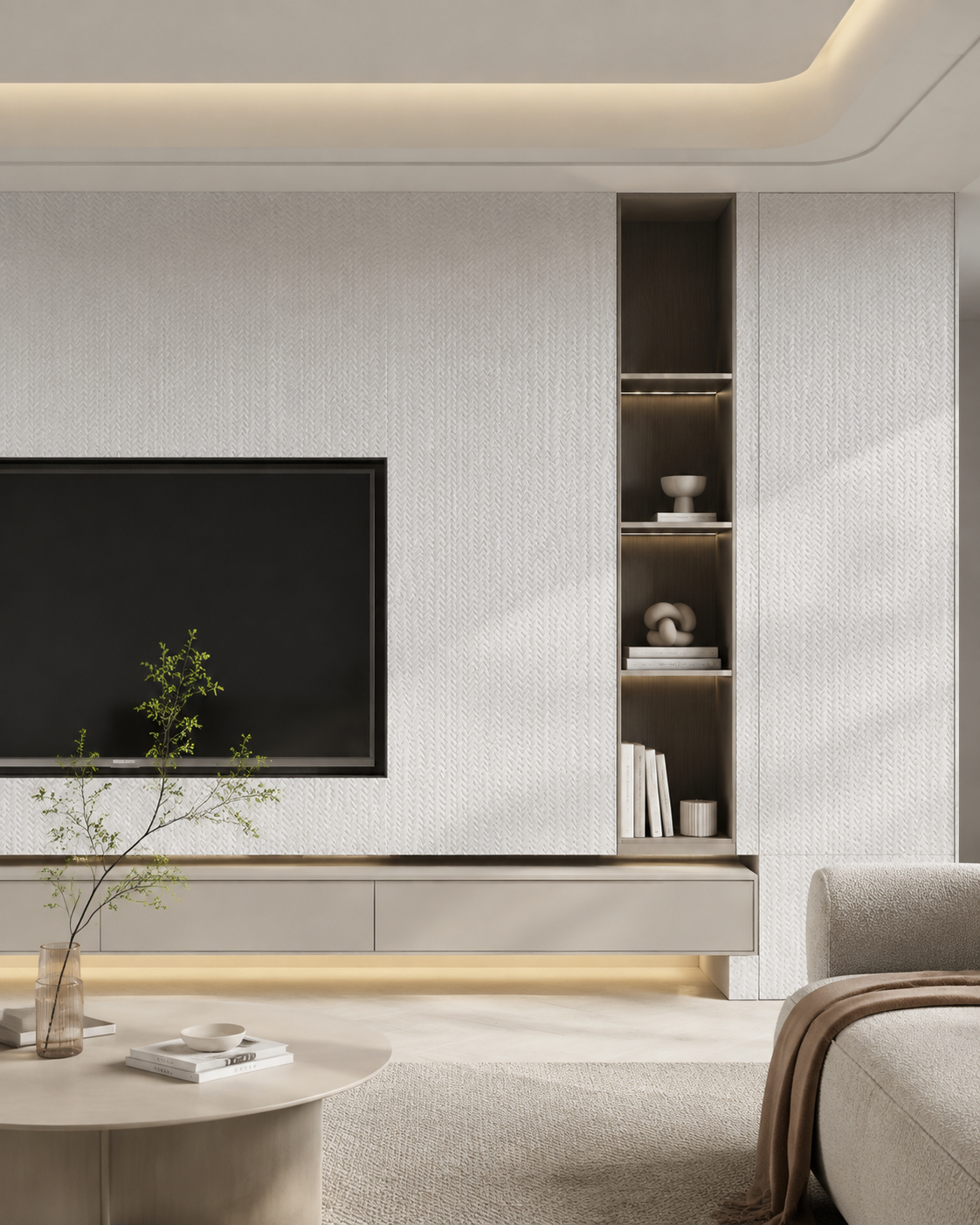
It is neither wood grain nor stone grain, but a fabric‑like granular texture– through carefully arranged particle structures and rhythmic surface organisation, it incorporates the sense of order inherent in Art Deco.
This texture does not rely on "resembling something" for recognition, but establishes its visual language through its own geometric order.
2.Original Copyright × 3D Deep Embossing: A Design Asset That Cannot Be Copied
In the traditional decorative panel industry, when a popular pattern appears, a flood of imitations – the same texture, the same colour, at lower prices – appears on the market within months.
Designers choose a unique pattern, only to find that six months later it has become "ubiquitous."
YAKCO BZ02 series addresses this problem with a dual barrier: original copyright registration + 3D deep embossing technology.
All designs in the YAKCO Art Deco series have been officially registered for copyright protection, legally preventing counterfeiting and homogenisation.
At the same time, based on the fully automatic short‑cycle pressing system developed through its own investment, YAKCO independently developed micron‑level 3D deep embossing technology, achieving a full three‑dimensional upgrade of the surface structure.
This is reflected in: custom‑designed geometric embossing steel plates enabling precise and controllable depth, creating layered and rich spatial light‑and‑shadow effects; digital printing precisely synchronised with embossed patterns, eliminating misalignment and visual inconsistency, removing the "veneered" feel; and a melamine integrated hot‑pressing structure that enhances surface durability, ensuring that the embossed texture remains clear and stable over the long term.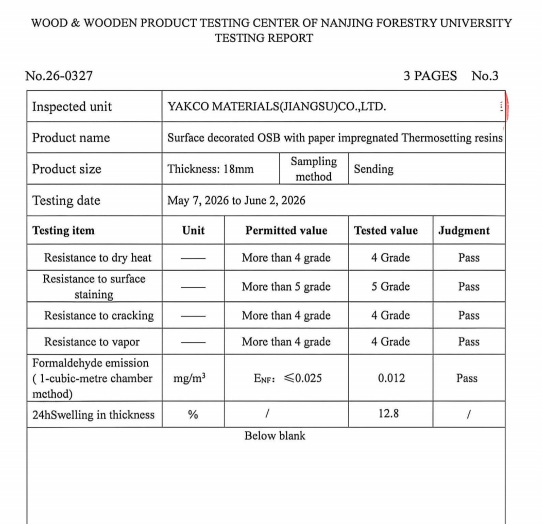
This means: even if someone copies the BZ02 pattern, they cannot replicate its tactile feel and light‑and‑shadow effects.
Original copyright protects the "pattern," while 3D deep embossing protects the "texture" – together, they form a complete "design moat."
3.Test Data: Behind the Design, the Substrate Provides the "Backbone"
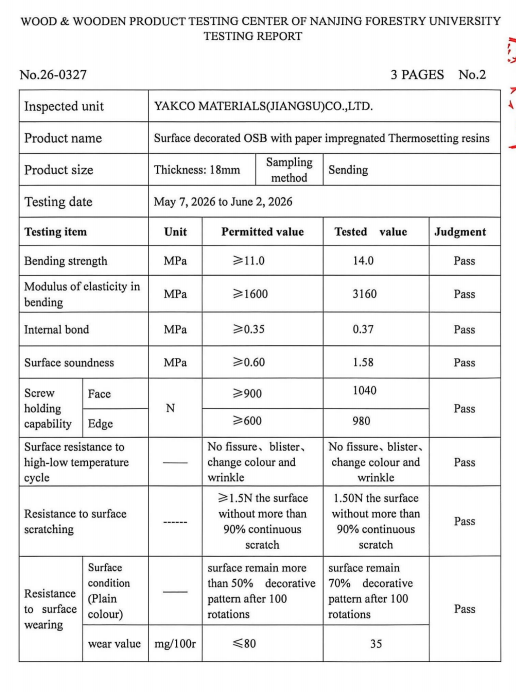
The design language of the BZ02 series is geometry, but the "durability" of geometry requires the substrate to guarantee it. The substrate of YAKCO Art Deco Melamine Board, in the 2026 national test, delivered a set of data worth noting:
Density 0.72 g/cm³– uniformly distributed, ensuring that large‑area geometric patterns are not distorted or deformed due to substrate density fluctuations.
For the BZ02 granules texture, uniform density means that every particle is embossed to the same depth, and the texture across the entire board is "consistent everywhere."
Surface soundness 1.58 MPa (2.6 times the national standard of 0.60 MPa) – ensuring that the decorative layer remains firmly anchored under thermal stress, moisture, and scratching. The edges of geometric lines are not "pulled" blurry, and the boundaries of granular textures do not "loosen" over time.
Internal bond 0.37 MPa (higher than the national standard of 0.35 MPa) – the internal layers of the substrate are "held together tightly," ensuring that the geometric embossing does not "deform" due to substrate deformation over long‑term use.
2h swelling in thickness 1.0%– only one‑eighth of the standard limit, ensuring that the BZ02 series maintains the integrity of its geometric patterns in humid environments such as kitchens, bathrooms, and balconies.
A stable substrate allows geometry to "stand firm."
4.Precise Matching of Geometric Language with Spatial Scenarios
The YAKCO Art Deco series establishes a complete product system, with each texture corresponding to specific spatial scenarios:
BZ02 Granules Texture– a fabric‑like granular surface, suitable for living room feature walls and full bedroom wall panels, creating a calm and refined atmosphere. The sense of order in the granular texture is in direct lineage with the geometric spirit of Art Deco.
ZZ25 Line Texture– a soft linear structure, suitable for corridor wall cladding and office space walls, creating a composed and restrained spatial character.
ZS31 Rhombus Texture– high‑contrast geometric relief, suitable for kitchen cabinetry, exhibition spaces, and lounge areas, enhancing spatial tension.
Each texture is an independent "design asset," rather than "just another option in the pattern library."
When a designer chooses the BZ02 granules texture, they are choosing a design language that is copyright‑protected, technologically defensible, and supported by test data.
5.Conclusion: The "Design Moat" of Art Deco Begins with Originality
The Neo Deco wave of 2026 is not merely a stylistic revival – it is an upgrade of design logic.
In today's highly homogenised decorative panel industry, what designers need is not "yet another wood grain" or "yet another stone grain," but a design language that cannot be replicated, cannot be imitated, and cannot be diluted.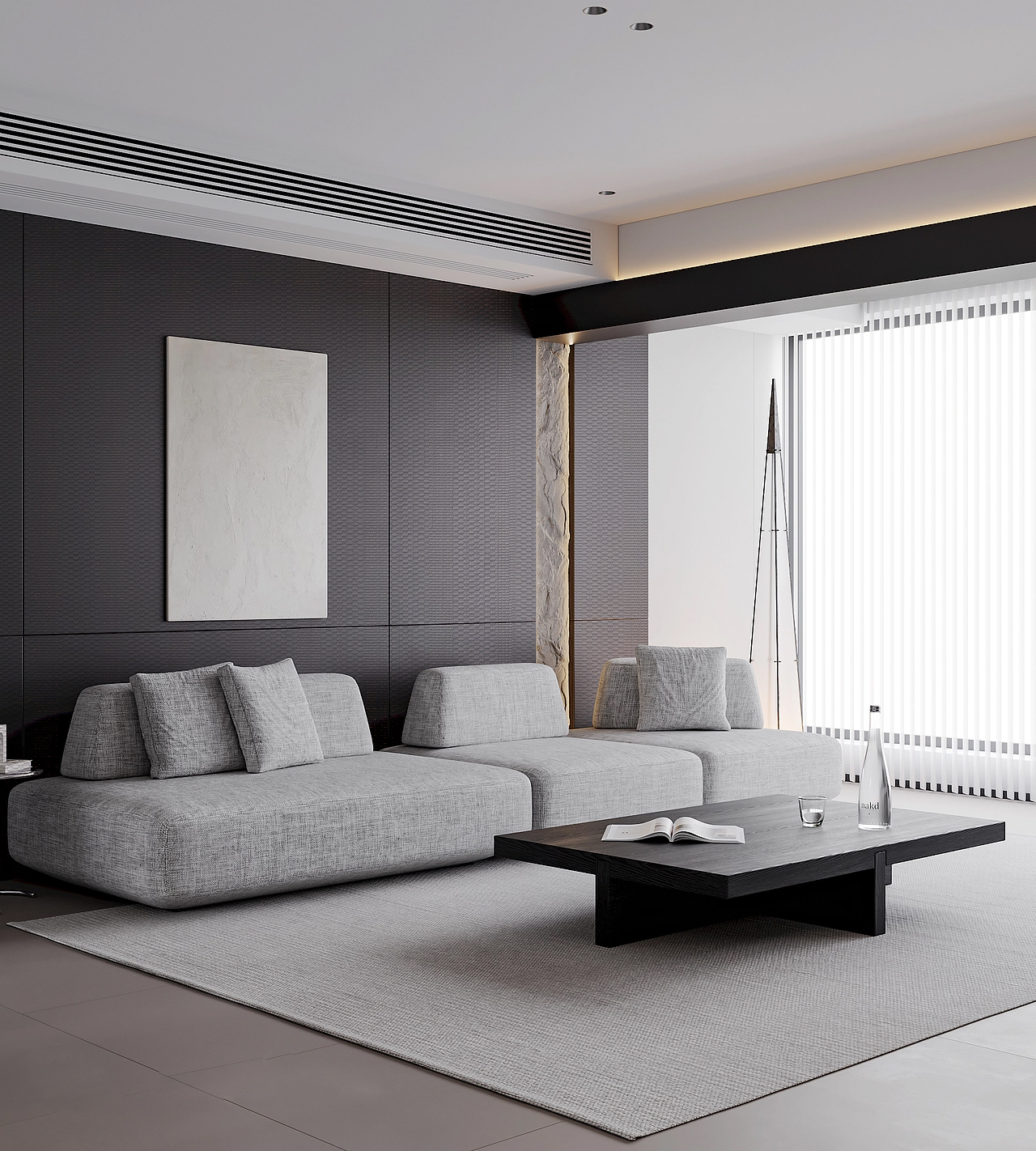
The value of YAKCO BZ02 Granules Texture Art Deco Melamine Board lies in this: it is not "like something," but rather "is something" – an independent design system based on original geometric language, supported by 3D deep embossing technology, and validated by test data.
When a designer says, "I want a texture that no one else has," YAKCO provides an answer with BZ02 – an answer that does not require choosing between "uniqueness" and "achievability."