中文简体
中文简体





Previous Post
What MDF Board and Melamine Board Are and When to Use Each
MDF board, which stands for Medium Density Fiberboard, is an engineered wood panel made by binding compressed wood fibers with synthetic resin adhesive under high heat and pressure. It produces a smooth, dense, and uniform surface with no grain or knots, making it one of the most workable sheet materials available to furniture makers, interior designers, and builders. When people ask what does mdf mean in wood, the answer is straightforward: it is a manufactured panel product, not a natural wood, and its performance characteristics are determined entirely by its manufacturing process rather than the source tree species.
A Melamine Board is a substrate panel, most commonly MDF or particle board, that has been laminated on one or both surfaces with a melamine resin impregnated paper layer. This lamination gives the board its finished appearance, its surface hardness, and its resistance to moisture, scratches, and stains. Art Deco Melamine Board extends this concept further by applying decorative paper patterns inspired by the geometric, symmetrical, and ornamental visual language of the Art Deco design movement, making it a functional and aesthetically distinctive building material for cabinetry, wall paneling, and furniture fronts.
If your priority is a smooth paintable surface for built-in furniture or detailed trim work, MDF is your best choice. If you need a ready-finished, durable surface with a decorative face that requires no additional painting or laminating, a Melamine Board on either an MDF or particle board core is the more practical solution. Understanding the difference between these two categories saves both time and money on any woodworking or interior finishing project.
What Is MDF Made Of: The Composition and Manufacturing Process
Raw Materials That Go Into MDF Production
Understanding what is mdf made of requires looking at the entire production chain. The primary raw material is wood fiber, which is sourced from a combination of industrial wood waste such as sawdust, wood shavings, and off-cuts from sawmills, as well as purpose-grown plantation timber. Unlike plywood, which preserves the grain structure of wood veneers, MDF breaks the source wood down to its individual fiber level before reconstituting it into a homogeneous panel.
The fiber is combined with a synthetic thermosetting resin binder, most commonly urea-formaldehyde (UF) resin, comprising 8 to 12 percent of the total panel weight. Higher-grade MDF products for moisture-resistant or exterior-adjacent applications may use melamine-urea-formaldehyde (MUF) or phenol-formaldehyde (PF) resins, which offer significantly better resistance to humidity and water. Additional additives may include paraffin wax for water repellency at the fiber level, fire retardants for construction applications, and biocides for panels intended for humid environments.
The Step-by-Step Manufacturing Process
The production of MDF follows a consistent industrial sequence that determines the final panel's density, strength, and surface quality:
- Wood chips are cleaned, debarked, and softened in a pressurized steam vessel called a digester at temperatures reaching 160 to 180 degrees Celsius.
- The softened chips are mechanically refined into individual wood fibers using a refiner machine that separates the fiber bundles without destroying their structural integrity.
- Synthetic resin binder and any additives are blended into the fiber stream while it is still in a semi-moist state, ensuring even distribution throughout the mat.
- The blended fiber is air-dried to a moisture content of approximately 8 to 10 percent and then formed into a continuous mat by air-laying the fibers onto a moving belt.
- The mat is compressed in a continuous or multi-opening hot press at pressures of 2 to 5 megapascals and temperatures of 160 to 200 degrees Celsius, curing the resin and bonding the fibers into a rigid, uniform panel.
- The pressed panel is cooled, cut to size, and sanded on both faces to achieve the precise thickness and smooth surface finish that MDF is known for.
The result of this process is a panel with a density typically ranging from 600 to 800 kilograms per cubic meter, significantly denser than standard particle board (500 to 650 kg per cubic meter) and more uniform than plywood. This density is what gives MDF its characteristic weight, its ability to hold screws well in face applications, and its excellent machinability for routing and profiling.
What Does MDF Mean in Wood: Clarifying the Terminology
The question of what does mdf mean in wood is one that comes up frequently because MDF occupies an ambiguous position in common language. Strictly speaking, MDF is not wood in the traditional sense. It is an engineered wood composite, meaning it is manufactured from wood-derived raw materials but does not retain the cellular structure, grain pattern, or natural variability of solid timber. The term wood in everyday usage, however, is often applied loosely to cover the full spectrum of timber and wood-based panel products, which is why MDF is grouped in this category despite being fundamentally different from a plank of oak or pine.
MDF belongs to the family of wood-based panels alongside particle board, oriented strand board (OSB), and plywood. What distinguishes MDF from these alternatives is the fiber scale of its raw material and the resulting surface homogeneity. Particle board uses larger wood particles bonded with resin; OSB uses oriented strands of wood; plywood uses full veneer sheets. Only MDF uses fiber-level raw material, which is why it produces the smoothest and most featureless surface of all engineered wood panels. This surface quality is the primary reason MDF is the preferred substrate for paint finishing, veneer application, and melamine lamination.
What Is Melamine Board: Composition and Surface Technology
How the Melamine Lamination Process Works
What melamine board actually is, at its core, is a substrate panel with a thermoset melamine resin surface. The lamination process begins with decorative paper that has been printed with the desired pattern or color. This paper is then impregnated with melamine formaldehyde resin and dried to a semi-cured state, creating what is known as a melamine-impregnated overlay. This overlay is placed on the substrate panel and subjected to heat (typically 150 to 200 degrees Celsius) and pressure in a hydraulic press, which fully cures the resin and permanently bonds the paper to the substrate surface.
The result is a surface that is chemically bonded to the substrate rather than merely glued on top, which is why properly manufactured melamine surfaces do not peel, bubble, or delaminate under normal indoor use conditions. The cured melamine resin creates a thermoset plastic surface with a hardness of approximately 3 to 4 on the Mohs scale, comparable to many natural stones and significantly harder than painted MDF surfaces. This hardness translates directly into the scratch resistance, chemical resistance, and ease of cleaning that make Melamine Board the dominant choice for kitchen cabinets, office furniture, and retail display fixtures worldwide.
Substrate Options: MDF Core vs Particle Board Core in Melamine Board
Melamine Board is manufactured using two principal substrate options: MDF core and particle board core. The choice between these substrates significantly affects the board's weight, machinability, screw-holding performance, and cost. Understanding the distinction is essential when specifying materials for a project.
| Property | Melamine on MDF Core | Melamine on Particle Board Core |
|---|---|---|
| Density | 650 to 800 kg per cubic meter | 500 to 650 kg per cubic meter |
| Surface smoothness | Very high, ideal for thin overlays | Moderate, slightly textured core |
| Edge machinability | Excellent, clean profiles possible | Good, but prone to edge chipping |
| Screw holding in face | Excellent | Good |
| Screw holding at edge | Good | Fair, can strip under heavy load |
| Moisture resistance | Moderate (standard) to high (MR grade) | Low (standard) to moderate (P5 grade) |
| Relative cost | Higher | Lower |
| Typical application | Premium cabinetry, detailed furniture | Flat-pack furniture, shelving, carcassing |
For most quality furniture and cabinetry applications, melamine board on an MDF core delivers noticeably superior results in terms of edge quality after cutting, the ability to accept edge banding cleanly, and overall structural rigidity. Particle board cored melamine remains the dominant choice for cost-sensitive, high-volume flat-pack furniture production because its lower density reduces both material cost and shipping weight.
Melamine vs Particle Board: Understanding the Core Difference
The phrase melamine vs particle board reflects a common confusion in the market between the surface finish and the substrate. To be precise: particle board is a substrate material, while melamine is a surface treatment that can be applied to particle board, MDF, or other panel substrates. When consumers compare melamine vs particle board in a retail or furniture context, they are typically comparing melamine-faced particle board against raw or simply lacquered particle board, or comparing melamine-faced board against solid particle board used without a decorative surface.
Raw particle board without a melamine surface has very limited practical use as a furniture material. Its surface is rough, highly porous, and absorbs moisture rapidly, causing swelling and structural degradation. The application of a melamine surface transforms this relatively fragile substrate into a durable, cleanable, and visually finished product. This is why virtually all particle board sold for furniture and interior applications is supplied with a melamine face in the modern market.
When the comparison is genuinely between a melamine-faced particle board panel and a melamine-faced MDF panel of equivalent thickness, the MDF-cored version will consistently outperform on the following dimensions:
- Edge quality after sawing: MDF produces cleaner, less crumbly cut edges that accept edge banding with fewer voids
- Routing and shaping: MDF can be profiled, routed, and shaped with much greater precision, enabling decorative edge treatments not possible with particle board
- Paint adhesion if the melamine surface is removed or damaged: MDF accepts primer and topcoats uniformly while particle board edges remain highly porous and difficult to finish cleanly
- Load-bearing performance: MDF panels of equivalent thickness have higher modulus of rupture values, meaning they deflect less under shelf loading
The practical conclusion of the melamine vs particle board evaluation is that for budget-sensitive applications where the surfaces remain intact and load requirements are moderate, melamine-faced particle board delivers acceptable performance at lower cost. For quality furniture, detailed cabinetry, or applications where cut edges will be visible, melamine-faced MDF is the professional standard.
Art Deco Melamine Board: Aesthetic and Functional Applications
What Makes Art Deco Melamine Board Distinctive
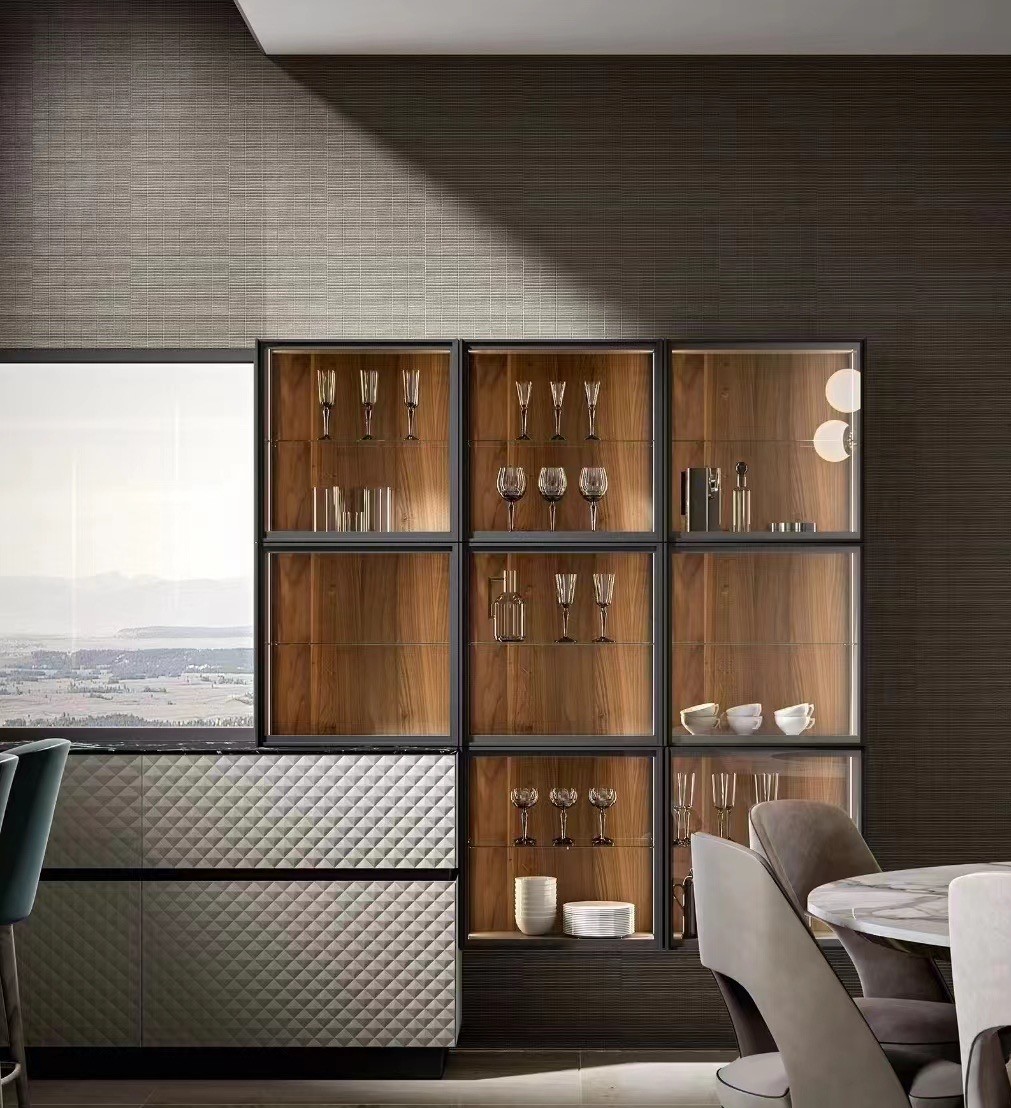
Art Deco Melamine Board combines the practical durability of standard melamine lamination technology with decorative surface patterns drawn from the Art Deco design movement, which originated in the 1920s and 1930s and is characterized by bold geometric forms, symmetrical compositions, rich contrasting colors, metallic accents, and stylized natural motifs such as sunbursts, chevrons, fan patterns, and stepped forms. In the context of a Melamine Board product, Art Deco patterns are printed onto the decorative paper before melamine resin impregnation, creating a surface that combines the hardness and durability of thermoset melamine with a visually striking decorative character.
Art Deco Melamine Board has grown significantly in popularity in contemporary interior design contexts where designers seek to move beyond the uniform matte and wood grain surfaces that have dominated the melamine board market for decades. Applications include statement kitchen cabinet fronts, feature wall paneling, retail display fixtures, reception desk fascias, and decorative furniture pieces where the surface pattern contributes directly to the spatial character of the room.
Design Characteristics of Art Deco Patterns in Melamine Surfaces
The defining visual elements of Art Deco Melamine Board patterns share several consistent characteristics regardless of the specific motif used:
- Symmetry and geometric precision: Art Deco patterns are typically bilaterally or radially symmetrical, with clean lines and mathematically defined forms that reflect the movement's celebration of modernity and industrial production
- High contrast color combinations: Classic Art Deco palettes pair deep blacks and navies with gold, silver, ivory, or jade green, creating bold visual contrast that reads well across large surface areas such as cabinet doors and wall panels
- Metallic or lustrous finish effects: Many Art Deco Melamine Board products incorporate metallic printing inks or textured press plates to simulate the gold leaf, chrome, and polished brass surfaces characteristic of the original design era
- Repeating tile-able patterns: Because the melamine surface is applied to large board formats (typically 1220 by 2440 mm or 1220 by 2800 mm), Art Deco patterns are engineered as seamlessly repeating designs that align correctly when panels are placed edge to edge
Practical Performance of Art Deco Melamine Board in Interior Projects
From a functional perspective, Art Deco Melamine Board performs identically to any other Melamine Board of equivalent specification. The decorative pattern is contained within the paper layer beneath the cured melamine resin surface, meaning it is fully protected from abrasion and cleaning. A well-manufactured Art Deco Melamine Board will resist scratching, household chemical contact, and moisture exposure at the surface level in exactly the same way as a plain white or wood grain melamine panel.
The key practical consideration unique to patterned melamine boards such as Art Deco variants is pattern matching at joints. When multiple panels are used in a continuous installation such as a full-height wardrobe or a wall of kitchen cabinets, the pattern repeat must be accounted for in the cutting plan to ensure visual continuity across the installation. This may increase material waste by 10 to 20 percent compared to a plain color installation, a factor that should be included in project budgeting.
How to Make MDF Waterproof: Practical Methods That Actually Work
Why Standard MDF Absorbs Moisture and What Happens When It Does
The question of how to make mdf waterproof arises from one of the most significant practical limitations of standard MDF: its high sensitivity to moisture. Standard MDF uses urea-formaldehyde resin as its binder, and while the resin itself is not particularly water-soluble, the wood fiber matrix it binds is highly hydrophilic. When exposed to moisture, the wood fibers absorb water and swell, causing the panel to expand, delaminate at the surface, and lose structural integrity. Standard MDF can swell by as much as 15 to 20 percent in thickness after prolonged moisture exposure, a level of dimensional change that destroys any applied surface finish and renders the panel unusable.
The edges of MDF panels are especially vulnerable because the cut edge exposes the raw fiber cross-section directly to the environment without the compacted surface layer that offers some incidental protection on the face. In kitchen and bathroom installations, edge swelling at the base of cabinet carcasses is one of the most common causes of premature furniture failure, typically occurring within 2 to 5 years in poorly sealed installations.
Method 1: Apply a Penetrating Primer as the First Line of Defense
The most effective starting point for how to make mdf waterproof in paint finishing applications is the application of a solvent-based or acrylic-based penetrating primer specifically formulated for MDF. These primers penetrate the porous fiber surface and partially fill the cellular structure of the wood fibers, significantly reducing the rate of moisture absorption. A single coat of a quality MDF primer reduces water absorption at the face by approximately 60 to 70 percent compared to raw MDF, and two coats can achieve an 80 to 90 percent reduction.
The most critical application zone is the cut edges. Edges should receive at least two to three thin coats of primer before any topcoat is applied, with light sanding between coats to consolidate the fiber surface. For maximum protection, a thin skim coat of fine surface filler can be applied to the edge after the first primer coat has dried, sanded back, and then primed again to create a genuinely sealed, smooth surface.
Method 2: Use a Polyurethane or Epoxy Topcoat System
For MDF used in higher moisture environments such as bathroom vanities, laundry rooms, or commercial catering environments, a polyurethane or two-part epoxy topcoat system provides a significantly more robust moisture barrier than standard water-based paints. Two-part epoxy coatings in particular form a cross-linked polymer film over the MDF surface that is functionally waterproof for direct water contact of up to several hours without causing the substrate to swell, provided all edges and penetrations are also coated.
The practical limitation of epoxy coating systems on MDF is their sensitivity to surface preparation. Any area of unsatisfactory primer adhesion, surface contamination, or inadequately sealed edge will become a pathway for moisture ingress that undermines the waterproofing effect of the rest of the coating. Rigorous surface preparation, including full sanding, dust removal, and solvent wipe-down before coating application, is essential for reliable results.
Method 3: Specify Moisture-Resistant MDF From the Outset
The most reliable approach to how to make mdf waterproof is to avoid the challenge entirely by specifying moisture-resistant (MR) grade MDF when a project will be used in humid conditions. MR MDF, also known as green-core MDF due to the green dye added to visually identify it, uses a melamine-urea-formaldehyde or phenol-formaldehyde resin system and includes paraffin wax additives that reduce the hydrophilicity of the fiber matrix at the manufacturing stage.
MR MDF is tested to the EN 622-5 standard and is required to show a thickness swell of no more than 12 percent after 24 hours of water immersion, compared to standard MDF which may swell 15 to 20 percent under the same test. While MR MDF is not suitable for exterior or direct water contact applications, it provides adequate moisture resistance for kitchens, bathrooms, and other interior humid zones when combined with appropriate priming and sealing at cut edges. The cost premium for MR MDF over standard MDF is typically 15 to 25 percent, a modest increase that is nearly always justified by the extended service life in moisture-exposed locations.
Method 4: Edge Treatment Options for Full Perimeter Sealing
Complete moisture protection of any MDF panel or Melamine Board installation requires attention to the exposed edges, which represent the weakest point in the moisture resistance of the system. Practical edge treatment options include:
- PVC edge banding: A thin strip of PVC or ABS plastic thermally bonded to the edge using a hot-melt adhesive. This is the industry standard for melamine-faced panels and provides effective sealing when properly applied with zero gaps at the joint line
- Solid wood lipping: A strip of solid timber glued to the panel edge, providing both aesthetic and moisture protection value. More common in premium furniture applications than in commercial production
- Flexible edge sealant: A brush-applied or cartridge-applied sealant used specifically at the base of cabinet carcasses where the edge meets a potentially wet floor surface, particularly in kitchen and utility room installations
- Laminate or veneer wrapping: Extending the face laminate or veneer around the edge in a folded or separately applied strip, providing a fully continuous surface covering across all exposed areas
MDF Board vs Other Engineered Wood Panels: Where MDF Excels and Where It Falls Short
Comparative Performance Across Key Properties
| Property | MDF Board | Particle Board | Plywood | Solid Timber |
|---|---|---|---|---|
| Surface smoothness | Excellent | Moderate | Good (face veneer dependent) | Variable (grain dependent) |
| Paint finish quality | Excellent | Poor (without primer) | Good | Good (with filling) |
| Dimensional stability | High (dry conditions) | Moderate | High (cross-grain construction) | Low (moves with humidity) |
| Moisture resistance (standard) | Low | Very low | Moderate to high | Species dependent |
| Routing and profiling | Excellent | Poor | Good | Excellent |
| Weight (18mm panel) | Approx. 13 to 15 kg per sqm | Approx. 10 to 12 kg per sqm | Approx. 10 to 12 kg per sqm | Species dependent |
| Relative material cost | Low to moderate | Lowest | Moderate to high | High |
| Structural use suitability | Limited | Very limited | Good | Excellent |
Where MDF Is the Best Choice
MDF board is the optimal choice for applications that prioritize surface quality, machinability, and dimensional consistency in dry indoor conditions. The most common and most appropriate uses include:
- Painted kitchen cabinet doors and drawer fronts, where its smooth, grain-free surface produces an unblemished paint finish impossible to achieve on any wood-grain substrate
- Interior door skins and moulded door profiles, where its uniform density allows CNC machining to produce crisp, consistent profiles at high production volumes
- Skirting boards, architraves, and decorative mouldings, where its ability to hold fine profile detail and accept paint without grain raising is unmatched in the panel product category
- Speaker boxes and acoustic enclosures, where its density and damping properties reduce resonance compared to lighter panel materials
- Substrate for veneer or high-pressure laminate (HPL) in furniture manufacturing, where its flat, stable surface eliminates the telegraphing of grain or texture through thin applied finishes
Where MDF Should Be Avoided
- Structural applications where the panel must resist bending loads over unsupported spans greater than 600mm without sagging, as MDF has lower stiffness-to-weight ratio than plywood
- Any exterior or semi-exterior application where the panel will be exposed to rain, ground moisture, or long periods of elevated humidity without full encapsulation in a waterproof coating system
- Edge-screwed connections bearing significant loads, as MDF holds screws poorly at its cut edge compared to its face due to the fiber orientation in the panel cross-section
- Applications where weight is critical, as its high density makes it one of the heaviest panel products per unit volume in the engineered wood category
Formaldehyde Emissions in MDF and Melamine Board: What Buyers Need to Know
One of the most important health and regulatory considerations when specifying what is mdf board for interior use is the formaldehyde emission level of the product. Urea-formaldehyde resin, the most common binder used in standard MDF production, releases formaldehyde gas slowly over time in a process called off-gassing. Formaldehyde is classified as a Group 1 human carcinogen by the International Agency for Research on Cancer (IARC), and prolonged exposure to elevated indoor concentrations is associated with increased risk of nasopharyngeal cancer and leukemia.
Regulatory standards for formaldehyde emissions from wood-based panels are established by several international frameworks. The most widely referenced are the European E1 and E0 standards and the California Air Resources Board (CARB) Phase 2 standard, which is the basis for the US EPA TSCA Title VI regulation. Under the E1 standard, MDF must not exceed 0.124 milligrams of formaldehyde per cubic meter of air (mg per cubic meter) measured under standardized conditions. The E0 standard sets a limit of 0.05 mg per cubic meter. CARB Phase 2 sets a limit of 0.11 mg per cubic meter for MDF and 0.09 mg per cubic meter for thin MDF panels.
When purchasing MDF or Melamine Board for residential interior use, particularly for enclosed spaces such as wardrobes, kitchen cabinets, or children's bedroom furniture, specifying CARB Phase 2 compliant or E0 grade panels reduces formaldehyde exposure to levels considered safe for continuous indoor habitation. Products that do not carry certification to one of these standards should be assumed to be E1 grade at best and should be ventilated thoroughly before installation in occupied spaces.
Practical Guide to Cutting, Finishing, and Installing MDF and Melamine Board
Cutting MDF and Melamine Board Cleanly
Both MDF and Melamine Board require specific cutting techniques to achieve clean results without chipping, tearing, or raising dust. For MDF, a fine-toothed circular saw blade with a minimum of 60 teeth for a 250mm blade diameter, used at high speed and fed at a steady, controlled rate, will produce clean face cuts with minimal fiber breakout. MDF generates extremely fine wood dust during cutting that is harmful when inhaled, and a respiratory mask rated for fine particulate matter (P2 or FFP2 minimum) must be worn at all times during machining.
For Melamine Board, the melamine surface is brittle and will chip if cut with an inappropriate blade. A triple chip grind (TCG) or alternate top bevel (ATB) blade with a minimum of 80 teeth is recommended for clean melamine cuts. When using a hand-held circular saw, scoring the cut line with a sharp knife before sawing prevents the surface layer from lifting ahead of the blade. Cutting with the good face down when using a hand-held circular saw (where the blade enters from below) and face up when using a table saw (where the blade enters from above) positions the vulnerable surface on the side where blade entry is clean rather than where blade exit chipping occurs.
Finishing MDF for Paint Applications
The process for achieving a high-quality painted finish on MDF requires more preparation steps than painting solid wood, but the final result can be superior because MDF has no grain to raise or knots to bleed through the finish:
- Sand the face surfaces with 120 grit abrasive to remove any surface contamination and lightly key the surface for primer adhesion.
- Apply a dedicated MDF primer or a solvent-based primer-sealer to all faces and edges. Edges require two to three coats with light sanding between applications.
- Allow the primer to cure fully (typically 4 to 8 hours for solvent-based products) and then sand all primed surfaces with 180 grit abrasive to a uniform smoothness.
- Apply the finish topcoat using a high-quality brush, roller, or spray system. Two coats of topcoat with a light 240 grit sand between coats produces a smooth, professional result.
- For kitchen or bathroom applications, use a polyurethane or catalyzed acrylic topcoat rather than standard emulsion for resistance to moisture and cleaning chemicals.
Frequently Asked Questions
1. What is mdf board and is it the same as particle board?
MDF board (Medium Density Fiberboard) and particle board are both engineered wood panels made with resin-bonded wood-derived material, but they are not the same product. MDF is made from refined wood fibers and has a much smoother, denser, and more uniform structure. Particle board is made from larger wood chips and particles and is less dense, less smooth, and less machinable. MDF is the superior substrate for painted finishes and detailed routing, while particle board is primarily used as a cost-effective core material in flat-pack furniture.
2. What does mdf mean in wood and is it considered real wood?
MDF stands for Medium Density Fiberboard. It is technically an engineered wood composite rather than real wood, as it does not retain the cellular structure, grain, or natural variability of timber. It is manufactured from wood-derived fibers bonded with synthetic resin. While it is not natural wood, it is widely used as a substitute in furniture and interior applications where its smooth surface and machinability are advantages over solid timber.
3. What is mdf made of and is it safe for indoor use?
MDF is made from wood fibers, synthetic resin binder (typically urea-formaldehyde), paraffin wax, and small quantities of additives. It is safe for indoor use when the product is certified to CARB Phase 2, E1, or E0 formaldehyde emission standards. Products meeting these standards have been tested to confirm that formaldehyde off-gassing is below levels considered safe for continuous indoor habitation. Always verify the emission certification of MDF purchased for enclosed indoor applications such as bedroom furniture or cabinetry.
4. What melamine board is best for kitchen cabinets?
For kitchen cabinets, melamine board on an MDF core is the preferred choice because it provides cleaner cut edges, better screw retention, and superior flatness compared to particle board cored alternatives. The melamine surface should be rated for at least 0.4mm thickness for durable kitchen use, and the substrate should be moisture-resistant (MR) grade MDF in areas near sinks or dishwashers. Art Deco Melamine Board on an MDF core is a popular choice for statement kitchen designs where surface pattern contributes to the room's aesthetic character.
5. How to make mdf waterproof for bathroom use?
To make MDF waterproof for bathroom use, begin by specifying MR (moisture-resistant) grade MDF rather than standard grade. Seal all surfaces and edges with two to three coats of solvent-based primer, followed by a two-part epoxy or polyurethane topcoat system. Pay particular attention to all cut edges, which are the primary entry points for moisture. Apply PVC or ABS edge banding to all exposed edges after cutting. In high-splash zones such as directly around a basin, MDF is not the ideal substrate regardless of sealing, and a more inherently moisture-resistant material such as marine plywood or a PVC-foam board should be considered instead.
6. What is the difference between melamine vs particle board?
Melamine is a surface treatment (a thermoset resin impregnated paper laminate) while particle board is a substrate material. In practice, the comparison is usually between melamine-faced particle board and melamine-faced MDF. Melamine-faced MDF outperforms melamine-faced particle board in surface smoothness, edge quality after cutting, routing capability, and screw-holding performance in the face of the panel. Melamine on particle board is lighter and less expensive, making it suitable for cost-sensitive flat-pack furniture applications where surface integrity is maintained.
7. How durable is Art Deco Melamine Board compared to plain melamine panels?
Art Deco Melamine Board is equally durable to plain melamine panels of the same specification because the decorative pattern is protected by the same cured melamine resin surface layer. The hardness, scratch resistance, moisture resistance at the surface, and chemical resistance are determined by the melamine resin quality and thickness, not by the pattern beneath it. The only additional practical consideration for Art Deco Melamine Board is pattern alignment and matching waste when cutting multiple panels for a continuous installation.
8. Can MDF be used outdoors if properly sealed?
Standard MDF and MR MDF are not suitable for outdoor use even with extensive sealing because their fiber matrix will eventually absorb moisture through any imperfection in the coating system, causing irreversible swelling and delamination. For exterior applications, specify exterior-grade MDF (sometimes called HDF-MR exterior) which uses phenol-formaldehyde resin and additional moisture-resistant additives, or select a more appropriate substrate such as marine plywood, exterior-grade OSB, or a PVC composite panel for the application.
9. What thickness of MDF is best for cabinet carcasses and shelving?
For cabinet carcasses in standard residential furniture applications, 18mm MDF is the industry standard, providing adequate stiffness for panels up to approximately 900mm unsupported span. For shelving carrying significant loads such as book shelves or pantry storage, 25mm MDF should be used for spans above 600mm to prevent visible sagging over time. For decorative applications such as cabinet doors, drawer fronts, and panel inserts, 12mm or 15mm MDF provides sufficient structural performance at reduced weight.
10. Is Art Deco Melamine Board suitable for commercial interior projects?
Yes. Art Deco Melamine Board is well-suited to commercial interior projects including retail environments, hotel lobbies, reception areas, restaurant interiors, and boutique office fit-outs where a distinctive visual identity is a project priority. For commercial applications, specify a melamine surface with an abrasion resistance rating appropriate for the traffic level of the installation, and confirm that the substrate meets any required fire classification standards such as Class B or Class C reaction to fire as specified by the building regulations applicable to the project.