中文简体
中文简体





Previous Post
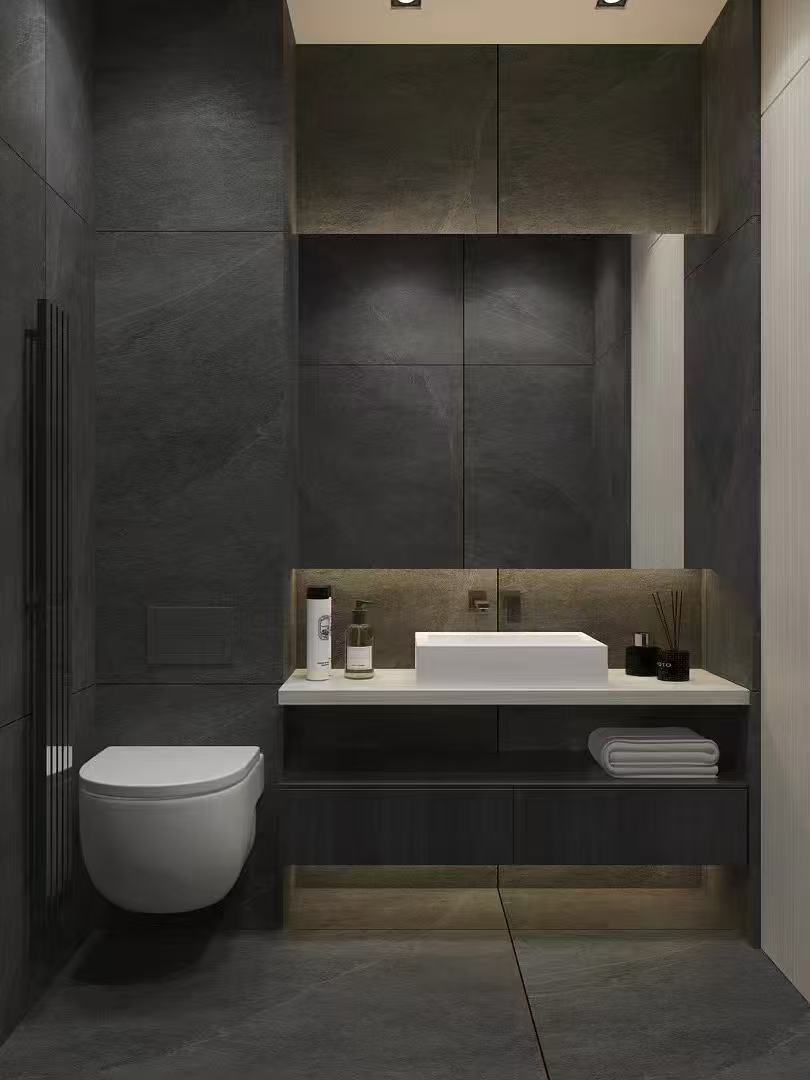
The appeal of decorative laminate lies in its ability to "replicate" the visual language of natural stone through industrial means—the grain of granite, the stratification of slate, the mottled texture of terrazzo.
Designers use it on lobby feature walls, corridor wainscoting, and elevator lobby walls, pursuing a spatial effect that "has the presence of stone."
But decorative laminate has a construction issue that is often overlooked: it looks like stone, but it is not a solid block of stone—it is a "skin" (the decorative surface layer) adhered to "flesh" (the substrate).
How firmly this "skin" sticks directly determines how long the "stone-like quality" of the laminate will last.
In 2026 national testing, YAKCO decorative laminate achieved a surface bond strength of 1.58 MPa—compared to the national standard requirement of just 0.60 MPa.
This figure answers the most fundamental question about decorative laminate: how firmly does this stone-textured "skin" stay attached on vertical walls?
More:yakco technology
1.What Is "Surface Bond Strength," and Why Is It Particularly Important for Decorative Laminate?
Surface bond strength measures the adhesive bond between the decorative layer (the printed stone texture) and the substrate.
The higher the value, the stronger the bond between this "skin" and its "flesh."
For horizontal applications like countertops and tabletops, the impact of surface bond strength is primarily reflected in wear resistance and impact resistance.
But for vertical walls—lobby feature walls, corridor wainscoting, elevator lobby walls—the impact is more direct: it determines whether this decorative "skin" can remain firmly "attached" to the substrate over the long term, without loosening, lifting, or peeling.
On vertically installed decorative laminate panels, the decorative layer must withstand both "downward gravity" and "outward stress"—the slight deformation of the substrate caused by changes in temperature and humidity continuously exerts a "pulling" force on the decorative layer.
If surface bond strength is insufficient, this sustained pulling will create microscopic gaps between the decorative layer and the substrate.
A single panel may not show it, but when an entire wall is assembled, the "looseness" at the joints accumulates into a visual sense of "lack of refinement."
YAKCO's measured surface bond strength of 1.58 MPa is 2.6 times the national standard.
This more than double bond strength means that even if the substrate deforms slightly with temperature and humidity changes, the decorative layer remains firmly "anchored" to the substrate—no loosening, no lifting, no peeling.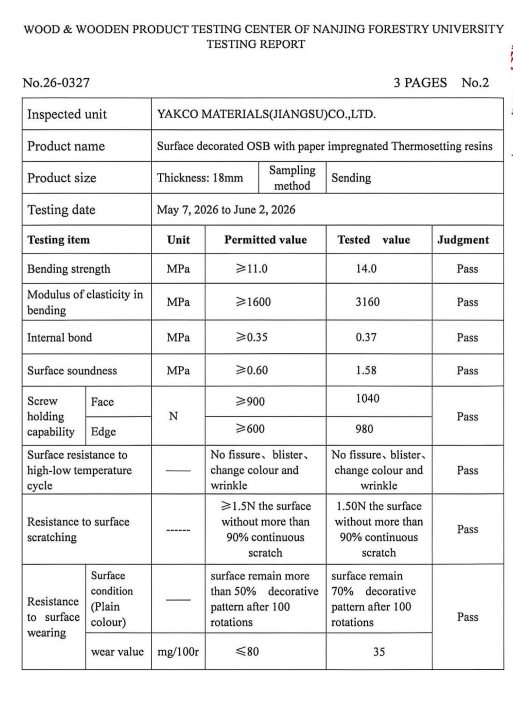
1.What Does 1.58 MPa Mean in Real-World Spaces?
Translate 1.58 MPa from the laboratory into real commercial space scenarios:
Hotel lobby feature walls—dozens of people pass by daily; walls are occasionally bumped by luggage, cleaning equipment, and decorative objects.
Panels with insufficient surface bond strength will develop microscopic "hollow spots" between the decorative layer and substrate after a few years—tapping produces a hollow sound, and edges begin to lift.
At 1.58 MPa, the decorative layer stays tightly adhered to the substrate, the wall sounds solid when tapped, and edges remain as flat as the day they were installed.
Office corridor wainscoting—cleaning staff wipe it down every day.
The "lateral pull" that a damp cloth exerts on the decorative layer may seem slight, but the cumulative effect of daily wiping over time is not negligible.
With insufficient surface bond strength, the edges of lines and patterns will gradually "curl up" after prolonged wiping.
At 1.58 MPa, even with daily wiping, the decorative layer remains firmly "nailed" to the substrate.
Elevator lobby walls—subject to frequent temperature and humidity fluctuations: summer air conditioning cooling and winter heating warm-up.
The thermal expansion and contraction of the substrate continuously exerts thermal stress on the decorative layer.
A bonding strength of 1.58 MPa ensures that even with repeated temperature differentials, the stone-textured surface stays firmly "attached" to the substrate—no delamination, no blistering.
2.The Process Logic Behind "Sticking Firmly"
A surface bond strength of 1.58 MPa is not achieved by accident.
It depends on two prerequisites:
Substrate flatness.
The flatter the contact surface between the decorative layer and the substrate, the greater the bonding area and the higher the bond strength.
If the substrate surface has microscopic undulations, the decorative layer adheres tightly at the high points but loosely in the valleys—resulting in inconsistent bond strength across the panel.
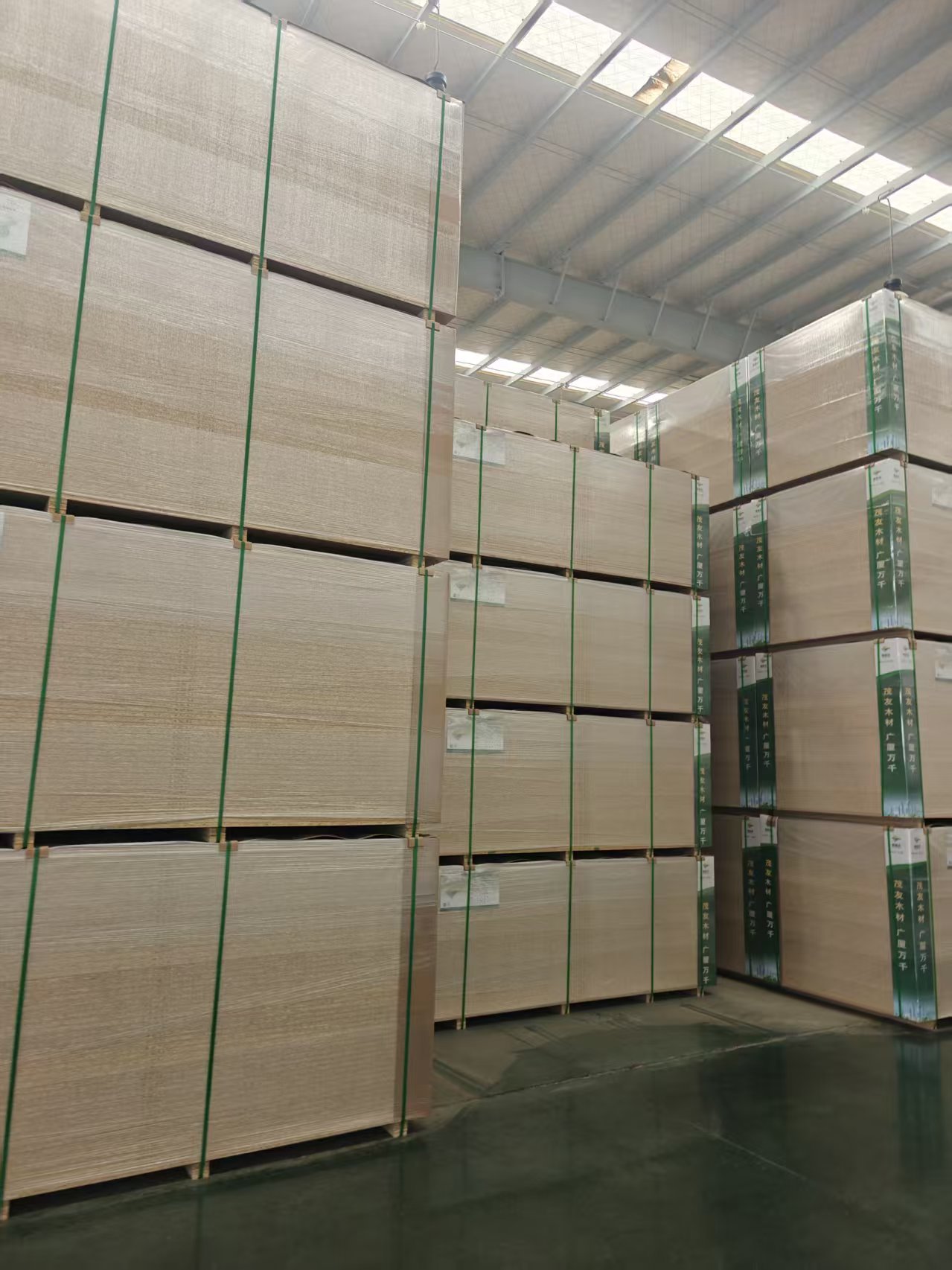
YAKCO's substrate has a stable density of 0.72 g/cm³ with uniform distribution, providing a flat "bonding base" for the decorative layer.
Resin penetration depth.
During the hot-pressing process, the resin in the melamine-impregnated paper must fully penetrate the substrate surface layer, forming a dual anchorage mechanism of "mechanical interlocking + chemical bonding."
If resin penetration is insufficient, the bond between the decorative layer and substrate is only "surface contact," not "structural connection."
YAKCO precisely controls hot-pressing temperature, pressure, and time to ensure complete resin penetration and a robust interfacial bond.
Substrate stability.
Even with high surface bond strength, if the substrate itself deforms under temperature and humidity changes, the decorative layer will be "torn" apart.
YAKCO's substrate has an internal bond strength of 0.37 MPa (above the national standard of 0.35 MPa), ensuring that the substrate itself does not loosen or delaminate, providing a stable "foundation" for the decorative layer.
1.The "Bonding Challenge" of Large-Area Decorative Laminate Walls
A 6-meter-wide stone-textured feature wall may require 20 to 30 panels to be assembled.
Between every two panels is a seam.
The flatness at these seams directly determines the "premium feel" of the entire wall—when seams align and edges are flush, the wall looks like "a single piece of stone"; when seams are misaligned and edges curl, the wall looks like what it is—"pieced together."
Edge lifting at seams is often not an installation issue, but rather a "diminishing" of bond strength between the decorative layer and substrate at the edges.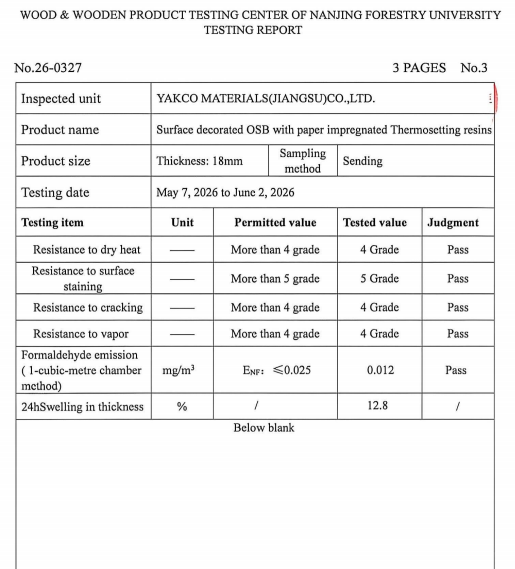
Panels with insufficient surface bond strength naturally have weaker bond strength at cut edges than in the middle area—cutting disrupts the continuity of the decorative layer and substrate at the edge.
Add to this the stress from temperature and humidity changes, and edges are the first to "loosen."
YAKCO's 1.58 MPa surface bond strength retains ample bonding margin even at the cut edges.
Edges don't lift, joints stay flush, and the wall's "integrality" is preserved.
Conclusion: The "Stone-Like Quality" of Decorative Laminate Begins with "Sticking Firmly"
When designers choose decorative laminate, they are pursuing a spatial effect that "has the presence of stone."
But this "stone-like quality" is not achieved just by printing the pattern—it requires the decorative layer to remain firmly "attached" to the substrate on vertical walls over the long term, without loosening, lifting, or peeling.
With a surface bond strength of 1.58 MPa—2.6 times the national standard—Arkel decorative laminate answers the most practical question about this material: How firmly does this stone-textured "skin" stay on the wall?
The answer is: firmly enough that you would never know it is a "skin."
The grain of granite, the stratification of slate, the mottled texture of terrazzo—these visual languages are not "stuck" onto the surface; they are "grown into" the panel itself.