中文简体
中文简体





Previous Post
As the global furniture manufacturing, commercial interior, and customized furnishing industries continue to evolve, the competitive focus within the decorative panel sector is also changing. In the past, buyers mainly focused on designs, pricing, and surface finishes. Today, however, more international buyers are paying close attention to one critical factor — Melamine Board Substrate.
For overseas purchasers, the substrate is no longer simply the “inner core” of a panel. It has become a key factor directly affecting furniture durability, processing efficiency, transportation stability, and brand reputation.
Especially in Europe, North America, the Middle East, and Southeast Asia, purchasing standards are gradually shifting from “low-cost sourcing” to “stable performance and long-term quality control.” Under this trend, high-performance Melamine Board Substrate is becoming an important competitive advantage in the premium decorative panel supply chain.
To learn more about YAKCO products
Why Substrate Quality Has Become a Key Purchasing Factor
In melamine decorative panel production, decorative paper determines the visual appearance, while the substrate defines the structural foundation of the product.
A high-quality substrate can provide:
- Better structural stability
- Higher machining compatibility
- Stronger load-bearing capacity
- Lower risk of deformation and cracking
- Improved edge banding performance
- Longer furniture service life
For furniture manufacturers, substrate quality directly affects:
- CNC machining stability
- Automatic edge banding efficiency
- Hardware fastening strength
- Structural stability after flat-pack transportation
- Dimensional stability after ocean shipping
As a result, more international buyers now pay close attention to third-party testing reports instead of focusing only on surface texture and pricing.
Third-Party Testing Is Becoming Essential in International Trade
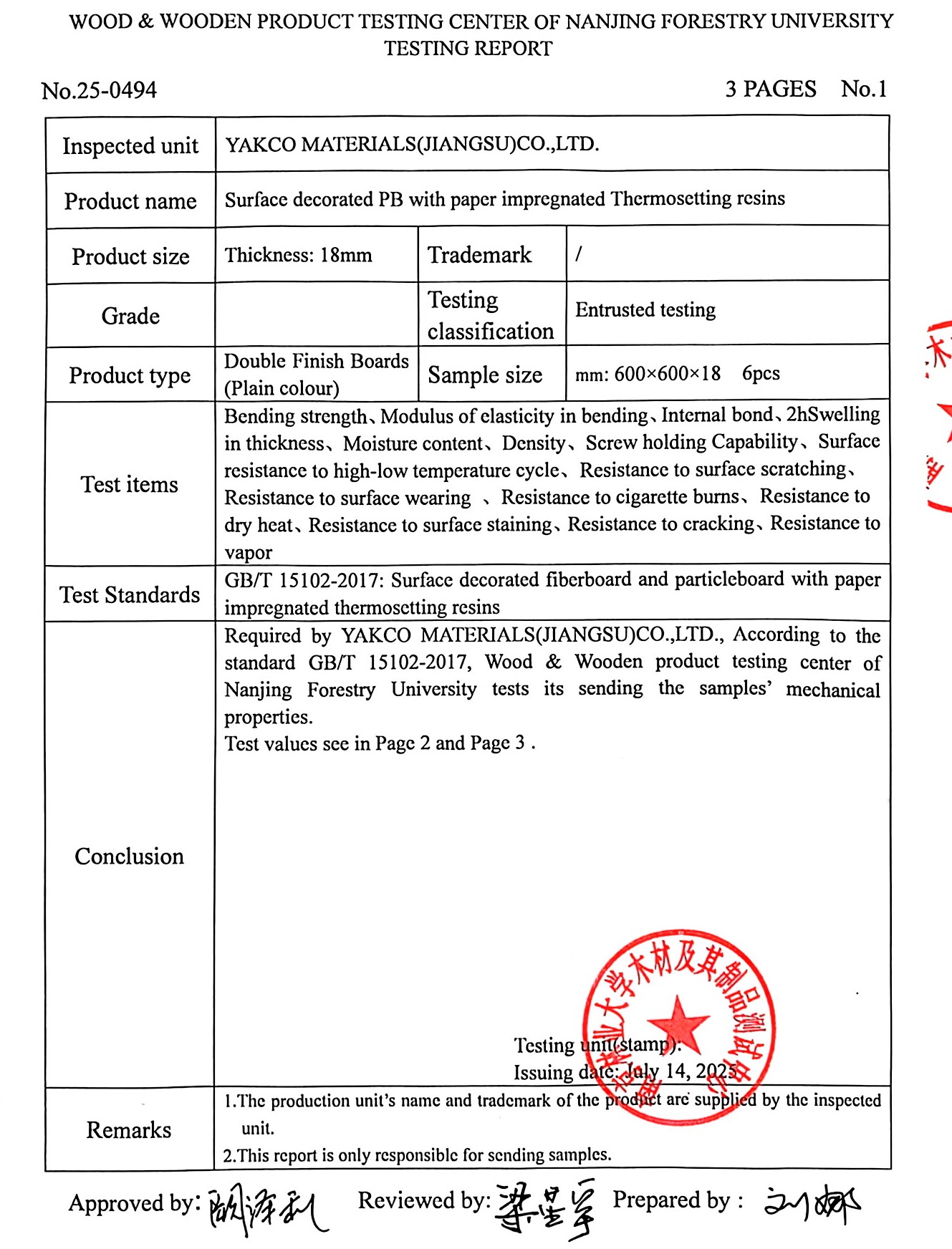
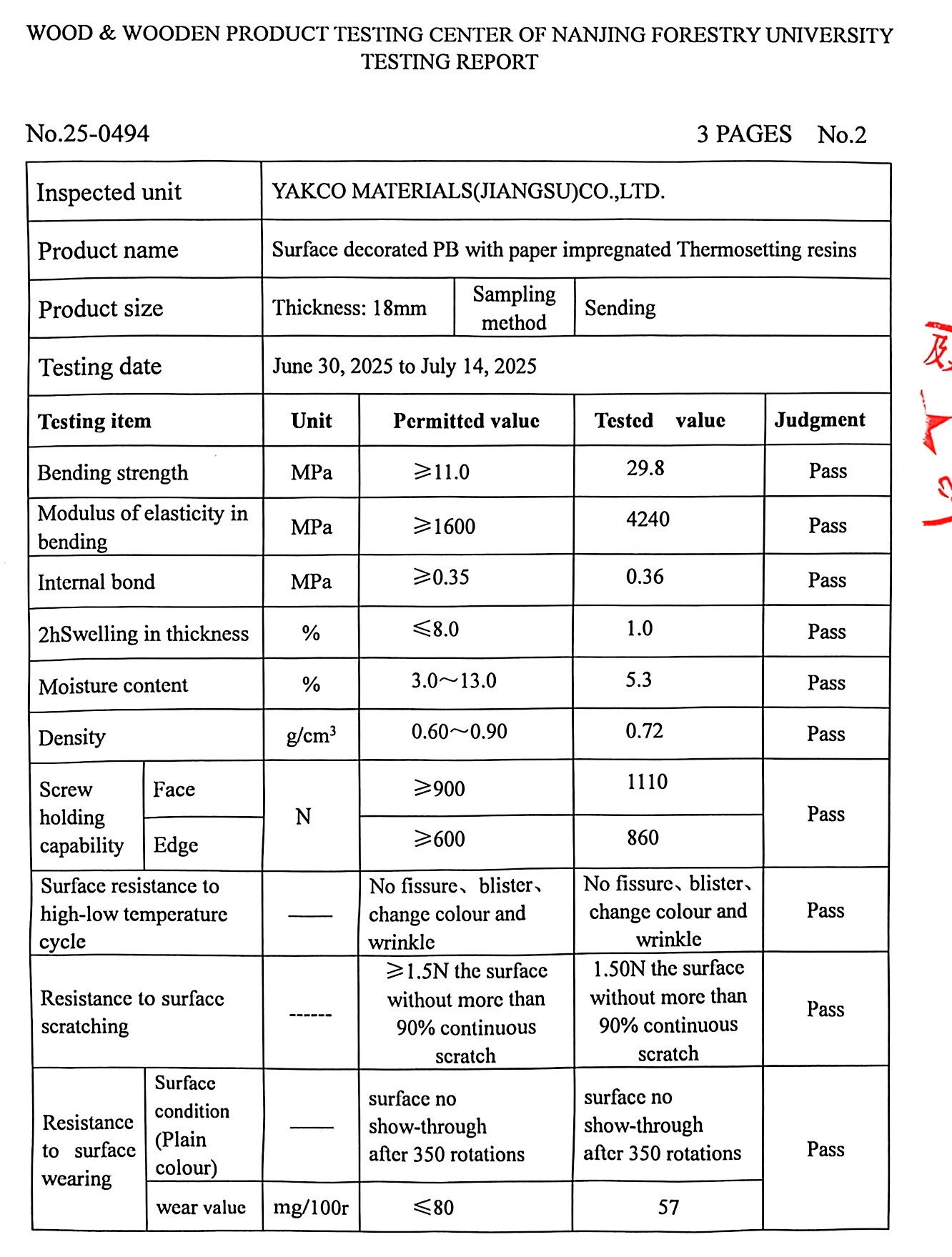
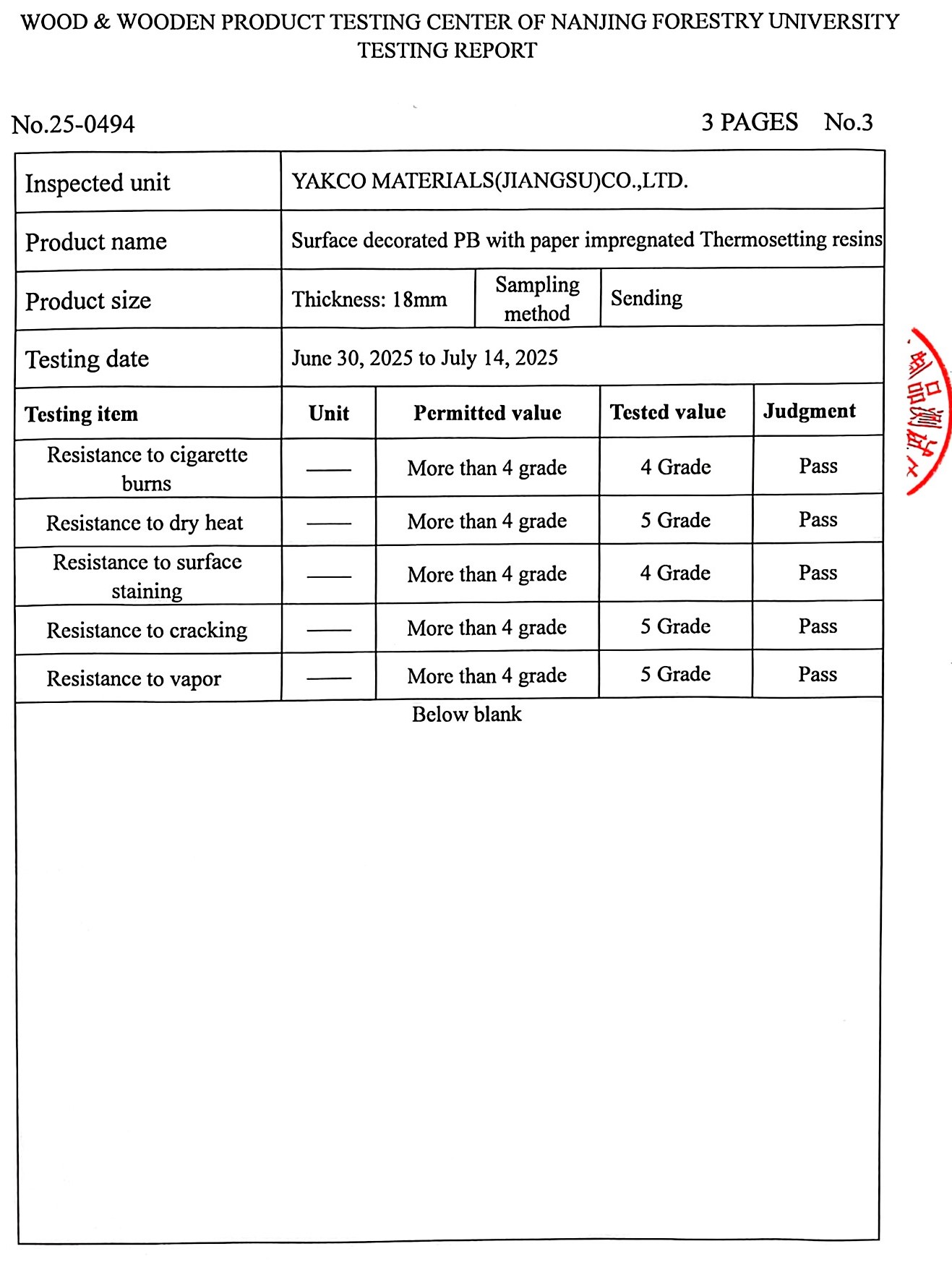
According to the testing report issued by the Wood & Wooden Product Testing Center of Nanjing Forestry University, the 18mm decorative board product was tested according to the GB/T 15102-2017 standard, covering mechanical properties, surface durability, and environmental adaptability.
A comprehensive testing system provides significant advantages for overseas buyers:
- Increased purchasing confidence
- Reduced quality dispute risks
- Easier access to project-based procurement systems
- Better compliance with brand supplier audits
- Stronger foundation for long-term cooperation
Especially in large furniture brands and commercial projects, testing reports have become an essential part of supply chain evaluation.
Stable Structural Performance Supports Heavy-Duty Furniture Applications
The testing data shows:
- Bending Strength: 29.8 MPa
- Modulus of Elasticity: 4240 MPa
- Internal Bond Strength: 0.36 MPa
These figures indicate that the board can maintain stable overall performance during long-term loading, structural applications, and complex machining processes.
For overseas furniture factories, such stability is highly suitable for:
- Large cabinet manufacturing
- Automated cutting systems
- High-speed edge banding production lines
- Long-distance ocean transportation
- Multi-climate market applications
Especially in office furniture, hotel furniture, and commercial interior projects, stable substrates significantly reduce the risk of deformation and cracking over time.
Low Swelling Rate Improves Global Market Adaptability
The report indicates:
- 2-Hour Thickness Swelling: 1.0%
A low swelling rate means the board can maintain dimensional stability even in humid environments or under temperature fluctuations.
This performance is especially important for international markets because climate conditions vary greatly:
- High humidity in Southeast Asia
- Significant temperature differences in the Middle East
- Moisture exposure during sea freight transportation
- Kitchen and bathroom furniture applications
Stable substrate performance helps reduce issues such as swelling, deformation, and edge banding failure caused by environmental changes.
Screw Holding Strength Determines Long-Term Furniture Stability
The testing report shows:
- Face Screw Holding Strength: 1110 N
- Edge Screw Holding Strength: 860 N
For modern panel furniture, screw holding capability directly affects:
- Hardware installation stability
- Cabinet structural strength
- Reassembly performance
- Long-term durability
Especially in the European and North American DIY furniture markets, strong screw holding performance has become one of the key purchasing considerations.
Surface Durability Directly Impacts End-User Experience
In addition to structural performance, modern Melamine Board Substrate must also provide excellent surface durability.
According to the report, the product achieved stable performance in the following tests:
- Dry Heat Resistance: Grade 5
- Vapor Resistance: Grade 5
- Crack Resistance: Grade 5
- Surface Staining Resistance: Grade 4
- Cigarette Burn Resistance: Grade 4
This makes the product highly suitable for:
- Commercial office spaces
- Hotel projects
- High-traffic public areas
- Residential high-frequency usage environments
For end users, stronger surface durability means:
- Easier cleaning
- Better wear resistance
- Improved aging resistance
- Longer-lasting appearance
High Compatibility Supports Modern Automated Production
As the global furniture industry continues shifting toward intelligent manufacturing, compatibility with automated processing systems is becoming increasingly important.
High-quality Melamine Board Substrate is generally better suited for:
- PUR edge banding
- EVA edge banding
- CNC processing
- High-speed drilling
- Automated cutting systems
Stable density structures and internal bonding strength help reduce:
- Edge chipping
- Delamination
- Uneven edge banding
- Surface damage
For large-scale furniture manufacturers, this means:
- Lower material waste
- Higher production efficiency
- More stable finished product quality
From “Basic Panel” to “High-Performance Material”
Today, international market expectations for Melamine Board Substrate are no longer limited to traditional panel standards.
Future industry development is expected to move toward:
- Lower formaldehyde emissions
- Higher wear resistance levels
- Combination with synchronized embossing technology
- Super matte and soft-touch surfaces
- Moisture-resistant and antibacterial performance
- Lightweight structural solutions
As global consumers continue demanding higher-quality living spaces, high-performance substrates are becoming a new value driver in the furniture industry.
For international buyers, selecting suppliers with stable testing capabilities, mature quality control systems, and long-term production reliability will become increasingly important in future supply chain partnerships.