中文简体
中文简体





Previous Post
In modern furniture manufacturing and interior design, the visual effect of the decorative surface is often the first thing consumers notice – wood grains, stone textures, fabric patterns, or three-dimensional embossing define the panel’s aesthetic identity.
However, the long-term performance of a high-quality decorative panel is not solely determined by how realistic its surface looks; it depends far more on the strength, stability, and durability of the substrate.
The substrate is the “invisible backbone” that determines whether the decorative panel can withstand the test of time.
More:yakco technology
Physical and Mechanical Properties: The “Hard Indicators” of the Substrate
For wood-based panels surfaced with paper impregnated thermosetting resins, the physical and mechanical properties of the substrate are directly related to structural safety and processing convenience during use.
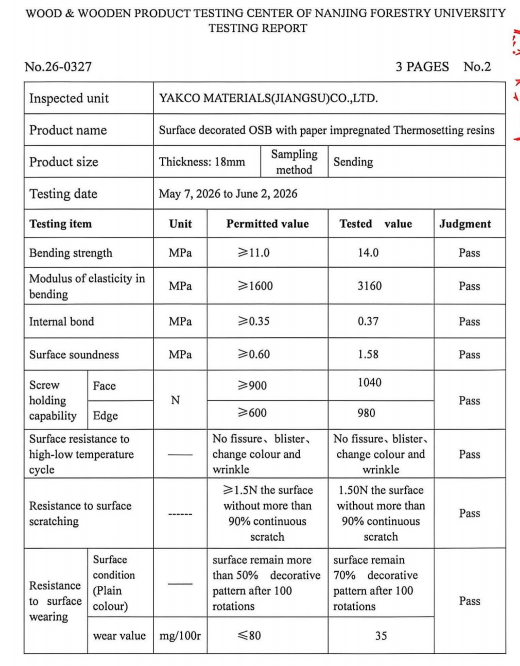
According to the testing standard GB/T 15102-2017 Surface decorated fiberboard and particleboard with paper impregnated thermosetting resins, the substrate of decorated OSB must meet multiple mechanical performance criteria.
In terms of bending strength, the standard requires ≥11.0 MPa, and the tested value reached 14.0 MPa – exceeding the requirement by 27%.
This means the panel resists fracture and deformation when bearing heavy loads. For modulus of elasticity in bending, the standard requires ≥1600 MPa, while the tested value reached 3160 MPa – nearly double the requirement.
A higher value indicates greater resistance to deformation under load, which is especially critical for large cabinet doors, long-span shelves, and similar applications.
Internal bond strength measures the bonding integrity between the internal layers of the substrate.
The standard requires ≥0.35 MPa, and the tested value was 0.37 MPa.
Although only slightly above the minimum, for oriented strand board (OSB) this parameter directly determines whether delamination or blistering occurs during long-term use.
Screw Holding Capability: The “Sense of Security” in Furniture Assembly
In furniture production and installation, screw holding capability is a key practical indicator.
Whether screws can firmly grip the panel directly determines the reliability of hardware connections.
Test data show: face screw holding force reached 1040 N against a requirement of ≥900 N; edge screw holding force reached 980 N against a requirement of ≥600 N.
This ensures that whether for cabinet assembly or hardware installation, the substrate provides ample holding power, effectively reducing the risk of screw loosening over time.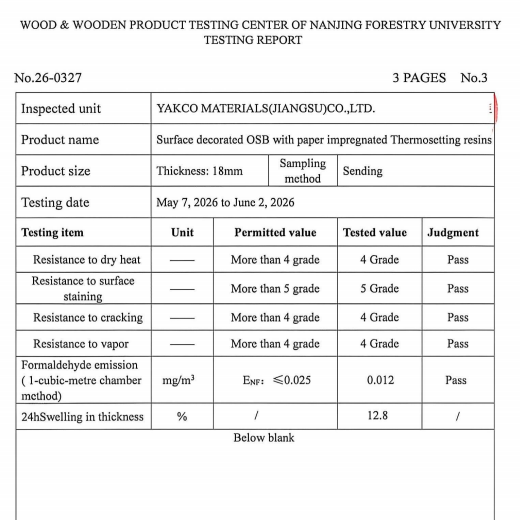
Surface Soundness: The “Adhesion Strength” Between Decorative Layer and Substrate
The bonding strength between the decorative paper and the substrate is equally important.
The standard requires surface soundness ≥0.60 MPa, and the tested value reached 1.58 MPa – indicating an extremely strong bond that resists peeling, blistering, or delamination in daily use.
A stable substrate ensures that the decorative layer remains firmly attached even under thermal stress, moisture, and scratching.
Substrate Density: The Key to Balancing “Texture” and “Practicality”
Density is one of the core parameters determining the overall performance of the substrate. The measured density was 0.72 g/cm³, placing it in the upper-middle range of the national standard (0.60–0.90 g/cm³).
This density provides sufficient structural strength while avoiding excessive weight that would complicate installation and handling.
More importantly, uniform density ensures consistent performance across batches – every panel feels, weighs, and machines the same way during installation.
Conclusion
The true value of a premium decorative panel lies far beyond its surface colour and pattern.
The physical and mechanical properties of the substrate – bending strength, modulus of elasticity, internal bond, screw holding capability, surface soundness – collectively define the panel’s “inner quality.”
For furniture manufacturers, interior designers, and procurement professionals, paying attention to substrate performance means investing in the product’s long-term service life and user experience.
The quality of the Melamine Board Substrate determines how far the decorative panel can go.
More about Products:Premium Melamine Board