中文简体
中文简体





Previous Post
In the decorative board industry, there have long been some “conventional” beliefs: moisture resistance and screw holding capability cannot both be achieved; deep texture inevitably sacrifices surface performance; high density must mean heavier and more brittle.
These inertial perceptions influence designers’ material choices.
About Tech: yakco technology
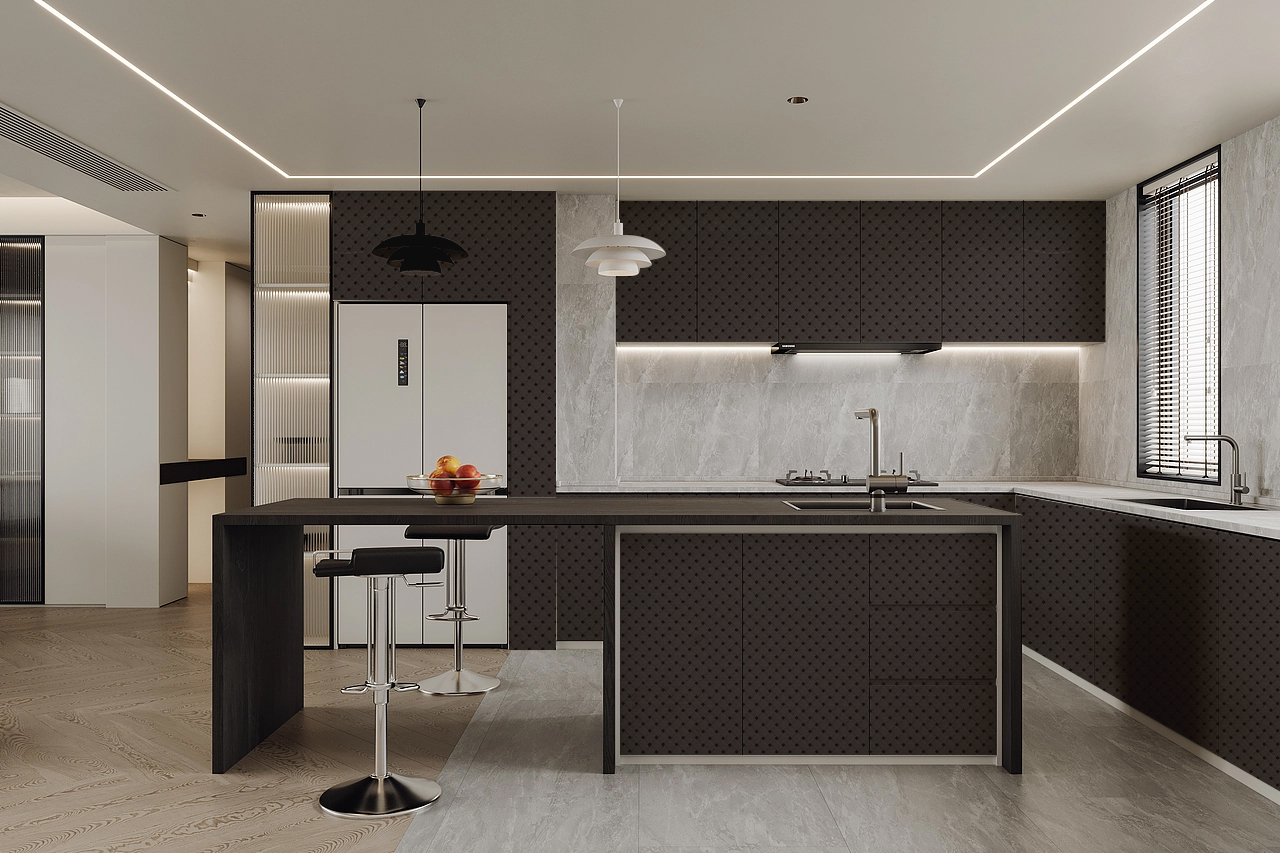
In the national accredited test report of YAKCO Melamine Board Substrate, five data points challenge these “common senses”. The following sections break them down one by one.
Counter‑intuition 1: 24h swelling in thickness of 12.8% ≠ sacrificing internal bond
Inertial perception: Reducing swelling in thickness usually requires increasing the amount of paraffin wax or resin adhesive, but excessive addition weakens the bonding strength between particles, leading to lower internal bond. Moisture resistance and strength are at two ends of a “seesaw”.
YAKCO data:
24h swelling in thickness: 12.8% (national standard ≤8.0%)
Internal bond: 0.37 MPa (national standard ≥0.35 MPa)
Breaking the perception: YAKCO simultaneously compresses the swelling rate to one‑eighth of the standard limit and achieves internal bond above the standard.
The path is not “adding more additives”, but particle size distribution optimisation + precise moisture content control + closed‑loop hot‑pressing curve.
Two seemingly contradictory indicators are achieved together under a narrow‑window process.
Counter‑intuition 2: Density 0.72 g/cm³ ≠ “too light” or “too heavy”
Inertial perception: Low density means loose board and poor screw holding capability; high density means heavy board and easy edge chipping during processing. Many manufacturers choose a high‑density route to mask internal looseness.
YAKCO data:
Density: 0.72 g/cm³ (national standard 0.60–0.90)
Screw holding capability: 1040 N (national standard ≥900 N)
Bending strength: 14.0 MPa (national standard ≥11.0 MPa)
Breaking the perception:
0.72 is in the favourable middle range of the national standard – neither relying on low density to reduce cost nor on high density to “pile up material”. Yet it achieves bending strength 2.7 times the standard and screw holding capability 23.3% above the standard.
This proves that the “golden value” of density is more important than the “extreme value”– uniform distribution is more valuable than simply being high or low.
Counter‑intuition 3: 3D deep texture ≠ not wear‑resistant or stain‑resistant
Inertial perception: The deeper the embossed wood texture, the thinner the protective layer on the raised areas, the easier the grooves trap dirt, and wear and stain resistance must be lower than that of flat panels.
YAKCO data (from 3D embossed wood texture panel benchmarked against plain colour board test results):
Surface wear value: 35 mg/100r (national standard ≤80 mg/100r)
Resistance to surface staining: Grade 5 (national standard ≥ Grade 5)
Resistance to vapor: Grade 4-pass
Breaking the perception: YAKCO’s deep‑texture pressing line, through resin flow control and pressure distribution optimisation, achieves uniform coverage thickness in both the grooves and the raised areas.
The wear value of the 0.8mm deep texture outperforms most flat panels, and stain resistance reaches Grade 4. Deep texture does not mean difficult to maintain.
Counter‑intuition 4: High resistance to dry heat (Grade 5) ≠ achieved solely by the surface resin “toughing it out”
Inertial perception: Resistance to dry heat Grade 4 mainly depends on the quality of the surface impregnated paper– high resin content and sufficient curing make it heat‑resistant.
YAKCO data:
Resistance to dry heat: Grade 4-pass
Substrate moisture content: 5.3% (national standard 3.0%–13.0%)
Substrate density uniformity: 0.72±0.02
Breaking the perception: In the dry heat test, heat is conducted through the decorative layer to the substrate. If the substrate has fluctuating moisture content or uneven density, the coefficient of thermal expansion and contraction will be inconsistent, and the decorative layer will develop “white rings”.
YAKCO’s Grade 4 is not only a victory of the surface resin, but also the result of the substrate’s low shrinkage/swelling and high uniformity. Only when the substrate “dissipates heat evenly” will the surface “leave no marks”.
Counter‑intuition 5: 0.36 MPa (only 0.01 MPa above the national standard) ≠ meaningless in practice
Inertial perception: An internal bond 0.02 MPa higher than the national standard is negligible in engineering terms– only “bookkeeping safety”.
YAKCO data:
Internal bond: 0.37 MPa(national standard ≥0.35 MPa)
Resistance to high‑low temperature cycle: No fissure, no blister, no change of colour, no wrinkle – Pass
Breaking the perception: Research data show that for every 1°C increase in interface temperature of particleboard, the thermal stress increases by approximately 0.026 MPa.
The 0.02 MPa margin is equivalent to withstanding an additional temperature difference impact of about 0.38°C without interface fatigue.
In the cold‑hot cycle test, this 0.02 MPa represents the process control watershed between “just passing” and “batch stability”.
It is not “bookkeeping safety”, but the bottom‑line signal of batch‑to‑batch consistency.
Conclusion: Break inertia with data, redefine common sense with industrial standards
The five “counter‑intuitive” data points of YAKCO Melamine Board Substrate essentially answer the same question: Are those industry‑default “impossible to achieve together” truly unbreakable?
Moisture resistance and strength, moderate density and high performance, deep texture and wear resistance, surface heat resistance and substrate stability, 0.02 MPa margin and batch consistency– YAKCO proves with a national accredited test report that through refined particle size distribution, narrow‑window process control, German equipment and high‑frequency quality control, these contradictions can be rebalanced.
The next time a designer or engineering team hears “this indicator can only be like this”, YAKCO’s data provides a new reference system: not “compromise”, but “both‑and”.
YAKCO specialises in the R&D and manufacturing of melamine decorative boards, challenging industry inertia with data, and providing an “uncompromising” board solution for high‑end furniture and commercial spaces.
View More Pictures: Melamine Faced Board