中文简体
中文简体






Previous Post
In the procurement of decorative materials for hotels, finished residential projects, and commercial complexes, the initial unit price of the panel is often the most intuitive decision factor.
But experienced procurement managers know: a “cheap” panel, if after three years its surface is worn, edge banding is cracked, stains have penetrated, and cabinet doors are deformed, will have a total cost far higher than a product with an initial unit price 15‑20% higher but which is “durable”.
About Details:yakco technology
The question is: how can you quickly identify whether a decorative panel is “truly durable” or just “paper compliant” using the supplier’s test report?
In YAKCO’s rock texture board test report, five data points can serve as “hard indicators” for procurement screening.
Item 1: 24h Swelling in Thickness– Judging the panel’s service life in humid environments
Test item: 24h swelling in thickness
Why it matters: This indicator directly determines the panel’s performance in wet areas such as kitchens, bathrooms, laundry rooms, and basements. Panels with high swelling will, after six months of use, show edge banding popping off, cabinet doors not closing, and wall cladding warping.
Procurement judgment: it means that even in long‑term high‑humidity environments (e.g., hotel laundry rooms, beachfront vacation homes), the thickness change of the panel is almost zero, and the edge banding and cabinet structure remain stable over the long term.
Item 2: Surface Wear Value (Wear Resistance)– Judging the refurbishment cycle of high‑frequency wiping areas
Test item: Resistance to surface wearing (plain colour board: whether show‑through occurs after 100 rotations, wear value in mg/100r)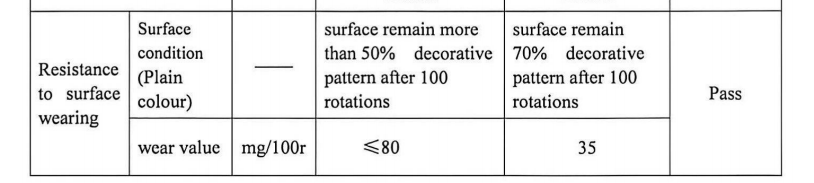
Why it matters: Hotel lobby walls, restaurant tabletops, shopping mall counters, hospital corridors– these are wiped repeatedly every day with cleaning cloths, mops, and even disinfectants. The lower the wear value, the longer the pattern and colour are retained.
Procurement screening line: Wear value ≤80 mg/100r is the national standard passing grade; ≤60 mg/100r is excellent.
YAKCO tested value: No show‑through after 100 rotations, wear value only 35 mg/100r
Procurement judgment: 35 mg/100r means it is more durable than the national standard passing grade. For a hotel with 300 guest rooms, the refurbishment cycle of walls and cabinets can be extended from 5 years to 7‑8 years, saving hundreds of thousands of RMB on a single project.
Item 3: Resistance to Surface Staining Grade– Judging cleaning and maintenance costs
Test item: Resistance to surface staining (grades 1‑5, ≥ Grade 4 is passing)
Why it matters: Coffee, red wine, soy sauce, oil stains, disinfectants, cosmetics– in commercial spaces, contaminants come into contact with panels almost every day. A low grade means staining and spots, requiring strong cleaners or even replacement.
Procurement screening line: ≥ Grade 4 is passing. Grade 4 is the minimum requirement for commercial spaces. Grade 5 is better but rare.
YAKCO tested value: Grade 5
Procurement judgment: Grade 5 means that most common contaminants can be wiped clean with a damp cloth– no staining, no rings. Cleaning staff do not need corrosive cleaners, reducing cleaning costs and the risk of surface damage.
Item 4: Resistance to Surface Scratching Grade – Judging the “fault tolerance” after hard object scraping
Test item: Resistance to surface scratching (whether there is >90% continuous scratch under 1.5N load)
Why it matters: Suitcase wheels, metal ornaments, keys, pet claws – the probability of these hard objects scratching the panel surface is extremely high in commercial spaces. Panels with a low scratch resistance grade will show conspicuous continuous white scratches, seriously affecting appearance.
Procurement screening line: National standard requires ≥1.5N with no >90% continuous scratch. A few high‑quality products can achieve 2.0N.
YAKCO tested value: 1.5N– Pass (no >90% continuous scratch)
Procurement judgment: YAKCO performs passably at the standard load of 1.5N, meaning that daily hard object scratching will not damage the overall aesthetics. For more extreme scenarios (e.g., sharp metal objects scratched vigorously), it is recommended to use bumper strips or local protection.
Item 5: Substrate Internal Bond – Judging whether the panel’s “skeleton” is loose
Test item: Internal bond (≥0.35 MPa passes)
Why it matters: This indicator is the “invisible skeleton” of the panel. Low internal bond means the substrate is loose inside – screws cannot be tightened, grooves fuzz, and the board delaminates when exposed to moisture. It does not directly affect surface appearance, but directly determines hardware connections and structural life.
Procurement screening line: ≥0.35 MPa is passing, ≥0.40 MPa is excellent. However, be aware: some manufacturers increase internal bond by excessive adhesive application, sacrificing environmental friendliness.
YAKCO tested value: 0.37 MPa (higher than the national standard)
Procurement judgment: 0.37 MPa is a “solid but not aggressive” value. YAKCO achieves it through Russian pine raw material + precise adhesive application, not by relying on excessive adhesive. Procurement should combine this with environmental test reports for comprehensive judgment.
Procurement Self‑Check List: Ask the supplier for these five data points
When reviewing decorative panel suppliers, procurement managers can request the following five test data points and compare them with YAKCO’s reference values:
1.24h Swelling in Thickness
Yakco: 12.8%
Yakco Grade: Far exceeds excellent
2.Surface Wear (wear value)
National Standard Passing Line: ≤80 mg/100r
Recommended Procurement Line: ≤60 mg/100r
Yakco: 35 mg/100r
Yakco Grade: Excellent
3.Resistance to Surface Staining
National Standard Passing Line: ≥ Grade 4
Recommended Procurement Line:≥ Grade 4
Yakco: Grade 5
Yakco Grade: Pass
4.Resistance to Surface Scratching
National Standard Passing Line: 1.5N, no continuous scratch
Recommended Procurement Line: 1.5N, no continuous scratch
Yakco: 1.5N– Pass
Yakco Grade: Pass
5.Internal Bond
National Standard Passing Line: ≥0.35 MPa
Recommended Procurement Line: ≥0.35 MPa
Yakco: 0.37 MPa
Yakco Grade: Above passing
Conclusion: Procurement confidence comes from quantifiable data, not supplier promises
These five data points for YAKCO’s rock grain board are not “peak boasts” from a laboratory, but quantifiable indicators that can be written into contract terms in engineering procurement.
When a supplier says “our panels are very durable”, the procurement manager can ask: What is the wear value? What is the swelling rate? What is the stain resistance grade?
Data does not lie.
YAKCO uses this test report to tell procurement managers: you don’t need to be a panel expert– you just need to know how to read these five numbers.
Know More: Premium Melamine Board