中文简体
中文简体





Previous Post
Decision‑makers for commercial projects often face a dilemma when selecting decorative materials: rock texture boards that look similar on renderings can vary in price by 30% or more.
The cheaper board saves money upfront, but a year later the tabletop is worn, the wall is stained, and the wall cladding is dented by suitcases–repair costs, business interruption losses, and diminished customer experience may end up costing more than the amount "saved" initially.
More: yakco technology
Is there a quantifiable standard to judge the "long‑term value" of a rock texture board?
The following sections break down the business case behind Yakco three data points from a procurement decision perspective.
1.Wear Value 35 mg/100r: Determines the "Refurbishment Cycle"
What commercial spaces fear most is not "broken," but "worn out"–the surface is not damaged, but the wear is severe, gloss is uneven, and patterns are faded, making the entire space look cheap.
At that point, you either tolerate the "worn" look or refurbish ahead of schedule.
YAKCO achieved a wear value of only 35 mg/100r, while the national standard requires ≤80 mg/100r. In real‑world use, this gap means: under the same usage intensity, the surface decorative layer of YAKCO rock grain boards lasts approximately 40%‑50% longer than products that just "pass" the standard.
For a restaurant with 30 table turns per day, ordinary rock grain board tabletops may need full replacement or refinishing in 3‑4 years.
YAKCO rock texture board tabletops can extend the replacement cycle to 5‑6 years.
For a restaurant with 100 tables, delaying tabletop replacement by 2 years can save tens of thousands to hundreds of thousands of RMB in direct material and labour costs–depending on tabletop size and material.
Procurement judgment: The lower the wear value, the longer the refurbishment cycle.
35 mg/100r means the "aesthetic lifespan" of this tabletop outperforms most competitors in commercial spaces.
2.Resistance to Surface Scratching 1.5N: Determines the "Daily Wear" Level
Rock texture walls in hotel lobbies and rock texture display stands in boutique stores–the metal corners of suitcases, keys, and the edges of metal ornaments brush past the walls every day.
A single scratch is not a problem, but dozens every day, sustained over a year, means thousands of frictions.
Once scratches are deep enough to damage the decorative layer, the printed pattern of the rock grain is "cut off," and the visual realism collapses.
YAKCO achieved 1.5N in resistance to surface scratching, with no more than 90% continuous scratch under the standard load.
The business logic behind this data is: the shallower and less continuous the scratches, the fewer repairs needed. In commercial spaces, ordinary rock texture melamine faced boards may require professional repair personnel to treat wall scratches every quarter, with each repair costing hundreds to thousands of RMB, and it is difficult to restore the original appearance.
YAKCO's 1.5N scratch resistance means that everyday scratches do not leave long, deep continuous scars–they are unnoticeable from a distance, requiring no repair and no "wall damage" marking.
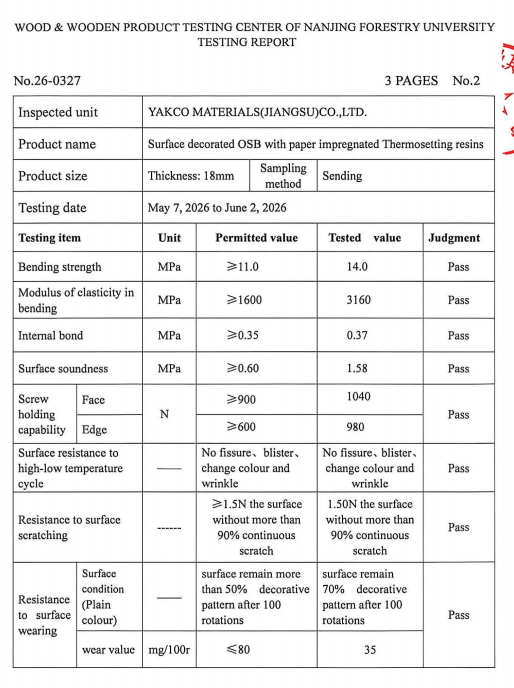
Procurement judgment: Scratch resistance determines the "fault tolerance" of walls and cabinet surfaces in "high‑contact" environments.
The margin of 1.5N saves the project from the hidden bill of "scratch repairs."
3.Resistance to Surface Staining Grade 5: Determines "Cleaning Efficiency"
The cost of cleaning in commercial spaces is often underestimated.
Red wine, coffee, and soy sauce stains on tabletops–if they cannot be wiped off, cleaning staff need to use strong cleaners or even abrasive pastes–time‑consuming, labour‑intensive, and damaging to the surface.
Worse, penetrated stains cannot be removed–the panel must be replaced.
YAKCO achieved Grade 5 in resistance to surface staining (the highest level), with the national standard requiring≥ Grade 4.
Grade 5 means that in the standard test, common contaminants such as coffee, red wine, and soy sauce leave no trace after wiping.
Translated into commercial scenarios: cleaning staff can restore tabletop cleanliness with a damp cloth–no special cleaners, no extra labour hours, no professional restoration.
For a medium‑to‑large restaurant, monthly cleaning labour and chemical costs can be reduced by 20%‑30%.
Procurement judgment: Grade 5 stain resistance means "lower daily cleaning costs, lower deep‑cleaning frequency, and lower panel replacement probability."
4.The "Unified Foundation" Behind the Three Data Points
Wear resistance, scratch resistance, and stain resistance–these three surface properties do not exist in isolation.
They share the same foundation: substrate stability. YAKCO's substrate has a stable density of 0.72 g/cm³and internal bond of 0.37 MPa, ensuring that the decorative layer does not develop micro‑cracks due to substrate deformation over long‑term use–micro‑cracks are "channels" for accelerated wear, "shortcuts" for liquid penetration, and "starting points" for deeper scratches.
A stable substrate allows surface properties to last.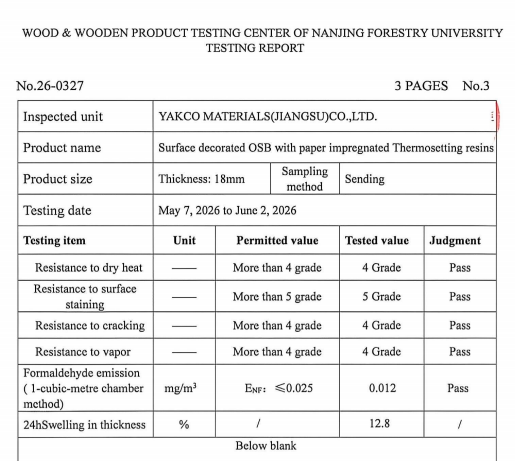
5.Conclusion: Cheaper Boards Often End Up More Expensive
The logic of material selection in commercial spaces is completely different from retail procurement.
Retail looks at unit price; commercial looks at total cost of ownership–the purchase price is only a small part of the total expenditure; repairs, refurbishment, cleaning, and business interruption are the major costs.