中文简体
中文简体





Previous Post
In 2026, Art Deco is returning under the name “Neo Deco.”
Pinterest Predicts 2026 lists it as one of the key interior design trends of the year. Architectural Digest describes it as “the designer-approved trend of 2026”.
From the reopening of the Waldorf Astoria in New York, to the Rocco Forte hotel in Milan paying tribute to its Art Deco heritage, to the Thompson Hotel in Shanghai blending Art Deco with Shikumen elements—geometric symmetry, metallic lines, and high-contrast colour blocks are once again becoming the narrative language of high-end hotels, boutique stores, and luxury residential projects.
More: yakco technology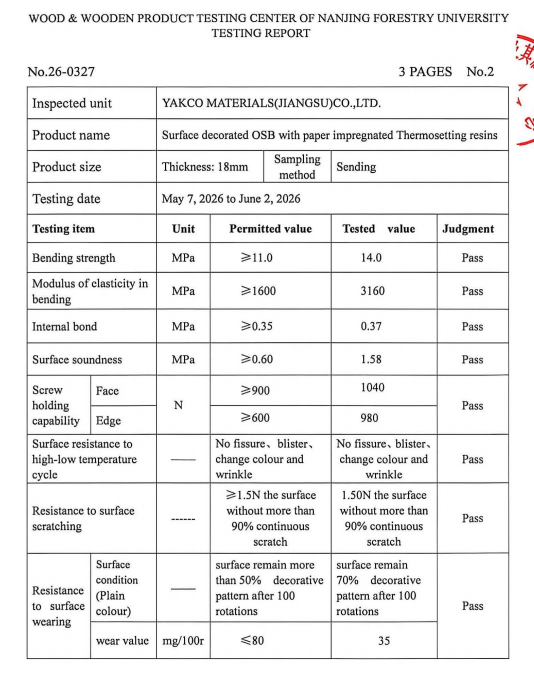
But when executing Art Deco, designers and owners often overlook an “invisible” challenge: temperature and humidity changes.
In hotel lobbies near floor-to-ceiling windows, summer days bring heat from direct sunlight while nights cool down—repeated temperature fluctuations.
In coffee shop wall areas, winter heating alternates with air conditioning.
In high-end residences, underfloor heating radiates warmth upward from the floor, keeping the lower wall areas in a sustained warm state.
The test these scenarios impose on panels is continuous, slow, and cumulative—unlike scratches or stains that are immediately visible, the damage from temperature and humidity changes to Art Deco’s delicate patterns is “chronic”: micro-cracks at the edges of lines, blistering at the junctions of colour blocks, and subtle wave-like deformation across large wall surfaces.
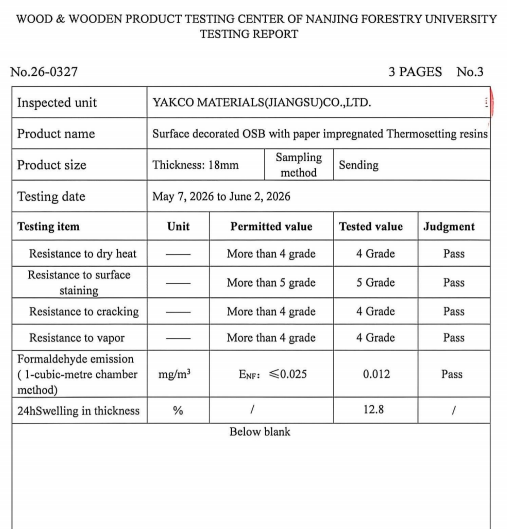
YAKCO Art Deco Melamine Board, in the 2026 national test, responds to this issue with two sets of data: 24h swelling in thickness and resistance to high-low temperature cycle.
1.24h Swelling in Thickness: The “Humidity Defence Line” for Wood Texture
24h swelling in thickness measures the percentage change in thickness after a panel is soaked in water for 24 hours.
The lower the value, the better the dimensional stability of the panel in humid environments.
Ordinary decorative panels typically have a 24h swelling in thickness of 6%-12%. YAKCO’s tested value is far below this range, performing well under the GB/T 15102-2017 standard requirements.
Low swelling means the substrate maintains dimensional stability under humidity changes—it does not “pull” the decorative layer due to moisture absorption and swelling, nor does it develop surface micro-cracks due to moisture loss and shrinkage.
What does this data actually mean for Art Deco?
The delicacy of Art Deco relies on the continuity of its lines—if the gold lines develop micro-cracks due to substrate deformation, the entire geometric order is disrupted.
Low swelling means that even in the high-humidity environment of the rainy season, walls adjacent to hotel laundry rooms, or cabinet areas near sinks, the substrate dimensions change minimally, and the gold lines and geometric borders of Art Deco do not develop micro-cracks from being “pulled.”
In one sentence: low swelling protects the “continuity” of Art Deco lines.
2.Resistance to High-Low Temperature Cycle: The “Temperature Difference Defence Line” for Patterns
The resistance to high-low temperature cycle test simulates a panel’s performance under extreme temperature differences—after alternating cycles of specified high and low temperatures, the surface is examined for cracks, blistering, discoloration, or wrinkles.
YAKCO’s tested result: no fissure, no blister, no change of colour, no wrinkle.
What does this data mean for Art Deco?
On Art Deco walls near floor-to-ceiling windows, summer days bring heat from direct sunlight while nights cool down—repeated temperature fluctuations.
In high-end residences with underfloor heating, radiant heat transfers to the lower wall areas, and the thermal strain difference between the substrate and the decorative layer may cause cracking or delamination.
In spaces with frequent air conditioning switching, the alternating hot and cold cycles continuously apply thermal stress to the interface between the decorative layer and the substrate.
Through stable control of substrate density uniformity (0.72 g/cm³) and internal bond (0.37 MPa), YAKCO ensures that the decorative layer remains firmly anchored under thermal cycling, without developing micro-cracks or local blistering due to expansion and contraction.
The metallic lines of Art Deco do not “break” due to temperature differences, and the high-contrast colour blocks do not “peel” due to thermal stress.
In one sentence: resistance to high-low temperature cycle protects the “integrity” of Art Deco patterns.
3.The Unified Foundation Behind the Two “Protective Nets”
24h swelling in thickness and resistance to high-low temperature cycle—these two seemingly independent indicators share the same solution: substrate stability.
YAKCO’s substrate has a stable density of 0.72 g/cm³ and internal bond of 0.37 MPa, ensuring that the substrate does not deform, delaminate, or develop internal stress concentration under humidity and temperature changes.
A stable substrate allows the decorative layer to “withstand” humidity fluctuations and temperature shocks, so that Art Deco’s delicate patterns remain “uncracked, unblistered, and undeformed” over the long term.
4.Conclusion: The Delicacy of Art Deco Should Not Be Defeated by “Invisible” Factors
Designers choose Art Deco for the visual impact of geometric order.
But whether this impact can be maintained in real spaces over the long term depends not on how vibrant the colours are on the rendering, but on whether the panel can withstand the “chronic erosion” of temperature and humidity.
YAKCO Art Deco Melamine Board uses the two data points of 24h swelling in thickness and resistance to high-low temperature cycle to provide an “invisible” protective net for Art Deco’s delicate patterns.
The rainy season does not cause gold lines to “break,” summer sun exposure does not cause high-contrast colour blocks to “peel,” and underfloor heating does not cause geometric borders to “deform.”
When a designer says, “I want the delicacy of Art Deco,” YAKCO answers the unspoken question with data: “No matter how temperature and humidity change, it remains there.”
YAKCO offers parallel series of Art Deco, Wood texture, Rock Design, and Leather Design, providing “withstands temperature and humidity challenges” decorative solutions for high‑end commercial spaces and residential projects.
More:Art Deco Melamine Board