中文简体
中文简体





Previous Post
The delicacy of Art Deco is built upon a series of precision details: the width of gold lines, the sharpness of geometric borders, the clarity of high‑contrast colour block edges.
These details can be infinitely magnified on renderings, but in real spaces, they are being "worn" every day – not disappearing suddenly, but consumed micron by micron.
YAKCO Art Deco Melamine Board, in the 2026 national test, uses a set of wear‑related data to answer the most practical question for Art Deco's precision patterns: those 0.3mm‑wide gold lines, sharp geometric borders, and high‑contrast colour block edges – how are they worn away? And how long can they be "preserved"?
More: yakco technology
1.The First Layer of Wear: Surface "Hazing" – The Chronic Loss of Contrast
The visual impact of Art Deco comes from high contrast – the extreme contrast between gold and dark colours. But this contrast is first weakened by surface "hazing."
Under a microscope, the melamine resin layer is smooth, but with daily cleaning and wiping, microscopic scratches appear on the resin surface – not visible "scratches" to the naked eye, but countless fine grooves.
These grooves scatter light, making the originally high‑reflection metallic texture appear "foggy" – gold no longer shines, dark colours no longer appear deep. Contrast is lost imperceptibly.
YAKCO's wear value of 35 mg/100r is far better than the national standard requirement of ≤80 mg/100r.
This low wear rate means that the accumulation of microscopic scratches on the resin surface is extremely slow – even after years of daily wiping, the surface remains smooth, light reflection remains concentrated, and the contrast between gold and dark colours remains full.
2.The Second Layer of Wear: Line Edge "Bleeding" – The Gradual Loss of Sharpness
The gold lines of Art Deco are the visual skeleton. But the "sharpness" of the lines – the clarity of their edges – is the second casualty of wear.
Wear on the decorative layer is not uniform. At the edges of patterns – where gold meets dark colours – the resin layer is more easily "thinned." This is because the resin thickness at the edges is inherently slightly thinner than in flat areas, and during cleaning, the cloth applies greater friction to the raised line edges.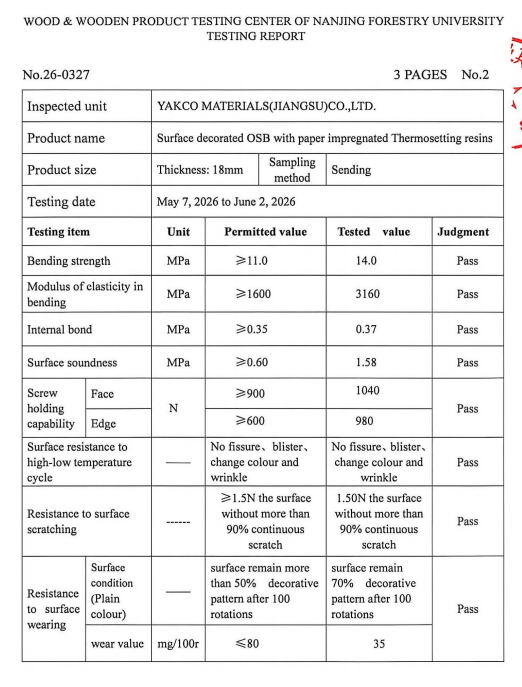
Day after day, the edges of the gold lines go from "sharp" to "rough," from "clear" to "blurred." Visually, the gold lines appear to have "bled" – boundaries are no longer distinct, and the delicacy is lost.
YAKCO's scratch resistance of 1.5N, with no more than 90% continuous scratch under the standard load, means that line edges are not "cut through" by hard objects in a single incident – they are "protected" within the decorative layer, and even with long‑term wiping, the edges remain clear.
3.The Third Layer of Wear: Colour Block Surface "Fading" – The Attenuation of Colour Saturation
Art Deco's high‑contrast colour blocks – black, gold, blue, silver – rely on the thickness and integrity of the ink layer to present saturated colours.
With each wipe, the decorative layer decreases at the micron level. When the resin layer is worn thin enough, the underlying ink layer becomes exposed to friction. Ink particles are gradually worn away – not as whole pieces, but surface‑layer ink molecules are "carried away." Colour saturation declines accordingly: black turns grey, gold fades, blue darkens.
YAKCO's pattern retention of 70% (after 100 rotations), where the national standard requires only 50%, means that the ink layer is "protected" for longer – even after friction equivalent to years of daily use, the pattern retains most of its colour and detail. Black remains black, gold remains gold.
4.The Fourth Layer of Wear: Microscopicrise and fall "Worn Flat" – The Loss of Tactile Realism
The metallic texture of Art Deco is not only visual but also tactile.
The microscopic concave-convex on high‑gloss metallic areas – fine concave-convex created by embossing – give the surface a "texture" when touched. This tactile detail is the final casualty of wear.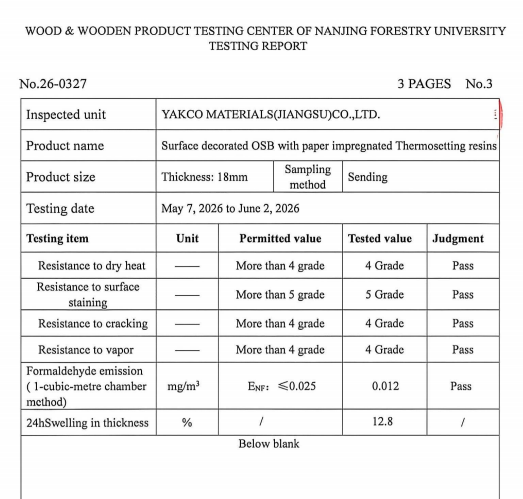
When the resin layer is worn flat, the microscopic concave-convex also disappear. The surface becomes smooth and flat – but the tactile experience of "texture" is also lost. The metallic finish goes from "touchable delicacy" to "touchable flatness."
YAKCO's wear value of 35 mg/100r and surface soundness of 1.58 MPa work together to ensure that the microscopic concave-convex of the decorative layer are not worn flat, and the tactile realism is preserved.
5.Substrate Support: The "Bottom‑Line Defence" Against Wear
All wear – surface hazing, edge bleeding, colour fading, tactile loss – is ultimately affected by substrate stability.
If the substrate undergoes slight deformation due to temperature and humidity changes, micro‑cracks appear on the decorative layer – these micro‑cracks accelerate wear, deepen scratches, and expand channels for liquid penetration.
YAKCO's substrate has a stable density of 0.72 g/cm³ and internal bond of 0.37 MPa. A stable substrate allows the decorative layer to "withstand" daily cleaning and wiping, and Art Deco's precision patterns to be "preserved".
Conclusion: The "Wear Ledger" of Precision Patterns Is "Settled" by Data
Art Deco's precision patterns – 0.3mm gold lines, sharp geometric borders, high‑contrast colour block edges – are being worn every day in real spaces. This wear is not sudden, but gradual, cumulative, and measured in microns.
YAKCO Art Deco Melamine Board uses the data of wear value 35 mg/100r, pattern retention 70%, scratch resistance 1.5N, and surface soundness 1.58MPa to settle every line of the "wear ledger" for precision patterns: no surface hazing, no edge bleeding, no colour fading, no tactile loss.
When a designer says, "I want the delicacy of Art Deco," YAKCO answers the unspoken question with data: "It withstands wear, it withstands time."