中文简体
中文简体





Previous Post
The delicacy of Art Deco is, at its core, the delicacy of lines—gold vertical stripes that run straight through, fan‑shaped rays that radiate completely from the centre, and stepped geometric borders where every turn is precise.
The "long‑term lifespan" of these lines depends on an often‑overlooked indicator: how firmly the decorative layer is bonded to the substrate.
YAKCO data determines whether Art Deco's delicate lines remain "tight, flat, and attached" over long‑term use.
More:yakco technology

1.What Is "Surface Soundness"?
Surface soundness measures the bonding strength between the decorative layer (the layer printed with the Art Deco pattern) and the substrate.
The higher the value, the more firmly the "skin" is bonded to the "flesh."
For Art Deco, the significance of surface soundness is: it determines whether the gold lines can remain "tightly attached" to the substrate over years of use, without micro‑detachment or loosening.
If surface soundness is insufficient, the edges of the lines will develop slight "lifting"—invisible to the eye, but you can feel the "unevenness" when running your finger over it.
More importantly, this lifting expands over time—cleaning wiping, temperature and humidity changes, everyday touching—each is a "pull" on the decorative layer.
After a few years, the edges of the gold lines may go from "sharp" to "rough," and the boundaries of the geometric borders may go from "clear" to "blurred."
2.Why Is Art Deco "Particularly Sensitive" to Surface Soundness?
Patterns on ordinary decorative panels usually consist of large colour blocks or repeating textures, where edge lifting and boundary blurring are not easily noticed.
But Art Deco's pattern logic is completely different:
Lines are the visual skeleton.
Art Deco's gold lines are typically only 0.3mm to 1mm wide.
Once the edges of the lines lift or blur, visually it becomes a "broken line"—the entire geometric order collapses.
High contrast magnifies flaws.
The clearer the boundary between gold and dark colours, the more any edge lifting or boundary blurring is magnified.
If the edge of a 0.3mm gold line lifts by 0.1mm, visually it appears as "the line has become thicker."
Large‑scale applications expose details.
Art Deco is often used on large wall surfaces. On a 3‑metre‑high wall cladding, any edge lifting on any line is magnified.
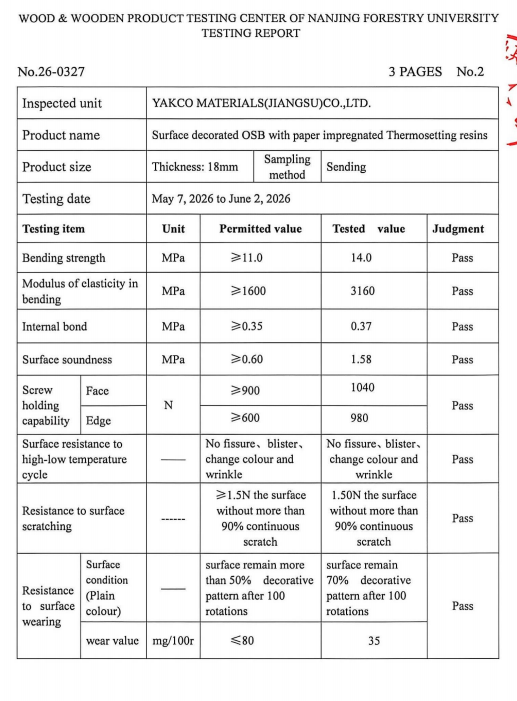
3.How Does the "Physical Margin" of 1.58 MPa Translate into "Long‑Term Lifespan"?
A surface soundness of 1.58 MPa, 2.6 times the national standard requirement of 0.60 MPa, translates into three "long‑term guarantees" in real‑world use:
Cleaning wiping does not loosen.
In commercial spaces, Art Deco walls and cabinet doors are wiped by cleaning staff every day. Each wiping applies a "lateral pull" to the decorative layer.
On panels with insufficient surface soundness, the edges of the lines gradually "lift" after long‑term wiping. 1.58 MPa means that even with daily wiping, the decorative layer remains firmly "nailed" to the substrate, and the line edges do not loosen.
Temperature and humidity changes do not cause delamination.
Art Deco walls near floor‑to‑ceiling windows, air conditioning vents, and underfloor heating areas experience frequent temperature and humidity changes.
With insufficient surface soundness, the stress difference between the decorative layer and the substrate causes micro‑"delamination."
1.58 MPa of bonding strength ensures that even with repeated temperature and humidity changes, the gold lines remain "tightly attached" to the substrate, without lifting or detaching.
Edges do not weaken after cutting.
Large‑area Art Deco applications require cutting. Cutting disrupts the continuity of the bond between the decorative layer and the substrate at the edges, making the bonding strength naturally weaker than in the central area.
The margin of 1.58 MPa means that even after cutting, the edges retain sufficient bonding strength, without "loose edges" due to cutting.
4.The "Invisible Support" of the Substrate: The Chassis Behind Surface Soundness
A surface soundness of 1.58 MPa does not exist in isolation.
It depends on two underlying indicators of the substrate:
Density 0.72 g/cm³– uniformly distributed, meaning there are no "weak spots" in the contact area between the decorative layer and the substrate, and the bonding strength is consistent across every part of the panel.
Internal bond 0.37 MPa– the internal layers of the substrate are "held together tightly," so even if the decorative layer is firmly attached, the substrate itself does not loosen.
These two indicators are the prerequisites for the stable output of 1.58 MPa.
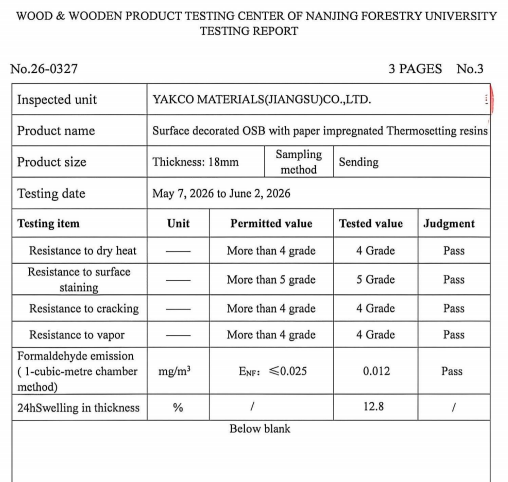
5.Conclusion: The "Long‑Term Lifespan" of Art Deco Begins with Bonding
Designers choose Art Deco for the delicacy of lines and the order of geometry.
But whether the lines remain sharp after years, and whether the geometry remains intact after long‑term use—does not depend on how vibrant the colours are on the rendering, but on the "bonding strength" between the decorative layer and the substrate.
YAKCO Art Deco Melamine Board answers the most fundamental question for Art Deco with surface soundness 1.58 MPa (2.6 times the national standard): How many years can the gold lines and geometric borders remain "tightly attached" in real spaces?
The answer is: as long as the bond is firm, the lines will always be there. Sharp, intact, unlifted, undetached.